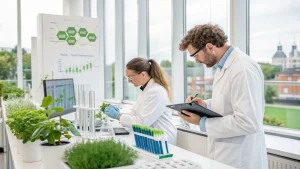
Meta FAIR and VSParticle have announced a breakthrough collaboration to accelerate the clean energy transition. The partnership brings together VSParticle’s expertise in nanotechnology, cutting-edge AI research from Meta, and advanced scientific insights from the University of Toronto. The initiative aims to develop innovative solutions that enhance the efficiency and effectiveness of clean energy technologies.
High-performance computing is being used to manage and analyze vast amounts of data, drive simulations, and optimize processes. AI-generated instructions have been sent to VSParticle on how to make new nanoporous materials that could potentially supercharge the green transition. VSParticle has taken 525 of these recipes and synthesized them into nanomaterials called electrocatalysts using a nanoprinter.
Electrocatalysts speed up chemical reactions that involve electricity, such as splitting water into hydrogen and oxygen, converting CO2 into fuels, or generating power in fuel cells. They make these processes more efficient, reducing the energy required and enabling clean energy technologies.
Meta and VSParticle collaboration
“We’ve synthesized, tested, and validated hundreds of nanomaterials at a scale and speed never seen before,” said Aaike van Vugt, co-founder and CEO of VSParticle. “This rapid prototyping gives researchers a quick way to validate AI predictions and discover low-cost electrocatalysts that might have taken years or even decades to find using traditional methods.”
The findings were integrated into an open-source experimental database, which can now be used to train AI models to become better at predicting new material combinations. Larry Zitnick, Research Director at Meta AI, said the research is “breaking new ground” in material discovery.
VSParticle is collaborating with several organizations to expand its dataset and mature its technology. The company is also enhancing its nanoprinters to be faster and more efficient, aiming to increase production from 300 sparks per second to 20,000 sparks per second. The collaborative project has successfully identified, synthesized, and tested hundreds of electrocatalysts critical for clean energy solutions, resulting in the creation of the world’s first and largest open-source experimental catalyst database.
The project also achieved a record 20 million computer simulations, which will be leveraged to build even larger databases, further scaling up the process. “By producing unique electrocatalysts at unprecedented speed, our partnership with Meta and the University of Toronto is not only helping to validate years of theory but also shortening the discovery-to-application timeline,” said van Vugt. “This collaboration proves that the materials needed for clean energy systems can be discovered and deployed rapidly, meeting the urgency of the climate crisis.”
The collaboration is a landmark achievement in the path to scalable clean energy solutions, underscoring the critical intersection of AI, nanotechnology, and experimental science in addressing global climate challenges.

Noah Nguyen is a multi-talented developer who brings a unique perspective to his craft. Initially a creative writing professor, he turned to Dev work for the ability to work remotely. He now lives in Seattle, spending time hiking and drinking craft beer with his fiancee.