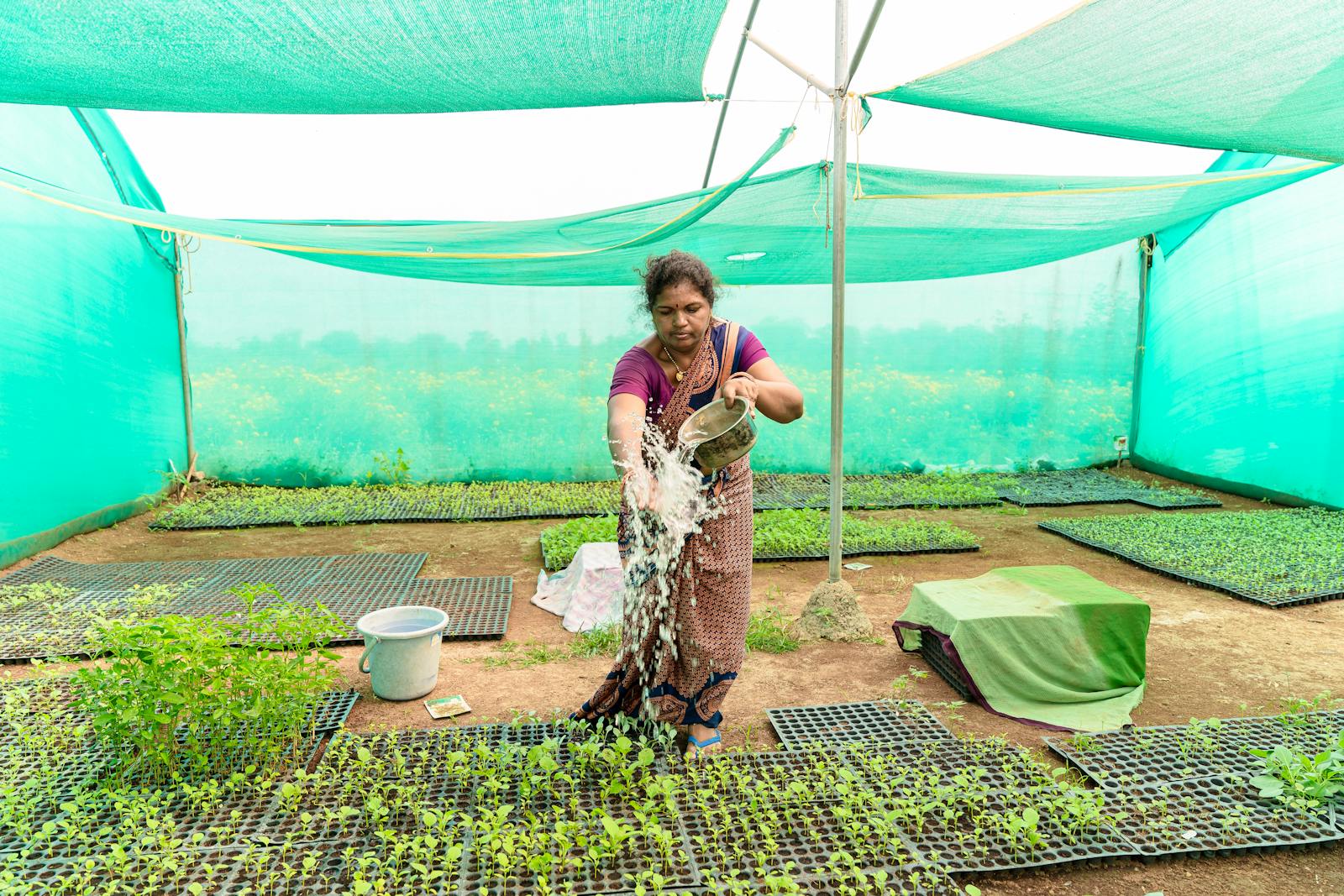
Harish B., a 40-year-old farmer near Bengaluru, India, has seen firsthand how artificial intelligence (AI) is transforming agriculture. He took over his family’s 5.6-hectare farm a decade ago, modernizing operations with drip irrigation and mist blowers. But it was his partnership with Fasal, a Bengaluru-based agritech startup, that truly revolutionized his farming practices.
Fasal uses IoT sensors, predictive modeling, and AI to provide tailored advice on irrigation, nutrient application, and pest management. Since working with Fasal, Harish has reduced his water usage by 30 percent. “Before, with our old method, we were using more water,” he says.
“Now it’s more accurate, and we only use as much as we need.”
Harish is not alone. Across India, farmers are turning to AI-powered tools to navigate challenges like water shortages, climate change, and disorganized supply chains. The Indian government has also recognized the potential of AI in agriculture, declaring it a focus area in 2018 and committing $300 million to digital agriculture projects.
Startups like Fasal and Cropin are at the forefront of this agritech revolution. They leverage AI to analyze weather data and satellite imagery, providing precision farming insights.
AI-powered farming advancements
Fasal’s services have reportedly saved 82 billion liters of water and reduced greenhouse gas emissions by 54,000 tonnes across its operating area. However, cost remains a significant barrier for many small farmers. While Harish says the technology is paying for itself, he acknowledges that smaller farmers often cannot afford these tools or the additional equipment they require.
Organizations like Digital Green are exploring alternative solutions to make AI accessible to all farmers. The nonprofit uses AI and video-sharing platforms to help small farmers adopt new practices at a fraction of traditional costs. Their chatbot, trained on farmer-generated content, offers tailored advice based on location and weather.
As Rikin Gandhi, CEO of Digital Green, points out, farmers need more than just information. They want ways to connect that information to markets and services. For AI to truly revolutionize Indian agriculture, it must be affordable, trustworthy, and accessible to the farmers who need it most.
India’s agritech sector has the potential to become a model for other developing countries. But its success will depend on ensuring that the benefits of AI reach every farmer, no matter how small their plot of land may be. As Harish and his fellow farmers have shown, when given the right tools, they can achieve remarkable things.

Cameron is a highly regarded contributor in the rapidly evolving fields of artificial intelligence (AI) and machine learning. His articles delve into the theoretical underpinnings of AI, the practical applications of machine learning across industries, ethical considerations of autonomous systems, and the societal impacts of these disruptive technologies.