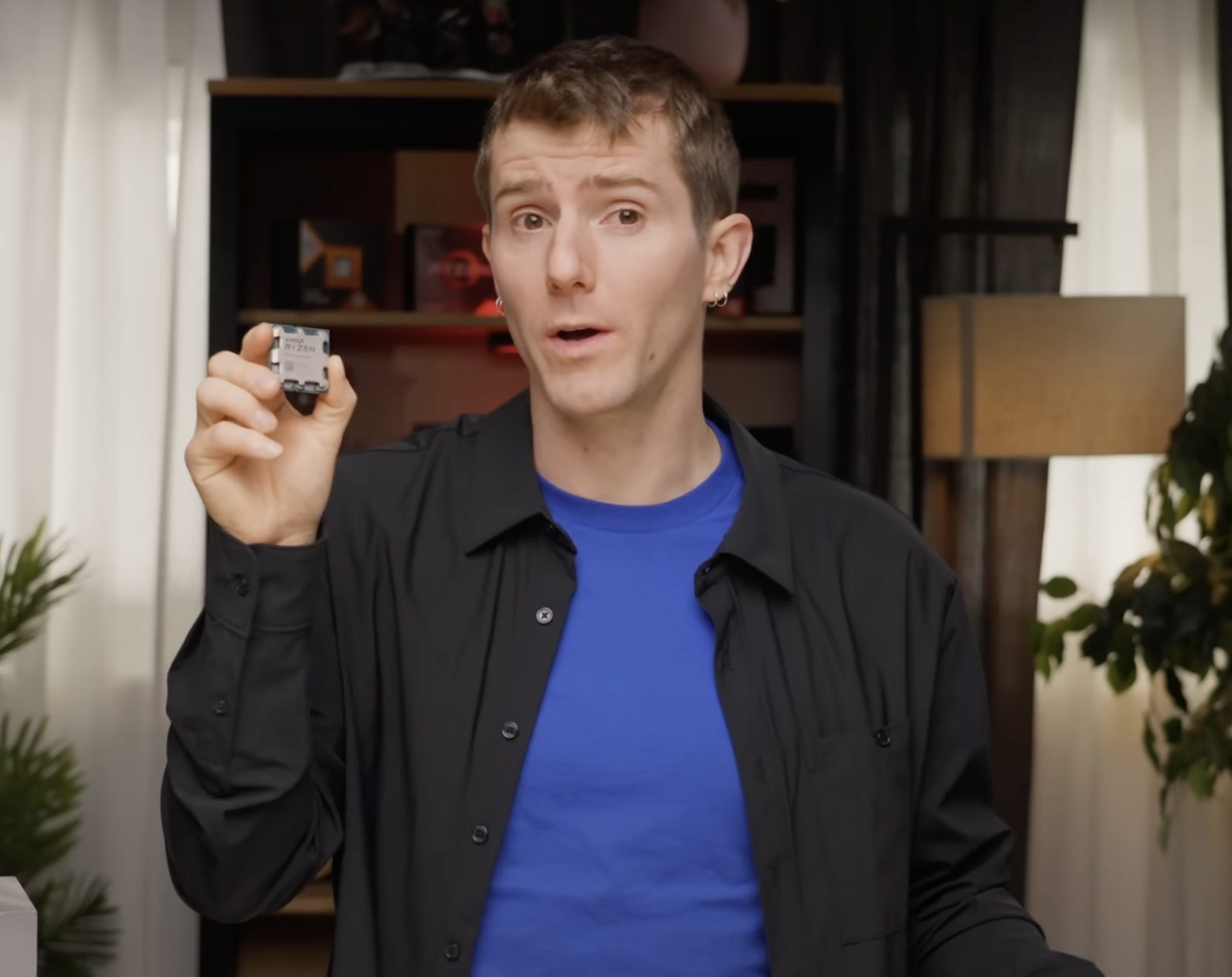
For months, I’ve been recommending the AMD Ryzen 5700X3D as the go-to CPU for budget gaming builds. But who wants to pay for a gaming PC that’s outdated before you even finish checkout? There’s a secret gaming CPU that goes head-to-head with the 5700X3D, sits on a future-ready platform, and costs less. Meet the AMD Ryzen 5 7500F.
This hidden gem has mostly flown under the radar because it’s targeted at system builders and bulk buyers rather than retail consumers. You won’t find it in fancy boxes at your local computer store. While you can occasionally spot it on Newegg, AliExpress seems to be the most reliable place to get one at a reasonable price. I had some time to watch a first-hand review from Linus Tech Tips’ YouTube channel. Considering my personal review and experience, here’s what you need to know.
What Makes the 7500F Special?
On paper, the 7500F is remarkably similar to a Ryzen 5 7600 non-X, except it lacks integrated graphics (hence the “F” suffix), which explains its lower price. Compared to the 5700X3D, there are some trade-offs:
- It has only about one-third of the cache (no 3D V-Cache technology)
- Being an OEM chip, it comes with no AMD direct warranty or box cooler
But these compromises come with significant advantages that make it worth considering. The 7500F boosts nearly 1GHz higher, uses newer Zen 4 cores, supports faster DDR5 memory, and sits in the modern AM5 socket, giving you room to upgrade in the future.
Gaming Performance That Punches Above Its Weight
In testing, the 7500F performs impressively well. It trails slightly behind the 7600X and 5700X3D in games like Cyberpunk and Shadow of the Tomb Raider, but remains within striking distance, with a gap smaller than the price difference between these chips.
In games where clock speed is king, like Rocket League, the 7500F actually pulls ahead with a massive 24% lead over its primary competitor. And when we compare it to similarly priced Intel chips, the results aren’t even close—not a single Intel chip beats our 7500F in any of the tests.
There’s another secret budget option worth mentioning: the Ryzen 8400F. Often available for just over $90, this CPU outperforms the more expensive Intel i3-13400F in almost all our tests. While it’s about 20% slower than the 7500F on average, its price-to-performance ratio is outstanding.
Real-World Gaming Scenarios
When paired with a mid-range GPU like the RTX 4060, both the 8400F and 7500F make you question why gamers are spending big money on premium CPUs at all. The 7500F stays remarkably close to the old budget gaming king (5700X3D), even pulling slightly ahead overall at 1440p and matching the gold standard 9800X3D in games like Cyberpunk and F1 24.
As you move to higher resolutions or more powerful GPUs, the picture changes somewhat. With an RTX 4070 Super, the 8400F starts to fall behind, especially at 1080p. But the 7500F continues to trade blows with the 5700X3D, with each CPU winning in different games.
In our most extreme test—pairing these budget CPUs with an RTX 4090 for 4K gaming—the 7500F performed surprisingly well, staying close to the 9800X3D in most games. The only meaningful performance difference was in Cities Skylines 2, where the 1% lows were noticeably better on the premium chip.
The Verdict: AMD’s Budget Dominance
What does all this mean? First, Intel has a lot of catching up to do. AMD now dominates CPU gaming performance charts at the high end, mid-range, and with these two stealthy budget Ryzens, even the low end. There isn’t a single bright spot for Team Blue in this segment.
For gamers on a budget, both the 7500F and 8400F offer strong real-world performance if you can find them at the right price. I recommend the 7500F as the better long-term proposition, though the 8400F is one of the very few quality sub-$100 processors available today.
Just be aware that the 8400F is limited to eight PCIe Gen 4 lanes for your GPU, which could become a limitation in the future. The 7500F, on the other hand, sits on AMD’s AM5 platform, which the company has promised to support until at least 2027.
While availability might be an issue for some—especially with import tariffs potentially affecting prices for American buyers—our testing confirmed that chips from both AliExpress and Newegg were equally genuine. If you can get your hands on one, the 7500F represents one of the best values in PC gaming today.
Frequently Asked Questions
Q: How does the Ryzen 7500F compare to more expensive gaming CPUs?
The Ryzen 7500F performs surprisingly close to much more expensive options like the 5700X3D and even the 9800X3D in many games. While it trails in some CPU-intensive titles, the performance gap is often smaller than the price difference suggests, making it an excellent value proposition.
Q: Is the lack of integrated graphics in the 7500F a significant drawback?
For most gamers, the absence of integrated graphics isn’t an issue, since they will be using a dedicated GPU anyway. This omission is actually what allows the 7500F to be priced lower than comparable CPUs with integrated graphics, making it a wise choice for budget-conscious gamers.
Q: Should I be concerned about buying a CPU from AliExpress?
While purchasing from AliExpress might seem risky, our testing confirmed that the 7500F chips from both AliExpress and Newegg were genuine AMD products with identical performance. Be aware that import tariffs may affect the final pricing for buyers in certain countries.
Q: How future-proof is the Ryzen 7500F?
The 7500F sits on AMD’s AM5 socket, which AMD has committed to supporting until at least 2027. This means you’ll have upgrade options without needing to change your motherboard. Additionally, it supports newer technologies like DDR5 memory and PCIe 5.0, making it more future-ready than older platforms.
Q: What GPU would pair well with the Ryzen 7500F?
The 7500F works well with a wide range of graphics processing units (GPUs). For a balanced build, consider mid-range options like the AMD RX 7970/7970XT or even Intel’s Arc B580. Our testing showed excellent performance with GPUs from the RTX 4060 class up to high-end cards, though pairing it with something like an RTX 4090 would create a significant system imbalance.

Finn is an expert news reporter at DevX. He writes on what top experts are saying.