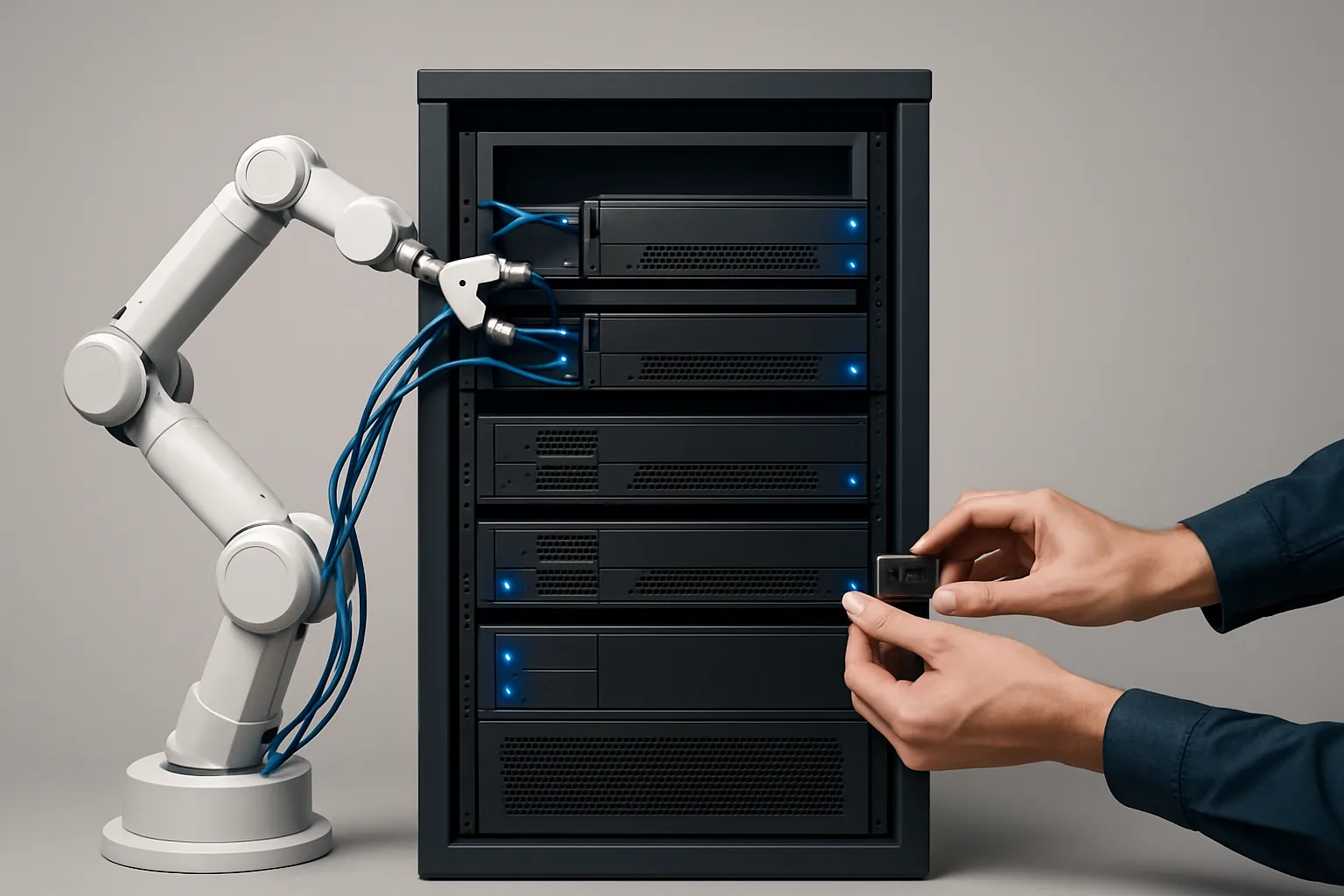
Automation in systems administration is reshaping the tech industry, creating both opportunities and challenges. We asked experts to share their perspectives on the importance of automation in systems administration. Discover how to strike the right balance between automated processes and human judgment in modern infrastructure management.
- Amplify Human Judgment with Automation
- Balance Automated Reboots with Human Oversight
- Three-Tier Approach to Systems Automation
- Reduce Noise and Protect Focus
- Automate for Consistency Allow Manual Intervention
- Streamline Routine Tasks Keep Humans in Loop
- Automation Transforms IT Infrastructure Management
Amplify Human Judgment with Automation
We’ve learned that successful automation isn’t about eliminating human judgment — it’s about amplifying it.
We automate the predictable: data entry, document collection workflows, deadline calculations based on contract dates, and compliance checklist generation. When a new purchase agreement comes in, our tool extracts all data from the contract and key dates to schedule tasks across the transaction timeline.
But here’s where manual intervention remains critical: human review of AI tool results and relationship management.
When a buyer’s loan contingency deadline falls on a holiday, or when conflicting amendments arrive simultaneously, the system flags these for human review.
We use a simple confidence scoring system — anything below 95% certainty gets queued for TC verification.
The key is making intervention points obvious and actionable. Our frontend presents these as “decision cards” with all context pre-loaded. A TC can resolve most flags in under 30 seconds because the system has already done the analysis — it just needs human judgment on the edge cases.
Practical tip: Start by automating notifications and data entry, not decisions. Once you have 6 months of data on how humans handle exceptions, then you can start automating those patterns too.
 Casey Spaulding
Software Engineer | Founder, DocJacket
Balance Automated Reboots with Human Oversight
In my view, automation in systems administration is essential — it drives consistency, reduces human error, and frees teams from repetitive work. Few areas illustrate this better than server reboots. A reboot seems simple, but in production environments, it touches uptime, dependencies, and user experience. Automating the process ensures servers are rebooted consistently, during approved windows, and with the proper pre- and post-checks. For example, automation can confirm that patches are applied, services shut down gracefully, and monitoring alerts are silenced before the reboot begins. Afterward, automation verifies that key processes have restarted and that the server has rejoined its cluster or pool correctly.
That said, I don’t believe in automation without oversight. The balance comes from recognizing that not every situation can be anticipated by a script. Hardware anomalies, unusual service dependencies, or critical business events can make a fully automated reboot risky. That’s where manual intervention adds value: approving the reboot, handling exceptions, or troubleshooting issues automation can’t predict.
In practice, I use a hybrid strategy:
1. Standardize and automate the routine. Regular patch-cycle reboots are scripted and scheduled during maintenance windows. Logs and health checks confirm success.
2. Gate critical steps with human approval. If automation detects anomalies — like failed health checks or unusual resource consumption — it pauses and alerts an administrator.
3. Keep transparency high. Automated systems document every action so humans can quickly audit and intervene when needed.
This balance has helped my teams reduce downtime and stress. We no longer worry about forgetting a step or rebooting a server at the wrong time, yet we still maintain human judgment where it matters most.
In short: automation handles the “when” and “how” of server reboots, but humans still own the “should we.” That partnership keeps systems reliable, secure, and resilient.
 Adrian Ghira
Managing Partner & CEO, GAM Tech
Three-Tier Approach to Systems Automation
Automation isn’t just “on or off” in systems administration.
I use a three-tier approach that most teams miss. Routine tasks like backup verification run automatically, critical operations like security patches use manually-triggered scripts, and complex troubleshooting stays fully manual.
When a new Windows security breach was detected last year, this approach saved us. Customers were panicking, and we had to update over 600 servers across multiple clients. I executed our automated patch deployment scripts that handled login and fixes across all environments in about 30 minutes instead of the multiple days it would have taken logging into each server individually.
Teams fail when they automate for the cool factor or with the mindset that “this could be automated” rather than for operational value. That’s how you get brittle systems that collapse when they hit the edge cases nobody coded for.
Krishna kanth Mundada
Devops Engineer, Versent
Reduce Noise and Protect Focus
As teams grow, you don’t just get more people — you get more complexity. More moving parts, more cross-dependencies, more things that can quietly fall through the cracks. At some point, you realize that without automation, you’re building on sand.
For us, the goal has never been to automate everything. It’s to reduce the noise — the routines, the handovers, the things that steal attention from actual problem-solving. You build systems not just to save time, but to protect focus.
That said, I don’t believe in fully hands-off operations either. There are always cases that fall outside the script — edge scenarios, unexpected inputs, weird integrations. And when that happens, you want your team to be able to step in quickly, with clarity and control.
The real value of automation, in my view, is that it lets people spend their time where it matters. Not firefighting, not fixing the same issue for the third time — but making judgment calls, solving real problems, and improving the system itself.
That balance is where the maturity lies. Not in how much you’ve automated — but in how well your team and your systems support each other when it counts.
 Konstantin Yalovik
CEO, launchOptions
Automate for Consistency Allow Manual Intervention
Automation has become an essential part of system administration because, at some point, the infrastructures you manage will become too complicated and dynamic to handle completely by hand. Patching, alerting, logging, and provisioning are repeatable, time-consuming, and mistake-prone tasks when done manually and, therefore, ripe for automation. Automating these processes allows administrators to spend their time on more complex questions about system design, security strategy, and performance optimization.
Of course, I don’t believe in automating everything indiscriminately. There is a balance in understanding when there should be human involvement in the process, during incident response scenarios, and dealing with edge case scenarios that automation hasn’t been trained for. My approach is to automate for consistency and speed, but always allow for manual intervention if context, intuition, or creativity is needed.
My ultimate rule is this: if a task is high frequency, low risk, and well-documented, automate it. If it is low frequency and could lead to high impact (such as diagnosing an outage or approving critical changes), it should ultimately have human oversight. Finding this balance in the process minimizes the risks of dealing with operational complexity and helps create a margin of safety. You still get the efficiency of the system process, without sacrificing the possible flexibility, analysis, and critical thinking that only an experienced administrator can bring.
 Sergio Oliveira
Director of Development, DesignRush
Streamline Routine Tasks Keep Humans in Loop
Automation has become essential in systems administration, especially as environments grow more complex and data-driven. Manual processes simply don’t scale — tasks like provisioning resources, monitoring performance, or managing user access can be automated with far greater speed and consistency, freeing teams to focus on higher-value work.
That said, the balance comes from recognizing that not everything should be automated. Some processes benefit from human judgment — like troubleshooting unusual incidents, making ethical decisions around data usage, or handling edge cases that automation can’t anticipate. In my experience, the best results come from automating the repetitive, rules-based tasks while keeping humans in the loop for oversight and decision-making.
For example, I’ve seen automation streamline routine reporting and alerting in analytics pipelines, but we still rely on analysts to investigate anomalies and interpret context. This hybrid approach reduces errors, improves efficiency, and ensures that automation supports, rather than replaces, critical human expertise.
Ultimately, automation isn’t about eliminating human involvement — it’s about creating systems where people can spend less time on repetitive work and more time solving problems that truly require their skills.
 Gabirjel Zelic
Senior Analyst and Data Studio Expert, MeasureMinds Group
Automation Transforms IT Infrastructure Management
Automation has become essential in modern systems administration, transforming how IT infrastructure is managed. By automating routine tasks, administrators free up valuable time to focus on strategic projects that drive business value forward.
The efficiency gains from automation are immediate and measurable. Systems can be deployed in minutes instead of hours, and hundreds of servers can be managed with the same effort previously needed for just a few.
Consistency is another critical benefit experienced with automation. Every configuration gets applied exactly the same way every time, eliminating those frustrating errors that occur when manually typing commands or copying settings.
As an organization grows, automation becomes a scaling superpower. Exponentially larger infrastructures can be managed without hiring proportionally more staff, making growth sustainable and cost-effective.
Automated monitoring provides eyes everywhere in the infrastructure simultaneously. Instant alerts are received when something goes wrong, with an army of AI agents that can pre-qualify the alert to cut out all the noise.
Finding the right balance between automation and manual control requires thoughtful planning that includes a human in the chain.
It is advisable to start by automating simple, repetitive tasks like user account creation or log rotation, then gradually tackle more complex processes as confidence grows.
Complex decisions requiring creativity or judgment still need human expertise. Manual control should be maintained over architectural decisions, security incident responses, and situations requiring nuanced problem-solving.
Human oversight remains crucial even with robust automation in place. The ability to intervene is necessary when automation encounters unexpected scenarios or when critical systems require that extra level of careful attention.
Lastly, the work output will have far fewer errors, so the output quality will be better. An AI agent will catch a problem it’s trained on 100% of the time, whereas a human counterpart might miss some.
 Steve Dempsey
Principal, NeoTech Networks LLC