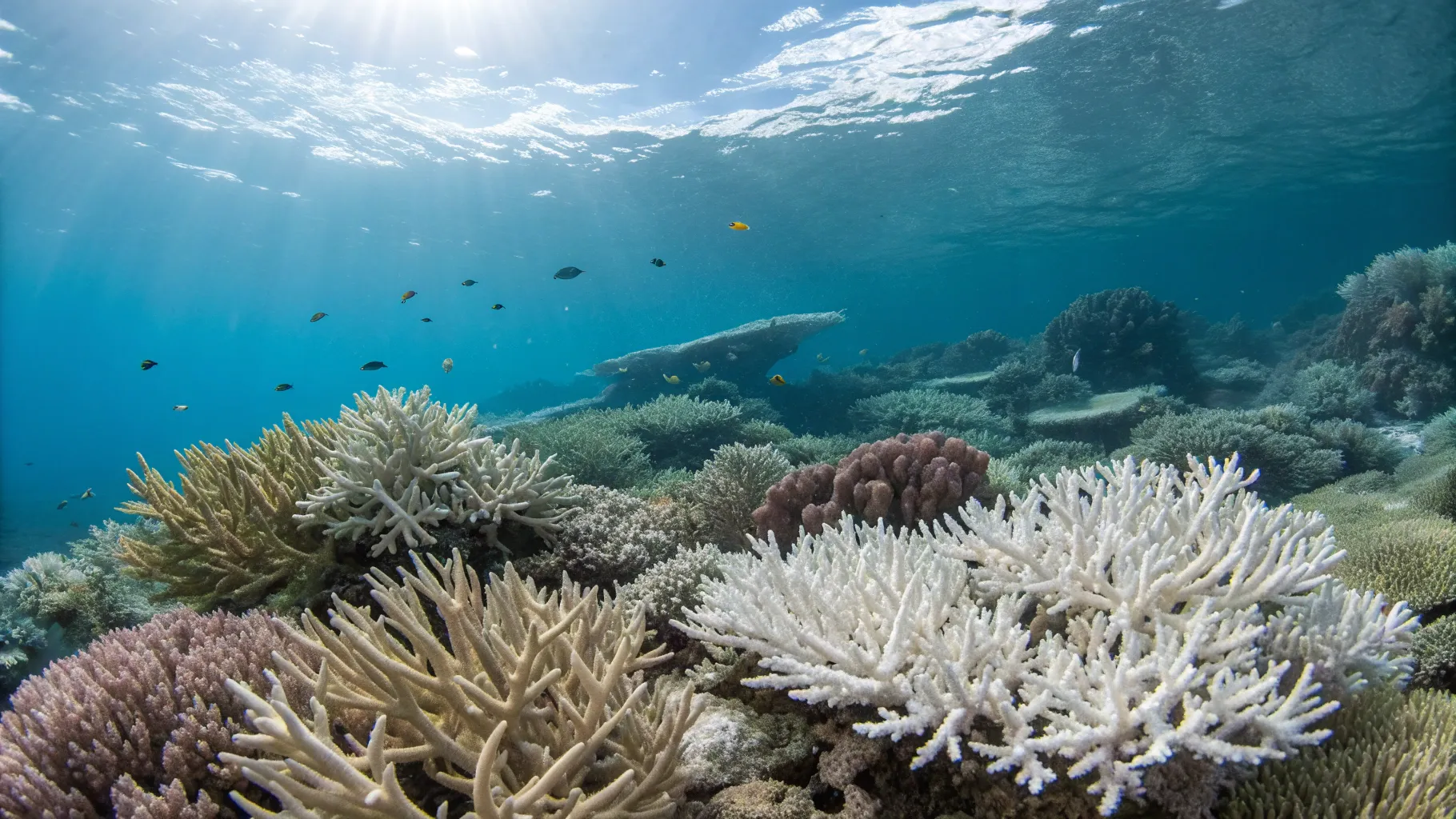
Record ocean heat is driving mass coral bleaching from the Caribbean to the Pacific, in what scientists describe as a clear alarm about climate risk. The latest bleaching surge has unfolded across multiple regions over the past year, intensifying during the recent El Niño and pushing sensitive reef systems to their limits.
Marine agencies report widespread stress in Australia’s Great Barrier Reef, the Coral Triangle, and the Florida Keys, as sea temperatures stayed far above seasonal norms. Managers and tourism operators are bracing for ecological and economic fallout, while researchers say recovery will depend on rapid emissions cuts and years of local stewardship.
Today’s global coral bleaching events are the worst kind of climate warning.
Background And Context
Bleaching occurs when corals, stressed by heat, expel the symbiotic algae that feed them. If high temperatures persist, corals can die. Mass bleaching events were first documented on a global scale in 1998, followed by waves in 2010 and 2014–2017. Scientists and reef managers say the current surge represents another worldwide episode, made worse by persistent marine heatwaves.
NOAA has tracked record ocean temperatures since mid-2023, with large areas of the tropics spending weeks above critical thresholds. Many reefs reached high “Degree Heating Weeks,” a metric that quantifies accumulated thermal stress. The result has been widespread paling, bleaching, and in the worst-hit sites, mortality.
Coral reefs support roughly a quarter of marine species despite covering less than 1% of the ocean floor. They underpin fisheries, tourism, and coastal protection for hundreds of millions of people. Losing them would reshape coastal economies and food security.
Heat And Biology
El Niño stacked on top of long-term warming, creating sustained thermal stress. Researchers note that repeated heat waves leave reefs with less recovery time. Some species can rebound if cooler water returns quickly. Others are less resilient and face compounding damage from disease and storms.
Field teams have documented patchy outcomes. Shallow sites often warm faster and bleach first. Deeper or current-swept reefs sometimes fare better. Local stressors, such as poor water quality and overfishing, also influence survival.
- High and prolonged sea temperatures drive bleaching.
- Recovery depends on lower heat, clean water, and time.
- Frequent events reduce the chance of full recovery.
Economic Stakes And Local Responses
Tourism operators report cancellations where bleaching is most visible. Guides in Florida and parts of the Caribbean say clients have noticed pale or damaged corals during peak season. In Australia, monitoring results have prompted temporary changes to visitor routes to protect vulnerable sites.
Local managers are testing interventions. These include coral nurseries, selective breeding for heat tolerance, and shade or cooling trials at small scales. Water quality upgrades, stricter fishing controls, and pollution limits can help corals endure heat by reducing other stressors.
These efforts are not a substitute for global action, experts say. They can buy time, protect key sites, and support species diversity, but long-term coral survival depends on stabilizing temperatures.
Science, Uncertainty, And What Recovery Looks Like
Even after severe events, some reefs recover. Scientists have recorded regrowth over several years when temperatures ease. Fast-growing branching corals can return first, though they are also more heat-sensitive. Massive corals grow slowly but can be more resistant, shaping which habitats rebound.
Managers caution that repeated bleaching narrows options. If heat returns every year or two, corals cannot fully rebuild. Predictions point to more frequent marine heatwaves without steep global emissions cuts.
Policy And The Path Ahead
International bodies have called for cuts in greenhouse gas emissions to hold warming near 1.5 degrees Celsius. That goal is widely seen as critical for coral survival. Coastal nations are also updating reef protection plans, aligning fisheries rules, and funding restoration trials.
Communities that depend on reefs are adapting their livelihoods. Some fishers are shifting effort to less sensitive species, while tourism groups are investing in education and low-impact practices. Insurers and coastal planners are weighing the rising cost of storm damage as reefs weaken.
The current bleaching wave is both a biological and economic shock. It is also a test of global resolve. If heat recedes in coming months, some corals may rebound. But the trend is clear: without rapid emissions cuts and sustained local care, future bleaching will be more frequent and more severe.
The message from the reefs is direct and urgent. Managers will track mortality and recovery through the year, while governments debate energy and climate policy. What happens next will determine if these ecosystems remain anchors of coastal life or fade on a warming planet.

Deanna Ritchie is a managing editor at DevX. She has a degree in English Literature. She has written 2000+ articles on getting out of debt and mastering your finances. She has edited over 60,000 articles in her life. She has a passion for helping writers inspire others through their words. Deanna has also been an editor at Entrepreneur Magazine and ReadWrite.