Nvidia’s GTC week isn’t for casual spectators, yet it spills into daily life faster than most tech shows. My view is simple: the real story isn’t new chips—it’s who gets agency. What stood out was a push to make AI agents easier and safer for regular users, mixed with hype that deserves a cool head.
What Actually Matters For People
The clearest signal came from the attention on OpenClaw, the open project that turns models into tool-using agents with memory. The attendee I followed described it bluntly:
“OpenClaw is everywhere.”
That matters because agents stop being chatbots and start doing work.
Here’s the twist: Nvidia used its stage to push “Nemo Claw,” a one-line installer that makes OpenClaw dead simple. That convenience pairs with a new security layer. The speaker spelled out the fear many share—leaking API keys, passwords, or finance data—then framed the pitch:
“If you install OpenClaw using Nemo Claw… it also adds that additional security layer.”
If this holds up, agent adoption shifts from hobbyists to the rest of us.
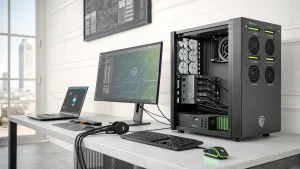
The hands-on story was even stronger. At a “Build‑A‑Claw” pop‑up, staff set up OpenClaw on a DGX Spark Box in minutes:
“They actually installed OpenClaw on this thing in about 2 minutes.”
They also loaded an open‑weight model—Neotron 3 Super with 120B parameters—running fully on device. As the attendee put it,
“I don’t even have to send my prompts to OpenAI or Anthropic… it runs locally.”
He added that it’s near the top tier:
“It’s actually pretty close to state‑of‑the‑art.”
My take: local, private, high‑quality agents are now real enough to test. That’s a shift in power from platforms to users.
The Hype I’m Skeptical Of
DLSS5 drew cheers in the room and side‑eye online. The promise is an AI upscaler that sharpens games live. But we’ve seen this movie: earlier versions added frames that sometimes “hallucinated” artifacts. The attendee saw the split:
“People in the room… loved what they were showing off. The sentiment online among gamers… not really a fan.”
I’m not convinced until we see shipping titles under real conditions.
Then there’s the headline‑grabbing “Space 1” concept—data centers in orbit. It’s fun, but the company itself admitted a basic blocker:
“They still haven’t quite figured out how to dissipate the heat off of these GPUs.”
Cool name, big slide, unsolved physics. I’ll wait for engineering, not renderings.
Power Concentration You Shouldn’t Ignore
The strongest undercurrent was reach. The attendee rattled off the partners—Google, AWS, Microsoft, Oracle, CoreWeave—and then the sectors, from autos to telco. His summary was stark:
“They are in all of them.”
That dominance is why AI progress feels so swift. It’s also why vendor risk is real. If one supplier touches almost everything, outages, pricing shifts, and supply shocks ripple everywhere.
Yes, The Acceleration Is Real
Charts flashed by: more tokens per second, larger context windows, falling costs, lower energy. The attendee captured the mood:
“Everything is scaling so fast.”
I see two truths here:
- Speed helps users: faster agents, richer context, cheaper runs.
- Speed raises stakes: errors scale too—security, quality, and safety can’t be afterthoughts.
That balance—access plus guardrails—should guide what we ask of vendors and policymakers now.
Where I Land
Nemo Claw plus open‑weight models on local hardware is the most meaningful step for everyday users. If the security layer delivers, it lowers the barrier for trying real agents without spraying data into the cloud. DLSS5 may wow onstage but needs proof in the wild. Space data centers are science fiction until heat math works. And Nvidia’s reach is both an engine and a single point of failure. We should push for choice and portability while we enjoy the gains.
Want to act on this?
- Test an agent locally with locked‑down keys and clear tool scopes.
- Benchmark DLSS5 yourself before you judge it.
- Ask vendors for model portability and exit paths.
- Track power use and cost per task, not just demo flair.
The promise is real. So are the trade‑offs. Let’s demand tools that put people in control—fast, private, and secure by default.
Frequently Asked Questions
Q: What’s the practical benefit of Nemo Claw for non‑experts?
It simplifies installing agent tools and adds a security layer, reducing the risk of leaking credentials while making setup fast enough for regular users to try safely.
Q: Can open‑weight models like Neotron 3 Super really run well on local hardware?
Yes, with the right GPU box, they can run fully on device. That brings privacy gains and removes cloud latency, though power and cost still matter.
Q: Should gamers trust DLSS5 right away?
Wait for independent tests in shipping games. Upscaling can look great, but past versions introduced visual artifacts. Judge by frame captures and reviews.
Q: Are space‑based data centers close to real?
Not yet. Heat dissipation in vacuum is unresolved. Until thermal design is proven, it’s a concept with big hurdles, not a near‑term service.
Q: Why does Nvidia’s reach matter to everyday users?
If one supplier touches most services, changes in price, supply, or policy can ripple into the apps you use. Portability and choice help reduce that risk.