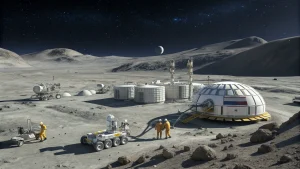
K2 has set its sights on orbit with a project called Gravitas, seeking to prove the technology needed to build data centers in space. The effort marks a bold bid to shift part of the world’s digital infrastructure off Earth, testing hardware, power, and networking systems that could store and process data above the atmosphere. While no launch timeline or payload details were disclosed, the move signals growing interest in off-planet computing as data demand soars and satellite networks proliferate.
“K2’s Gravitas is an ambitious project that aims to demonstrate the tech needed to build data centers in space.”
The concept raises immediate questions about feasibility, cost, and policy. It also stirs debate over who controls orbital computing and how it might change the economics of cloud services and satellite operations.
Why Orbit for Computing
The push for space-based computing is driven by two trends. First, satellites are gathering and moving more data than ever, from Earth imaging to broadband links. Processing some of that data in orbit could reduce bottlenecks and lower downlink needs. Second, cloud providers face growing pressure to cut emissions and energy use. Space offers near-constant solar power and isolation from physical security threats, though it introduces new risks.
Advocates say orbital data centers could serve as edge nodes for satellite constellations, handling tasks like image preprocessing, anomaly detection, or inter-satellite routing before sending compressed results to Earth. That could save bandwidth and improve service for time-sensitive applications, such as disaster monitoring or maritime tracking.
Technical Hurdles and Open Questions
Building a reliable server farm in orbit is hard. Vacuum offers no air for convection, making heat rejection dependent on radiators. Radiation can flip bits and damage electronics, demanding hardened components, error-correcting memory, and redundancy. Launch vibration and micro-meteoroids add further risk. Then there is networking: moving data between Earth and space introduces latency and bandwidth limits that vary by orbit.
- Thermal control relies on efficient radiators and careful power budgeting.
- Radiation effects require shielding and fault-tolerant designs.
- Links to Earth depend on spectrum access, ground stations, and cloud integration.
- Debris mitigation and end-of-life plans are essential.
Even if the engineering works, economics must follow. Launch costs have fallen with reusable rockets, yet every kilogram still carries a price. Any orbital workload must deliver clear value, such as reducing costly downlinks or enabling services not possible on Earth.
Industry and Policy Context
Space-based cloud concepts have circulated among aerospace firms and startups for years, often focusing on data processing near satellites. Governments have also funded in-space computing experiments for Earth observation and deep-space missions. K2’s Gravitas positions itself within that arc, proposing a more general-purpose data center approach.
Policy will shape how fast such systems scale. Operators need spectrum rights, export control compliance, and debris mitigation approvals. Data sovereignty laws may restrict where sensitive information resides or is processed, raising questions for multinational customers. Cybersecurity in orbit, including secure uplinks and on-orbit key handling, will be scrutinized by regulators and clients alike.
What Success Would Look Like
A credible demonstration would show sustained, fault-tolerant compute in orbit with clear performance metrics. It would validate thermal designs under load, prove reliable error handling, and integrate with terrestrial clouds. It might also test onboard AI models that turn raw satellite feeds into alerts or summaries in real time.
Key benchmarks could include power usage effectiveness adapted for space, error rates under radiation, and cost per processed gigabyte when accounting for launch and operations. Transparent reporting would help potential customers judge value against Earth-based alternatives.
Market Outlook and Use Cases
Near-term customers are likely within the space sector: Earth observation companies, satellite internet providers, and national security agencies. They have immediate data needs and existing orbital assets. Over time, if costs fall and reliability improves, industries like shipping, energy, and insurance could tap orbital services for near-real-time analytics from global sensors.
Analysts expect data growth to continue, with more satellites and higher-resolution sensors feeding demand. If Gravitas proves out even a limited set of workloads, it could carve a niche where bandwidth and latency constraints make in-space processing more efficient than sending raw data to Earth.
K2’s brief statement hints at the scale of its ambition, but proof will come from hardware in orbit and results shared on the ground. The next phase will likely feature component tests, radiation trials, and integration with satellite links and ground clouds. If the company can show stable operations, predictable costs, and strong security, it may open a new chapter for cloud computing at the edge of space. For now, the sector will be watching for technical milestones, regulatory approvals, and early pilot customers that reveal whether orbital data centers can move from concept to service.

Senior Software Engineer with a passion for building practical, user-centric applications. He specializes in full-stack development with a strong focus on crafting elegant, performant interfaces and scalable backend solutions. With experience leading teams and delivering robust, end-to-end products, he thrives on solving complex problems through clean and efficient code.