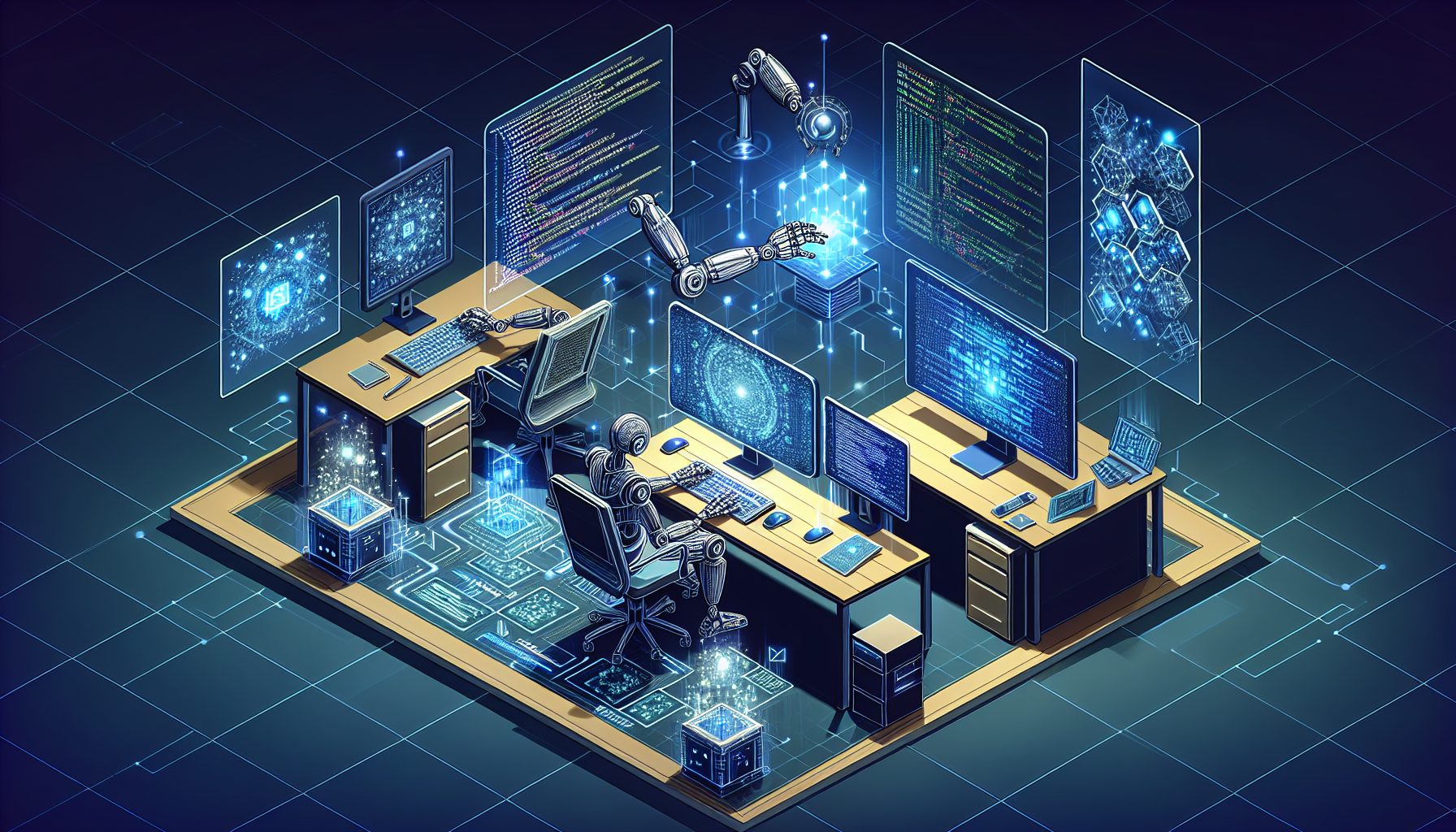
Google is increasingly relying on artificial intelligence to generate code for its products.
1/ Just finished my Q3 earnings remarks highlighting extraordinary momentum across the company and our differentiated full stack approach to AI innovation – robust infrastructure, research + models, and products + platforms. A few highlights: https://t.co/ZpF8zDwkcH 🧵
— Sundar Pichai (@sundarpichai) October 29, 2024
During the company’s recent earnings call, CEO Sundar Pichai revealed that more than 25% of new code at Google is now created by AI systems. Pichai emphasized that while AI generates a significant portion of the code, human programmers still review and accept the computer-generated contributions.
“This helps our engineers do more and move faster,” he stated. Google is not alone in using AI for coding tasks.
Make AI work for you with our new course on how to write effective prompts for #generativeAI.
In Google Prompting Essentials, you’ll learn about the 5-step prompting framework, advanced prompting techniques, and more → https://t.co/owq6tDvVAl#GrowWithGoogle pic.twitter.com/SwGUQrwSTw
— Google Cloud (@googlecloud) October 28, 2024
A survey from Stack Overflow indicates that over 76% of respondents are either using or planning to use AI tools in their development process this year.
Project Astra -> Google says its next-gen AI agents won’t launch until 2025 at the earliest
"Google CEO Sundar Pichai revealed the timeline in remarks during Google’s Q3 earnings call Tuesday. “[Google is] building out experiences where AI can see and reason about the world… pic.twitter.com/ICBVpX3ETU
— Glenn Gabe (@glenngabe) October 30, 2024
Another survey noted that 92% of US-based software developers are already using AI coding tools both in and outside of work. AI-assisted coding gained widespread attention in 2021 with the release of GitHub Copilot, which used a special coding AI model from OpenAI.
Ai in coding at Google
Since then, AI-based coding solutions have continued to improve, with GitHub recently announcing that developers would soon be able to use non-OpenAI models within the application. Despite the enthusiasm, concerns have been raised about the potential for computer-generated code to contain bugs and errors that are difficult to detect. A study by Stanford University found that developers using AI coding assistants tended to include more bugs in their code, despite believing that their code was more secure.
Talia Ringer, a professor at the University of Illinois at Urbana-Champaign, emphasized the mixed potential of AI-assisted coding, stating that “there are probably both benefits and risks involved,” and warning that “more code isn’t better code.”
The history of software development has always included controversial changes, from the shift to higher-level languages to the adoption of object-oriented programming. According to former Microsoft VP Steven Sinofsky, every generation of programming tools has faced skepticism, noting that arguments against new tools go back to Fortran. Ultimately, AI is a tool that can significantly accelerate coding when used by skilled humans.
As Google’s CEO highlighted, AI-generated code still requires human oversight to ensure functionality and quality. Just as a hammer alone cannot build a house, AI alone cannot replace the expertise and experience of human programmers.

Cameron is a highly regarded contributor in the rapidly evolving fields of artificial intelligence (AI) and machine learning. His articles delve into the theoretical underpinnings of AI, the practical applications of machine learning across industries, ethical considerations of autonomous systems, and the societal impacts of these disruptive technologies.