AI labs are racing to give machines a sense of physical cause and effect. The effort centers on “world models” that help systems predict what happens next in the real world. Three approaches are drawing attention: JEPA, Gaussian splats, and end-to-end generation. Each offers a different path to grounding, with hybrids now taking shape.
“Large language models lack grounding in physical causality — a gap world models are designed to fill.”
Why Language Alone Falls Short
Large language models excel at patterns in text. They do not directly experience motion, force, or friction. This limits their ability to plan in the physical world. Without grounded signals, they can produce fluent answers that fail when actions meet objects.
Researchers argue that models need to predict outcomes under changing conditions. This means building internal dynamics that match physics, not only words. The push mirrors earlier steps in computer vision, where learning from pixels improved recognition beyond labels alone.
Three Paths to World Models
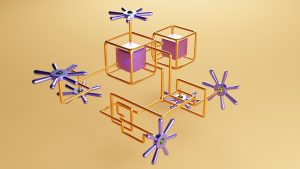
Efforts now cluster around three designs. Each has trade-offs in data needs, compute cost, and fidelity.
- JEPA (Joint Embedding Predictive Architecture): Learns abstract representations that predict future embeddings, not raw pixels. It aims for compact, general features that capture cause and effect while resisting noise. Advocates say this can scale and transfer across tasks.
- Gaussian splats: A 3D scene method that renders with point-like Gaussians. It produces fast, view-consistent images from many camera angles. It favors accurate geometry and lighting, which helps agents plan in stable scenes.
- End-to-end generation: Models that predict future frames, actions, or trajectories directly from sensory inputs. They strive for high realism and can tie perception to control. The cost is heavy training and risk of error compounding over long horizons.
“Here’s how three distinct architectural approaches (JEPA, Gaussian splats, and end-to-end generation) work, where each fits, and what hybrid architectures are already emerging.”
Where Each Approach Fits
JEPA suits settings that need fast planning on limited hardware. Its compressed features can support many tasks, from navigation to grasping. The method depends on smart training signals to avoid empty or biased embeddings.
Gaussian splats shine in spatially rich problems. Robotics labs use them for scene capture and simulation. The approach handles stable rooms, tools, and shelves well, but moving fluids or deformable objects remain hard.
End-to-end generation appeals to teams that want a single model to see, predict, and act. It pairs well with large datasets of video and robot logs. Long-term stability is still a hurdle, and safety reviews are laborious.
Hybrid Designs Are Gaining Ground
Groups now mix methods to balance strength and weakness. A common recipe is to learn a JEPA-style latent space, render scenes with Gaussian splats, and train a small controller on top. Another route uses end-to-end video prediction during pretraining, then distills a lighter planner.
Early case studies show gains in sample efficiency and transfer. A robot can learn reach-and-grasp with fewer trials when planning in a structured latent space tied to a faithful 3D scene. In simulation, splat-based maps cut rendering time while preserving key cues like depth and occlusion.
Industry Impact and Open Questions
Better world models could speed up warehouse picking, home robotics, and AR scene understanding. Autonomous systems may benefit from stronger forecasting of rare events. Game studios can use splats for quick scene edits while keeping stable views.
Challenges remain. Data quality is uneven, especially for edge cases. Benchmarks for causal grounding are still emerging. Compute costs are high, and policies must prevent unsafe behavior when predictions drift.
Experts also warn about overfitting to training setups. A model that works in a lab may fail in cluttered, changing homes. Progress will depend on diverse datasets, stress tests, and clear safety checks.
What to Watch Next
Several trends are likely. Expect more cross-pollination between 3D mapping and predictive embeddings. Distillation from large video models into small controllers should grow. Sim-to-real pipelines will lean on splats and JEPA for stability and speed.
Metrics that test counterfactuals will matter. Can a model predict what happens if friction doubles or if a tool slips? Answers to such tests will mark real progress in causality.
The push to ground AI in physics is advancing on three fronts and, increasingly, at their intersection. As hybrids mature, practical gains in reliability and safety may follow. The next phase will hinge on tougher evaluations, sharper data, and models that can explain not just what they predict, but why it should happen.

A seasoned technology executive with a proven record of developing and executing innovative strategies to scale high-growth SaaS platforms and enterprise solutions. As a hands-on CTO and systems architect, he combines technical excellence with visionary leadership to drive organizational success.