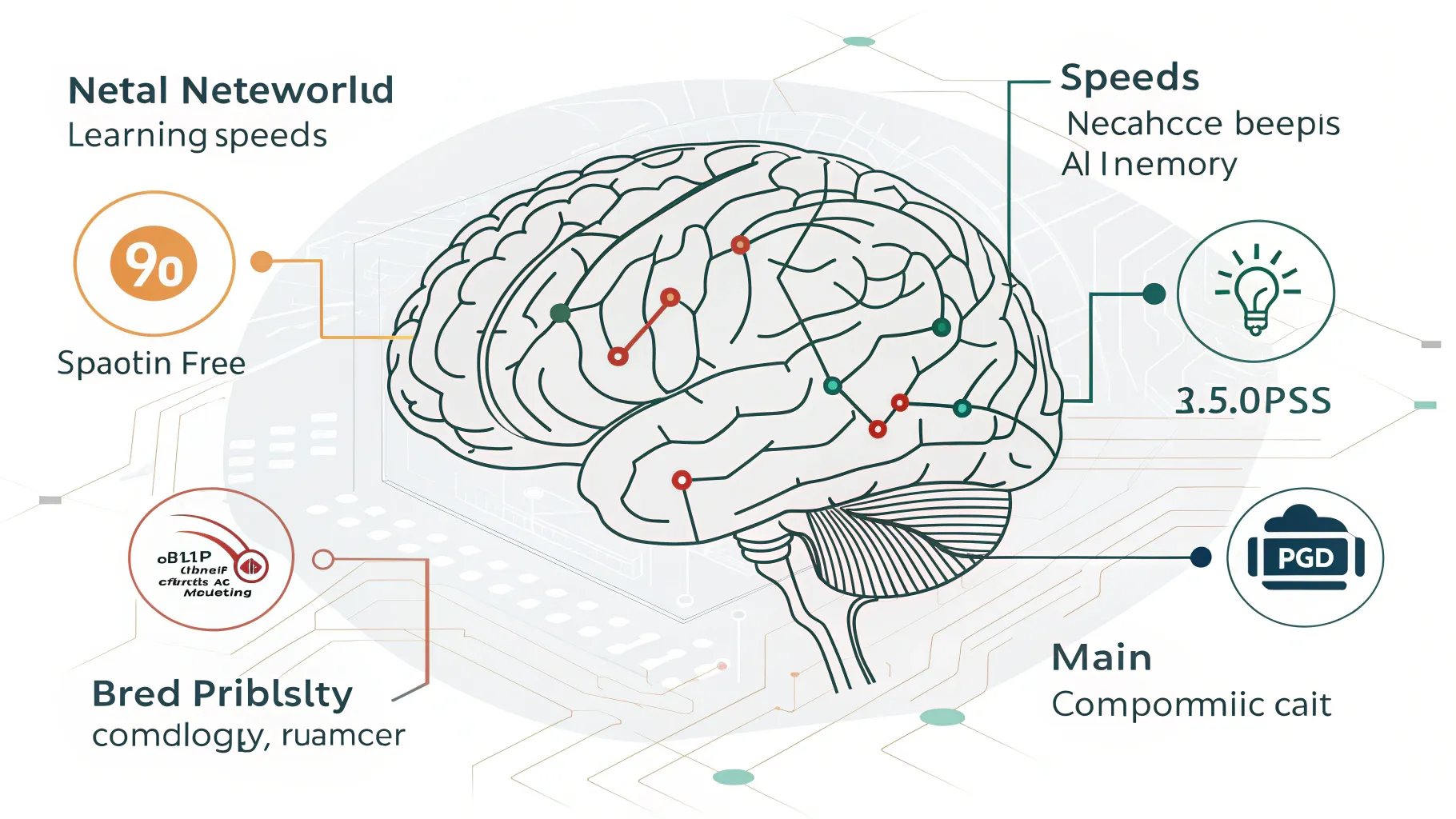
A new training approach modeled on how the brain stores memories is drawing notice across the AI field. The method, called “Nested Learning,” allows different parts of an AI model to update at different speeds. Advocates say it could make systems more stable, more adaptable, and less prone to forgetting.
The idea echoes a basic principle from neuroscience. The brain consolidates long-term memories slowly while short-term learning happens faster. Bringing that idea into machine learning, the framework separates fast-changing components from slower, more stable ones.
How the Method Works
Nested Learning organizes a model into layers or modules that learn on multiple timescales. Some parameters update quickly to capture fresh patterns. Others move slowly to hold core knowledge steady. In effect, the model keeps a stable “spine” while making local, rapid adjustments.
“Inspired by how the human brain consolidates memory, the ‘Nested Learning’ framework allows different parts of a model to learn and update at different speeds.”
In practice, this can look like separate learning rates, scheduled freezes, or hierarchical gates. Teams can adjust which parts adapt on the fly. That design aims to limit sudden swings, cut data drift, and improve performance in changing settings.
Why It Matters
AI systems often struggle with “catastrophic forgetting.” When trained on new data, a model can lose skills it had before. Researchers have tried several fixes, including elastic weight consolidation and replay buffers that mix old and new data. Nested Learning takes a different angle. It sets clear zones of fast and slow change, making long-term skills harder to erase.
This approach could help in scenarios where models see frequent updates. Personal assistants need to adapt to a user’s habits without erasing general language ability. Robots must learn new tasks without losing motor control. Finance and healthcare tools need to track shifting signals while maintaining safety constraints.
Links to Prior Research
The concept aligns with older theories that separate short-term “fast” learning from slow consolidation. In neuroscience, the hippocampus and cortex are thought to share this work. In machine learning, researchers have tested ideas such as fast and slow weights, meta-learning, and consolidation penalties. Nested Learning fits within this family but emphasizes a model-wide structure for timescale control.
While the mechanics vary, the goals are similar: retain core knowledge, adapt to new data, and reduce retraining costs. Early demonstrations suggest timescale separation can improve stability in continual learning tasks and in online updates.
Potential Uses and Early Interest
- On-device personalization without cloud retraining.
- Robotics where safety relies on stable motor policies.
- Fraud detection that adjusts to new patterns quickly.
- Healthcare models that update with new guidelines while preserving validated baselines.
Product teams are exploring whether the framework can cut downtime. If only a small part of a model needs frequent updates, businesses may save compute and energy. Privacy could also improve if short-term learning happens locally on user devices.
Risks and Open Questions
There are trade-offs. If slow components lock in biased patterns, a system may keep errors longer. If fast components change too quickly, models may become unstable. Tuning the split between fast and slow updates is also hard. It depends on the data cycle, the model size, and the application’s tolerance for drift.
Evaluation is another challenge. Benchmarks must test both adaptation speed and long-term retention. Teams will need clear metrics for “what should change” and “what must stay fixed.” That includes fairness and safety checks to ensure the slow backbone does not preserve harmful behavior.
What to Watch Next
Developers are likely to test Nested Learning on continual learning suites, streaming data tasks, and multi-task models. Integrations with replay methods, weight regularization, and modular routing could strengthen results. Tooling that exposes simple controls for timescales may drive adoption in production.
Regulators and auditors may also take interest. A visible separation between quick updates and slow, validated layers could support clearer change logs and risk reviews. That could make complex models easier to govern.
As one summary puts it, the core promise is simple: match the speed of learning to the value and stability of the knowledge. If the results hold, Nested Learning could help AI systems learn faster where it is safe to do so, and learn slower where it counts.
For now, the framework offers a practical path to reduce forgetting while keeping models responsive. The next phase will test how well it scales across real-world data, devices, and domains, and whether its stability gains translate into safer AI in daily use.

Senior Software Engineer with a passion for building practical, user-centric applications. He specializes in full-stack development with a strong focus on crafting elegant, performant interfaces and scalable backend solutions. With experience leading teams and delivering robust, end-to-end products, he thrives on solving complex problems through clean and efficient code.