The global AI race has just heated up significantly. Huawei’s release of their new AI GPU powering the CloudMatrix 384 marks what I consider a pivotal moment for China’s technological independence. This development represents China’s most powerful AI data center solution built using domestic technology—and it nearly doubles the performance of NVIDIA’s offering.
Think of this as China’s “DeepSeek moment” for AI data centers. While NVIDIA maintains global dominance, Huawei is constructing an entirely parallel ecosystem for the Chinese market, establishing their own supply chain from wafer manufacturing to chip design tools.
How Huawei’s New GPU Stacks Up
At the heart of this achievement is Huawei’s Ascend 910C GPU, their answer to NVIDIA’s state-of-the-art Blackwell 200 GPU. Following industry trends toward larger GPUs to handle exponentially growing AI models, Huawei has implemented a double die design with two GPU dies linked by an interconnect bridge.
According to official specifications, this new GPU delivers 800 tFLOPS of compute at 16-bit precision. For context:
- It’s four times more powerful than NVIDIA’s H20 (the most advanced chip NVIDIA can legally sell in China)
- It’s still three times less powerful than NVIDIA’s GB200
- It’s reportedly manufactured using 7nm technology by TSMC
While the raw performance of individual GPUs lags behind NVIDIA’s top offerings, Huawei’s system-level architecture completely changes the game.
The CloudMatrix 384: Huawei’s Radical Approach
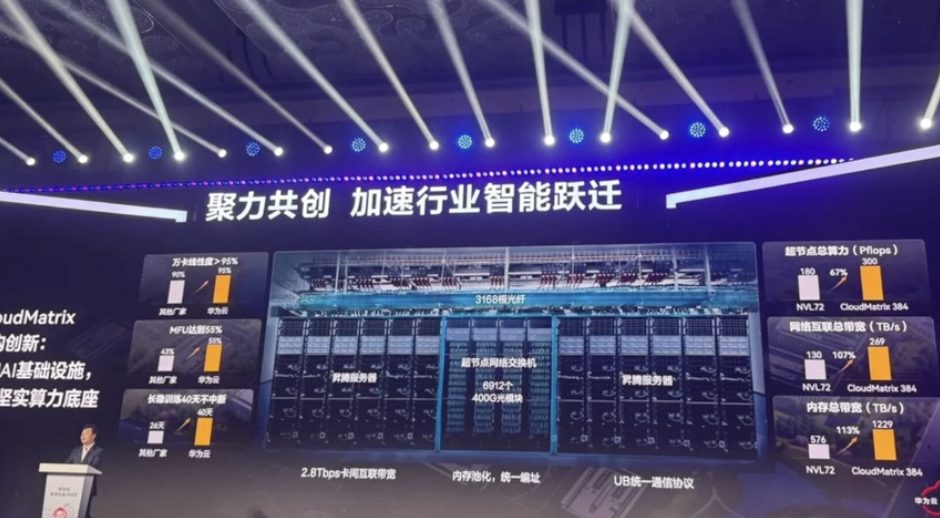
Huawei’s CloudMatrix 384 consists of 384 of their 910C GPUs—a five-fold increase over NVIDIA’s 72-GPU NVL72 system. This massive scaling allows Huawei to nearly double the overall system performance despite each individual GPU being less powerful.
What makes this approach truly radical is Huawei’s decision to go fully optical. While NVIDIA primarily uses copper connections between GPUs within racks (about 1,500 copper cables in their NVL72), Huawei has implemented optical connections not just between racks but between individual GPUs.
This creates both advantages and significant challenges:
- The optical approach provides enormous bandwidth for data transfer
- It consumes approximately 600kW versus NVIDIA’s 145kW (four times more power)
- It requires thousands of optical transceivers, making the system more complex and failure-prone
This power-hungry approach might seem impractical in Western markets, but it makes strategic sense in China, where energy costs are lower and the power grid has been significantly expanded with renewables, nuclear, and unfortunately, coal.
Software: China’s Hidden Strength
What’s often overlooked in discussions about hardware is China’s growing strength in software development. The CloudMatrix runs on Huawei’s proprietary CANN software stack, similar to NVIDIA’s CUDA but optimized for their Neural Processing Units (NPUs).
This software handles everything from compilers to graph optimization and workload distribution—critical functions when managing complex systems prone to failures. This software layer is becoming increasingly important as systems scale up in complexity.
Manufacturing Remains the Achilles’ Heel
Despite these impressive achievements, manufacturing remains China’s biggest challenge. Reports suggest the 910C GPU dies are still manufactured by TSMC at 7nm and imported to China. While I can’t verify this definitively, it’s clear that China continues to rely on foreign technology for critical components.
However, with time, funding, and perseverance—resources China has in abundance—this gap will likely narrow. The next generation of Huawei GPUs (the Ascend 910D and 920) are reportedly already in production.
The Real Long-Term Battle: Resources
Looking beyond the immediate technology race, I believe the true long-term determinant of AI leadership will be access to abundant, cheap energy and water. A typical 100-megawatt data center consumes roughly 2 million liters of water daily, with 70-80% eventually evaporating.
China is exploring novel approaches to this challenge, including experimental underwater data centers off the coast of Sanya, Hainan. While this allows for direct water cooling, it creates maintenance nightmares and potentially devastating environmental impacts on marine ecosystems.
The Huawei story illustrates a crucial point about modern technology competition: it’s no longer just about building the best individual components. System-level integration, infrastructure, and resource management are becoming equally important battlegrounds in the global AI race.
As NVIDIA’s CEO Jensen Huang has noted, they now consider themselves an infrastructure company rather than just a chip company. In this new paradigm, China may have found a way to compete despite lagging in silicon technology—by focusing on systems, networking, and software integration.
Frequently Asked Questions
Q: How does Huawei’s new GPU compare to NVIDIA’s offerings?
Huawei’s Ascend 910C GPU delivers 800 tFLOPS at 16-bit precision, making it four times more powerful than NVIDIA’s H20 (the most advanced chip NVIDIA can sell in China), but still three times less powerful than NVIDIA’s top-tier GB200 GPU. However, by using 384 GPUs in their CloudMatrix system versus NVIDIA’s 72 GPUs, Huawei achieves nearly double the overall system performance.
Q: What makes Huawei’s CloudMatrix system unique?
The CloudMatrix 384 stands out for its fully optical architecture, connecting all 384 GPUs with optical links rather than copper cables. This provides massive bandwidth but comes at the cost of higher power consumption (600kW vs. NVIDIA’s 145kW) and increased system complexity with thousands of optical transceivers.
Q: Is China still dependent on foreign technology for these systems?
Yes, manufacturing remains China’s biggest challenge. Reports suggest the 910C GPU dies are still manufactured by TSMC at 7nm and imported to China. The country continues to rely on technology from the US and Europe for critical components and tools, though they’re working to develop domestic alternatives.
Q: Why doesn’t the higher power consumption of Huawei’s system matter as much in China?
Energy costs in China are generally lower than in the US and Europe. Additionally, China has significantly expanded its power grid with renewables, nuclear, and coal in recent years. While Western markets might prioritize energy efficiency, Chinese customers may accept higher power consumption to achieve greater performance and technological independence.
Q: What are the long-term factors that will determine AI leadership?
Beyond chip technology, access to abundant, cheap energy and water will likely determine long-term AI leadership. Data centers require enormous amounts of both resources. China is exploring novel approaches like underwater data centers, though these create maintenance challenges and potential environmental concerns. The cost of intelligence will eventually converge with the cost of energy, making energy infrastructure a critical investment area.