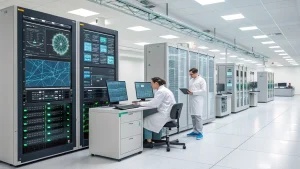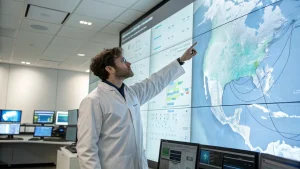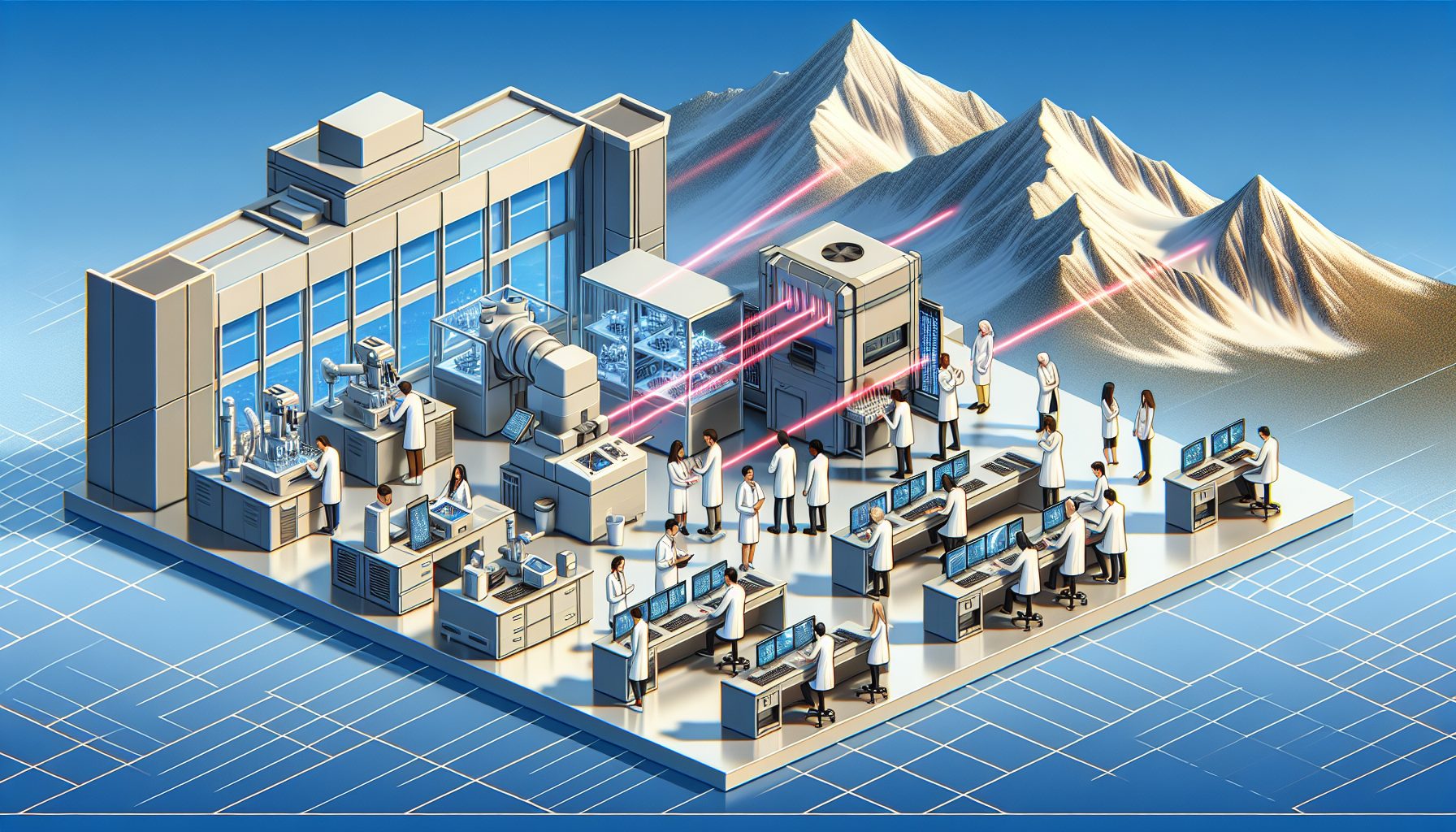
Construction is set to start this month on a groundbreaking new laser research facility at Colorado State University’s Foothills Campus. The Advanced Technology Lasers for Applications and Science (ATLAS) Facility aims to propel the United States’ fusion energy efforts. The ATLAS Facility will host a unique cluster of high-intensity, high-repetition rate lasers configured to fire simultaneously at a single fusion target.
The laser burst will deliver nearly 7 petawatts of power—over 5,000 times the electrical generation capacity of the U.S.—into a focal spot roughly the width of a human hair for approximately 100 quadrillionths of a second. This immense power has the potential to advance fusion research, potentially paving the way to achieve limitless and clean energy. The facility will also support interdisciplinary research in medicine, microchip lithography, high-resolution X-ray imaging, and various fundamental science studies.
CSU President Amy Parsons hosted the groundbreaking ceremony. “As a top institution recognized both for research and for sustainability, CSU is a fitting home for this facility. We have been a leader in laser research for decades, and our faculty are developing critical technologies.
This new facility will house one of the most powerful lasers in the world and establishes CSU as a nexus for laser fusion research,” Parsons said. Heike Freund, the Chief Operating Officer of Marvel Fusion, expressed enthusiasm for the partnership with CSU. “This groundbreaking marks an exciting new chapter in the partnership between Marvel Fusion and Colorado State University as we move forward with constructing a facility that will drive the future of fusion energy,” Freund stated.
“Fusion energy has the potential to revolutionize the approach to sustainable power, providing a virtually limitless, clean energy source.”
CSU Vice President for Research, Cassandra Moseley, echoed these sentiments. “We celebrate today with the scientists whose teams helped get us to this point, and with excitement for the research power and discovery that will take place in this facility,” said Moseley.
Laser facility propels fusion energy
The ATLAS Facility builds on the major 2022 breakthrough at the US government’s National Ignition Facility (NIF), where a net energy gain in a fusion reaction was achieved for the first time. Net energy gain means the reaction generated more energy than it consumed. However, achieving net energy gain is different from operating a continuous commercial fusion power plant.
Marvel Fusion plans to address this by producing these fusion blasts multiple times per second. ATLAS aims to repeat the laser blasts ten times per second to maintain an ongoing fusion reaction and provide a stable supply of clean energy. The facility is designed to enhance the laser’s power and efficiency while reducing costs.
Colorado State University will develop one of the lasers, while Marvel Fusion will build the other two. The goal is to complete the laser facility by 2026. The $150 million project is a public-private partnership with Marvel Fusion, with $28 million in funding from the U.S. Department of Energy (DOE) for the next three years.
Geri Richmond, undersecretary for science and innovation at the DOE, highlighted the lab’s potential to answer critical questions about science and laser usage, particularly in advancing fusion energy. The 71,000-square-foot facility will be constructed by Tetrad Corp., with McCarthy Building Cos., Inc. serving as the general contractor and SWBR leading the design.
It will incorporate more than 7,500 cubic yards of concrete, including five-foot-thick shielding walls around the target bay and a three-foot-thick slab below the laser and target bays for vibration isolation. The new lab is scheduled to open in mid-2026, marking a substantial advancement in fusion energy research and collaboration between public institutions and private industry. It represents a significant step forward in the global pursuit of fusion technology and the quest for sustainable energy.

Cameron is a highly regarded contributor in the rapidly evolving fields of artificial intelligence (AI) and machine learning. His articles delve into the theoretical underpinnings of AI, the practical applications of machine learning across industries, ethical considerations of autonomous systems, and the societal impacts of these disruptive technologies.