What if the fundamental assumption driving modern technology is completely wrong? We’ve built our entire digital world on the belief that reality can be perfectly captured in zeros and ones—that everything is deterministic, logical, and precise. But as I look around, I see a different truth: reality is messy, unpredictable, and beautifully chaotic.
Nature doesn’t operate in binary. Cells divide with tiny errors, creating the foundation for evolution. Neurons fire with inherent randomness, fueling our creativity. Even cosmic events like supernovas—chaotic explosions that scatter elements across space—create the building blocks for new stars and planets.
In nature, chaos isn’t a bug—it’s a feature. And perhaps it’s time our computers learned the same lesson.
The Illusion of Perfect Determinism
For centuries, scientists clung to the idea that the universe was perfectly predictable. This concept, formalized by mathematician Pierre-Simon Laplace, suggested that if you knew the position and momentum of every particle, you could calculate everything that would ever happen. No mystery, no randomness—just total determinism.
This is exactly how modern binary computing treats the world today. Our computers demand perfection: clean signals, precise timing, and exact calculations. We spend enormous amounts of energy forcing transistors to behave perfectly, fighting against their natural tendency toward noise and randomness.
But what if instead of fighting chaos, we embraced it?
Finding Patterns in Randomness
This revolutionary idea isn’t new. Over a century ago, Russian mathematician Andrey Markov challenged deterministic thinking by asking a bold question: Can randomness itself be predicted?
Markov observed that even in chaotic systems, patterns emerge. He discovered that by tracking how often one state follows another, he could predict probabilities of future states. This breakthrough gave us Markov chains—a mathematical framework for structured randomness that now powers everything from Google’s PageRank to advanced AI systems.
The implications were profound: randomness isn’t the enemy of prediction—it’s simply a different kind of pattern.
When Chaos Meets Computing
This concept collided with practical necessity during the Manhattan Project, when scientists needed to simulate nuclear chain reactions—perhaps the most chaotic process imaginable. Mathematician Stanisław Ulam had a breakthrough: instead of solving impossible equations exactly, why not run thousands of random trials and average the results?
This Monte Carlo method proved that randomness could be a computational tool, not just an obstacle. The more trials you run, the more accurate the result becomes—the law of large numbers in action.
This led to John von Neumann’s radical proposal in 1953: stochastic computing. Instead of representing numbers precisely, his system encoded them as probabilities in random bit streams. If 75% of bits are ones and 25% are zeros, that represents 0.75.
The beauty of this approach lies in its simplicity:
- Complex multiplication can be performed with a single logic gate instead of thousands of transistors
- The system continues working even when parts fail
- It mimics how biological systems process information
Early experiments like the RASCEL (Random Access Stochastic Computing Experimental Logic) proved the concept worked. But there was a fatal flaw: stochastic circuits needed thousands of random bits to achieve accuracy, making them unbearably slow. By 1978, the approach was abandoned, and computing continued down the binary path.
The Comeback of Chaos
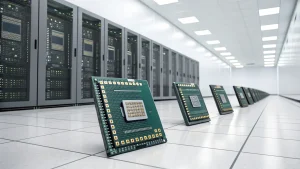
Today, we’re hitting the limits of traditional computing. Modern AI demands so much computation that data centers are straining power grids and cooling systems. We need a radical new approach.
This is where stochastic computing is making its comeback. Companies like Normal Computing are building chips that intentionally operate in the “danger zone” where transistors behave probabilistically. Instead of fighting noise, these chips harness it as a computational resource.
This approach is particularly well-suited for AI workloads. Models like Stable Diffusion and Sora don’t generate images and videos through precise calculations—they solve stochastic differential equations, gradually transforming random noise into structure.
Traditional GPUs can handle these tasks but inefficiently. They’re designed for graphics, not probability. Stochastic computing chips, however, let physics do the work directly—taking many tiny random steps that, guided by physical constraints, drift toward the correct solution.
The Future of Imperfection
The challenges ahead are significant. Stochastic computing isn’t general-purpose—it works best for specific problems involving probability. Scaling these systems to match GPU clusters remains unproven.
But the potential is enormous. If successful, this approach could fundamentally change computing: noise replacing multiplication, physics replacing math, and randomness becoming a feature, not a bug.
As we push the boundaries of AI and scientific computing, perhaps the answer isn’t more precision but embracing the beautiful chaos that defines our universe. After all, our own brains—still the most advanced computing systems we know—don’t operate in perfect binary. They thrive on noise, randomness, and probability.
Maybe the future of computing isn’t more perfect machines, but machines that, like nature itself, find strength in imperfection.
Frequently Asked Questions
Q: What exactly is stochastic computing?
Stochastic computing is an approach that represents data as probabilities within random bit streams rather than as precise binary values. For example, instead of storing 0.75 as a 32-bit number, it’s represented by a stream where 75% of bits are ones and 25% are zeros. This allows certain calculations to be performed with simpler hardware, though it requires many samples to achieve accuracy.
Q: Why did stochastic computing fail in the past?
The original stochastic computing systems from the 1960s-70s were too slow for practical use. They required thousands of random bits to achieve reasonable accuracy, and if the bit streams became correlated, the calculations would fail. At that time, the trade-off between speed and precision wasn’t acceptable for most applications.
Q: How does stochastic computing benefit AI specifically?
Many AI algorithms, particularly generative models like diffusion systems, are based on stochastic differential equations. These models gradually transform random noise into structured outputs. Traditional processors handle these operations inefficiently, while stochastic computing chips can process these probability-based calculations more naturally and with less energy.
Q: What are the main challenges for stochastic computing today?
The biggest challenges include generating truly random bit streams (since poor-quality randomness leads to calculation errors), scaling the technology to match the performance of GPU clusters, and overcoming the limitation that stochastic computing only works well for specific types of problems rather than general-purpose computing.
Q: Could stochastic computing replace traditional computing?
It’s unlikely to replace traditional computing entirely. A more realistic outcome is that stochastic processors might become specialized accelerators for specific workloads involving probability and simulation, similar to how GPUs accelerate graphics and AI tasks today. The future likely involves heterogeneous systems using different computing approaches for different problems.