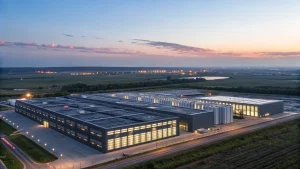
As artificial intelligence drives a surge in power-hungry computing, Exelon Chief Executive Calvin Butler says community support will decide where and how new data centers get built. Speaking on Fox Business’ Varney & Co., Butler framed local engagement as the make-or-break factor for meeting growing electricity demand linked to AI across the Mid-Atlantic and Midwest.
The message lands as utilities face a wave of requests from data center developers. Exelon’s operating companies serve major hubs from Chicago to Philadelphia, Baltimore, and Washington, D.C. That makes the utility a central player in how quickly the grid can adapt to new loads while keeping rates stable and reliability high.
Why Community Support Matters
“Local engagement is key to expanding data centers that power America’s growing AI demand.” — Calvin Butler, Exelon CEO, on Varney & Co.
Butler’s point reflects a simple reality. Local governments control zoning. Neighbors weigh traffic, noise, and visual impact. Schools and public services need clear plans for growth. Without early outreach and clear benefits, projects stall.
Community dealmaking often includes tax agreements, infrastructure upgrades, and job-training programs. Residents also want assurances on noise mitigation, backup generation, and timelines for construction. Developers that address those concerns first tend to move faster through permitting.
Background: Demand From AI And The Grid
Large language models and other AI tools depend on massive computing clusters. Those facilities require steady, high-quality power and fast connections to fiber networks. Utilities from Virginia to Ohio report sharp increases in long-term load forecasts linked to data centers.
Exelon’s utilities—ComEd, PECO, BGE, Pepco, Delmarva Power, and Atlantic City Electric—are investing in feeders, substations, and automation to handle higher peak loads and improve resilience in storms and heat waves. Grid planners are watching where clusters form because local capacity, not just regional supply, sets the pace for growth.
Balancing Growth With Reliability And Cost
Butler’s focus on local engagement aligns with three practical needs: reliability, affordability, and speed. Bringing a data center online can require new substations, thicker feeders, or upgraded transmission ties. Those investments need clear cost allocation between customers and the project.
- Reliability: Maintaining voltage quality and backup options for large, round-the-clock loads.
- Affordability: Avoiding bill spikes for households and small businesses.
- Speed: Sequencing utility work with construction schedules to prevent costly delays.
Some communities see data centers as anchors that attract suppliers and higher tax revenue. Others worry about land use and strain on local infrastructure. Water use for cooling is a frequent concern, pushing operators toward air cooling, recycled water, or heat reuse where practical.
Permitting, Siting, And Power Options
Permitting timelines can stretch for months or years if projects lack consensus. Early siting in industrial zones, transparent noise studies, and clear road plans help reduce friction. Butler’s comments indicate Exelon expects developers to arrive with local partners, not just engineering diagrams.
On power supply, many operators pursue renewable energy credits and long-term contracts to match usage. Utilities are modernizing distribution systems and coordinating with regional grid operators for bulk supply. Energy efficiency inside data halls, such as improved server utilization and heat management, can slow load growth without limiting computing capacity.
What Different Stakeholders Are Watching
Local officials want tax stability and job pathways for residents. Labor groups are tracking construction hours and safety. Environmental advocates seek tighter standards on noise, air permits for backup generators, and water stewardship. Business groups point to the risk of losing investment to faster-moving regions if approvals lag.
Butler’s emphasis on local engagement signals that utilities will weigh these interests early. It also suggests developers should prepare to fund grid upgrades that directly serve their sites and commit to long-term community benefits.
The rise of AI has pushed data infrastructure from a niche siting issue to a mainstream economic debate. Butler’s guidance is practical: projects that listen to their neighbors move faster and cost less in the long run. The next year will test whether utilities, developers, and cities can align on clear rules, fair cost sharing, and transparent timelines. Watch for more utility-community agreements, closer coordination on grid upgrades, and siting in areas with ready capacity to speed deployment while keeping service reliable.

Deanna Ritchie is a managing editor at DevX. She has a degree in English Literature. She has written 2000+ articles on getting out of debt and mastering your finances. She has edited over 60,000 articles in her life. She has a passion for helping writers inspire others through their words. Deanna has also been an editor at Entrepreneur Magazine and ReadWrite.