Sam Altman, the CEO of OpenAI, has warned that millions of jobs could be at risk as artificial intelligence (AI) continues to advance. Altman believes that AI has the potential to disrupt various sectors of the economy. According to experts, several entry-level and mid-level jobs are particularly vulnerable to being replaced by AI.
“How you decrease cost is not by firing the cheapest employees. You take the cheapest employee and make them worth the expensive employee.” One of the most heated debates in the AI discourse is who's more vulnerable: entry-level workers or the middle-aged https://t.co/RFYlNbfVY5
— Noam Scheiber (@noamscheiber) July 7, 2025
These include junior paralegal research, entry-level Python debugging, first-pass marketing copywriting, invoice reconciliation in finance, template-based customer support, and summarizing news articles. AI can efficiently handle tasks such as document analysis, contract reviews, case research, code review, debugging, generating marketing content, streamlining financial processes, handling routine customer inquiries, and summarizing news articles. This could lead to a reduced demand for human workers in these roles.
Which Workers Will #AI Hurt Most: The Young or the Experienced? #RiseoftheRobotshttps://t.co/k62U1bt5v6
— Martin Ford (@MFordFuture) July 7, 2025
However, while AI may render some jobs obsolete, it is also creating new opportunities.
Which Workers Will A.I. Hurt Most: The Young or the Experienced?
Check out this @nytimes piece on a pivotal time for AI in the workplace, featuring Lab Digital Fellow Sarah Bana and Postdoctoral Fellow @RuyuChen!https://t.co/GPmfAtjlG7
— Stanford Digital Economy Lab (@DigEconLab) July 8, 2025
Emerging roles in the AI era include prompt engineers, data curation leads, model-bias auditors, AI operations technicians, and synthetic media designers. These new positions involve designing inputs to optimize AI system outputs, overseeing training datasets, evaluating AI outputs for ethical standards, maintaining AI infrastructure, and utilizing AI tools to create new media experiences.
AI’s impact on the job market
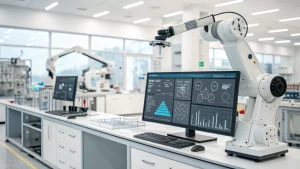
In addition to replacing specific jobs, AI is also enhancing many professions. AI-powered robots are being deployed in warehouses to speed up sorting and packing tasks.
“it would increasingly make sense for companies to hire junior employees who used A.I. to do what was once midlevel work, a handful of senior employees to oversee them and almost no middle-tier employees.” https://t.co/I7w8DiOrzt
— Yosuke YANASE (柳瀬陽介) (@yosukeyanase) July 7, 2025
Real-time AI captioning and subtitling systems are making human translators less essential in some media workflows. Autonomous inventory scanners and delivery bots are being tested in retail and delivery. AI assists in diagnostics, medical imaging, and administrative tasks in healthcare, although clinical decisions still require human oversight.
In education, AI supports personalized learning and automates grading, while classroom teaching still heavily relies on human interaction. In finance, AI is replacing many entry-level analyst roles with faster, algorithmic alternatives for tasks like fraud detection and auditing. The key to navigating this transition lies in reskilling the workforce.
As AI reshapes industries, workers will need to adapt by acquiring new skills suited to the evolving job market.

Deanna Ritchie is a managing editor at DevX. She has a degree in English Literature. She has written 2000+ articles on getting out of debt and mastering your finances. She has edited over 60,000 articles in her life. She has a passion for helping writers inspire others through their words. Deanna has also been an editor at Entrepreneur Magazine and ReadWrite.