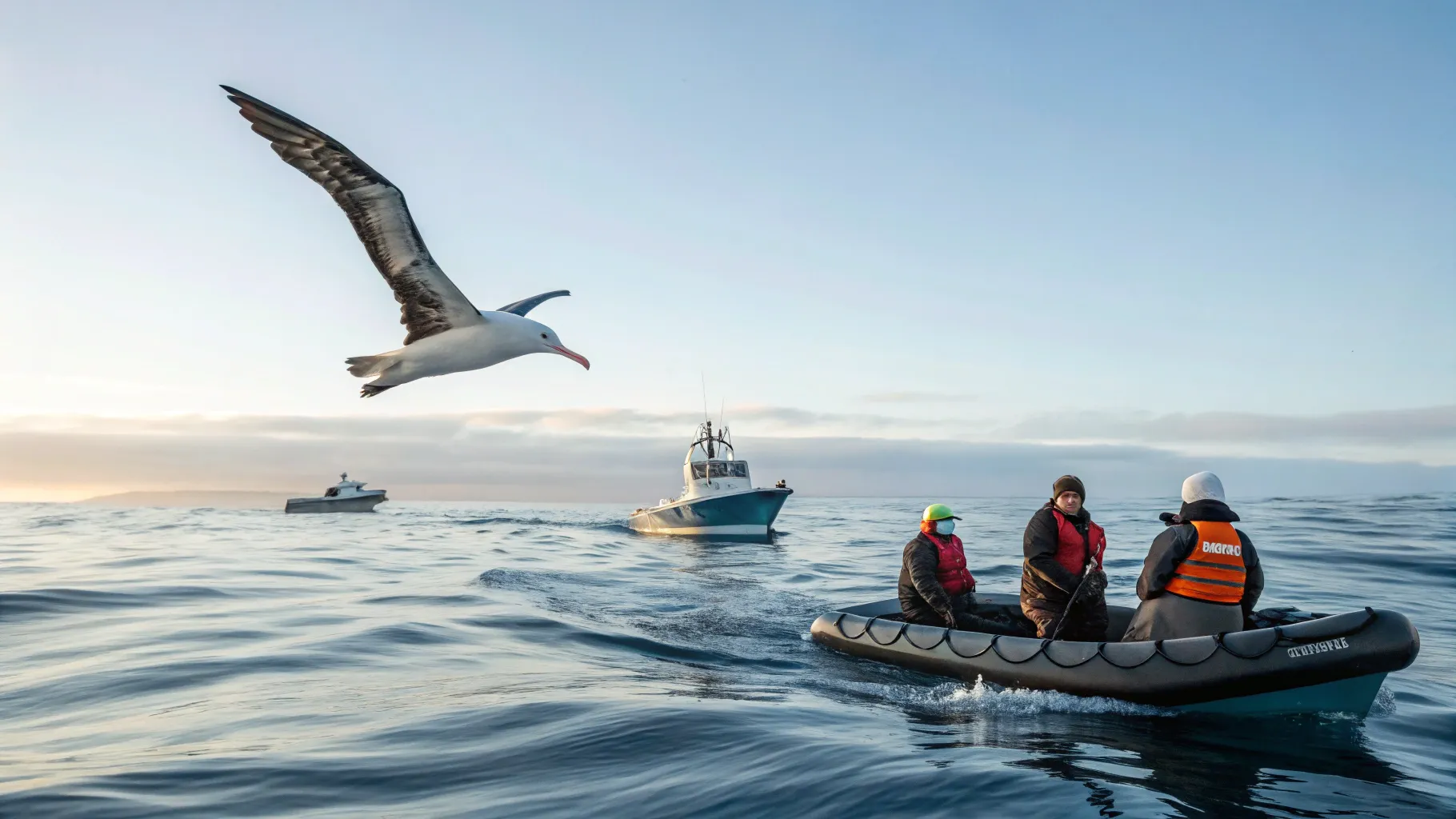
After five years of searching the Pacific for one of the ocean’s most elusive mammals, a research team nearly lost its breakthrough when a bold albatross swooped in at the worst moment. The expedition, conducted at sea and focused on finding the ginkgo-toothed beaked whale, reached a tense turning point when a bird attempted to make off with key gear during a critical observation.
The researchers had spent years chasing faint leads and fleeting dorsal fins. They were navigating remote waters, timing surveys to rare surface intervals, and logging every encounter. Then, as the team moved to secure evidence, a single seabird threatened to end it.
“The search for a gingko-toothed beaked whale had taken five years, when a thieving albatross nearly ruined it all.”
A Rare Species Few Have Seen
The ginkgo-toothed beaked whale (Mesoplodon ginkgodens) is among the least observed whales on Earth. Most confirmed records come from strandings rather than at-sea sightings. Public databases list the species as Data Deficient, reflecting how little is known about its range, population, or behavior.
Beaked whales dive deep, remain underwater for long periods, and surface briefly and quietly. Those traits defeat most survey methods. Even experienced crews may cross their habitat for weeks and see nothing more than a disturbance far off the bow.
Scientists rely on acoustic detections, biopsy darts, and photos to identify species. For Mesoplodon species, teeth shape—like the ginkgo leaf form that gives M. ginkgodens its name—helps distinguish one from another.
Five Years at Sea
According to the team’s account, the search ran across multiple seasons and weather patterns. It involved daybreak departures, coordinated watches, and long stretches without a single confirmed sighting. The crew refined routes using bathymetry and prey maps, favoring offshore canyons and steep drop-offs where deep divers feed.
Each year added new data. The team tested different hydrophones and refined their protocols for silent approaches once clicks were detected. They also cross-checked reports with fishers and other mariners, building a map of possible hotspots.
- Target area: remote Pacific transects with deep-water features
- Methods: passive acoustics, photo-ID, and cautious close approaches
- Goal: secure visual confirmation and a clean genetic sample
The Albatross Incident
On the day of the near miss, seas had calmed and visibility was good. The crew reported a short surfacing consistent with a beaked whale, followed by a tight turn to maintain a respectful distance. As they prepared to recover equipment used to document the event, an albatross dove on the line.
Albatrosses are known for opportunistic feeding at sea. They also grab floating items. In this case, the bird’s lunge threatened to tangle or carry off gear that held crucial evidence. A lost rig would have erased hours of work and a rare chance at identification.
The team moved quickly to shoo the bird and secure the line. They cleared the snag and protected the equipment. The whale had already slipped under, so the gear held the only proof of the encounter.
Why It Matters for Conservation
Reliable data on ginkgo-toothed beaked whales is scarce. Every verified sighting helps define range and habitat. That evidence informs shipping guidelines, sonar practices, and marine protected area planning. Without it, policies rely on assumptions that can miss sensitive zones.
Beaked whales are sensitive to intense noise. Several mass strandings in other species have been linked to sonar use by navies. Knowing where and when these animals feed and surface can guide mitigation plans.
Independent experts say that even a single clean record can shift maps. It can also strengthen funding cases for continued monitoring.
What Comes Next
The team plans to audit acoustic logs, review photographs, and, if obtained, analyze any genetic material. If confirmed, the encounter would add a rare entry to the species’ at-sea record and refine expected range lines in the region.
Future steps include more passive acoustic coverage, better camera systems for brief surfacings, and protocols to protect gear from curious seabirds. The crew also aims to expand partnerships with fishers who can report unusual sightings in real time.
The close call is a reminder that progress at sea depends on steady methods and a measure of luck. A single albatross nearly erased years of patient work. A few calm minutes, quick hands, and a secure line kept the evidence intact.
If the data checks out, conservation planners could gain a clearer picture of where this deep-diving whale travels. That would help set smarter rules for noise and vessel traffic. The next season may tell whether this near-miss becomes a turning point or just another hard-earned clue in a long search.

A seasoned technology executive with a proven record of developing and executing innovative strategies to scale high-growth SaaS platforms and enterprise solutions. As a hands-on CTO and systems architect, he combines technical excellence with visionary leadership to drive organizational success.