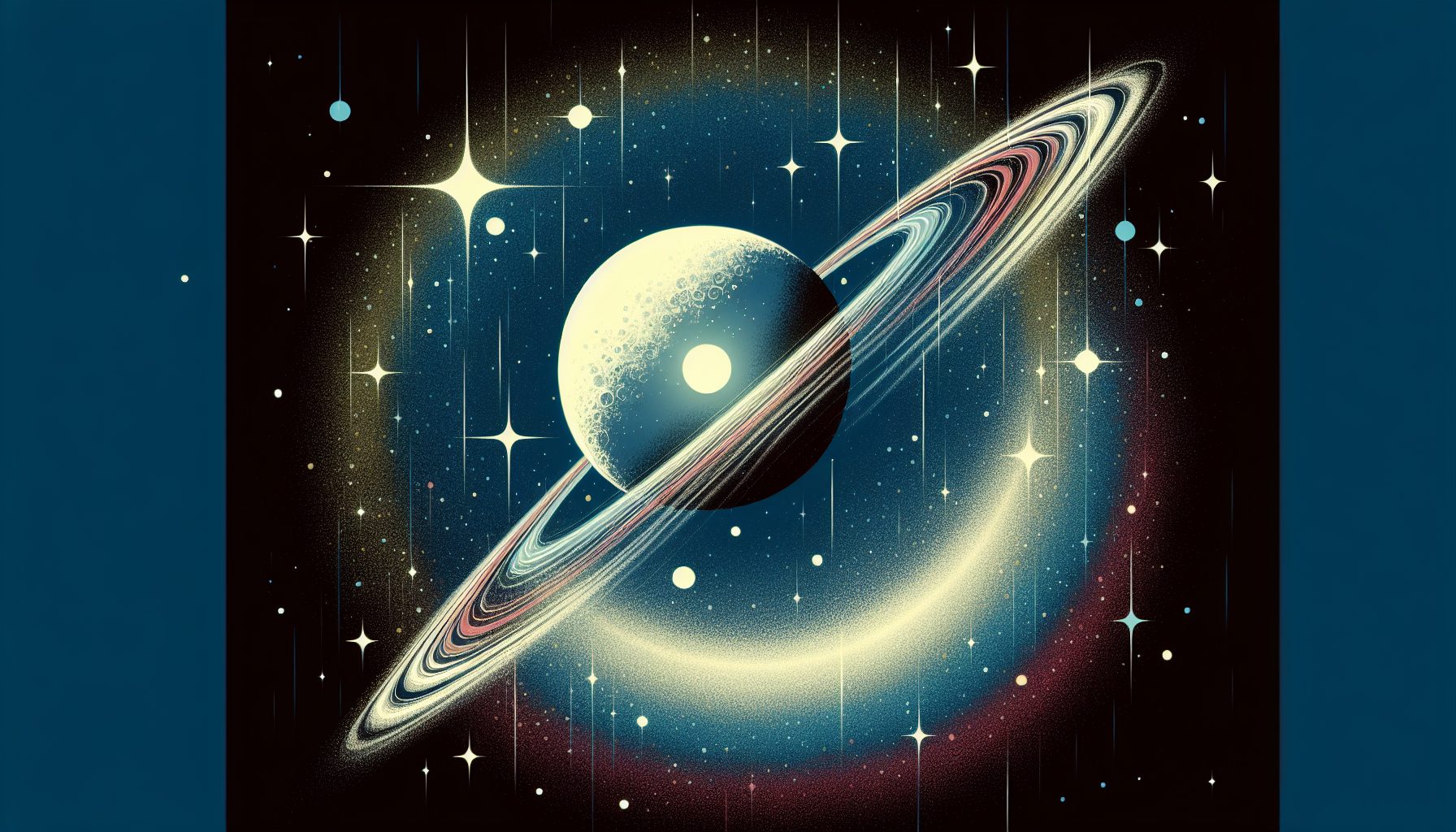
The moon and Saturn will put on a celestial show in the night sky this week. On July 23 and 24, the waning gibbous moon will make a close approach to the ringed planet. On the night of July 23, a 90% illuminated moon will appear slightly higher in the sky and to the right of Saturn.
Stargazers should look east before midnight for the best view. Finding a location with a clear view low to the eastern horizon around 11:00 PM EDT is recommended. Arriving about 30 minutes earlier will allow observers to catch the moonrise.
The following evening, on July 24, an 81% illuminated moon will be lower in the sky and to the left of Saturn. The moon will rise around 11:00 PM EDT, though checking the exact time for your specific location is advisable. From North America, the moon and Saturn will be visible against the backdrop of the Aquarius constellation.
They will have an apparent separation of about 10 degrees. In parts of Asia and Africa, observers will witness a more dramatic event. The moon will move across Saturn, causing an occultation that will make the planet disappear behind the moon for a few hours.
It’s important to note that these events are line-of-sight illusions. The moon is approximately 238,855 miles (384,400 km) from Earth.
Viewing Saturn’s celestial dance
Saturn is much farther away, around 832 million miles (1.34 billion km) on these nights. Saturn is nearing its annual opposition on September 8. At that time, it will be fully illuminated and at its brightest, making it an ideal time for observation.
However, even during the summer months leading up to this date, Saturn provides a stunning view. To see Saturn’s rings in detail, a telescope is recommended. A small 2-inch or 50mm refractor is sufficient to glimpse the ring pattern.
For those interested in capturing this celestial conjunction, proper astrophotography equipment is essential. Saturn’s distinctly yellowish hue will be easily visible during this month’s conjunction because of its contrast with the moon’s silvery light. The conjunction is easily visible on the same night from the southern hemisphere as well.
Saturn is currently experiencing retrograde motion. Instead of steadily moving eastwards night after night as measured against the backdrop of stars, it is appearing to backtrack westwards. By November, it will have finished its loop and will again move eastwards.
This optical effect is caused by the change of our perspective as Earth catches up with the outer planet and overtakes it. This year, the moment of overtaking, known as opposition, takes place on September 8. Because of its apparent backtracking, Saturn remains in the constellation of Aquarius, the water bearer, until later this year.

Noah Nguyen is a multi-talented developer who brings a unique perspective to his craft. Initially a creative writing professor, he turned to Dev work for the ability to work remotely. He now lives in Seattle, spending time hiking and drinking craft beer with his fiancee.