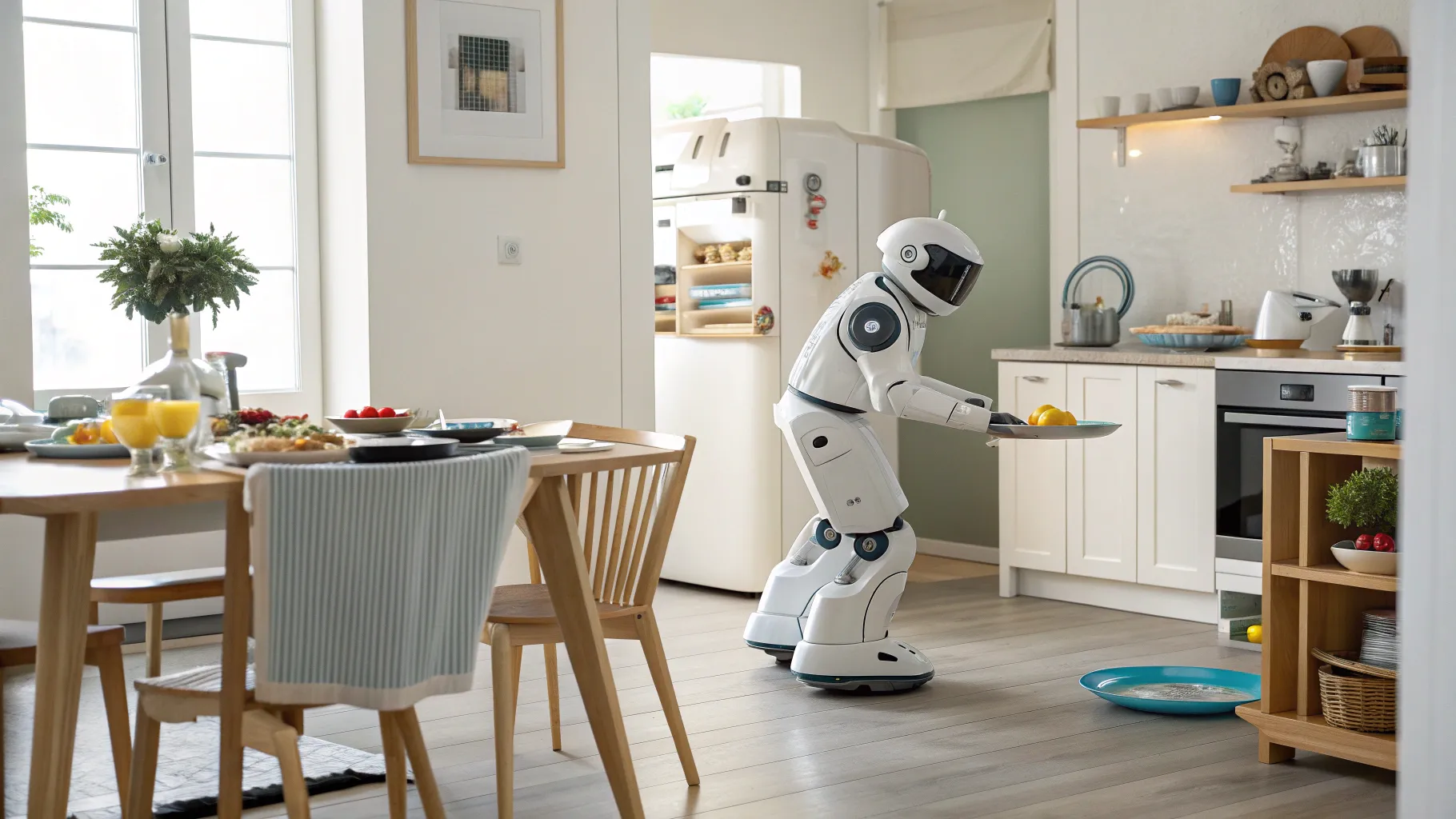
MIT’s Computer Science and Artificial Intelligence Laboratory has introduced a method to build lifelike virtual spaces where robots can practice daily tasks before entering the real world. The approach, called “Steerable Scene Generation,” assembles and refines 3D rooms so that objects behave as they would in homes and restaurants, offering a new way to prepare machines for messy, human environments.
The method constructs kitchens, living rooms, and dining areas using digital assets, then checks geometry and physics so that counters, drawers, chairs, and plates sit and move as expected. The research aims to shrink the gap between simulation and reality, a long-standing obstacle in training service robots.
Background: Why Simulation Still Struggles
Robotics teams often rely on simulation to train perception and control. Real-world data is costly, time-consuming, and risky for fragile hardware. Yet many simulators still produce scenes that look correct but fail under physical tests, such as sliding objects that should stay put or doors that clip through walls. These flaws can mislead learning systems and cause failures when code transfers to a real kitchen or dining room.
Academic and industry groups have tried various approaches, from hand-designed rooms to procedural generation. Popular platforms have improved graphics and physics over the past decade, but assembling large numbers of realistic, functionally accurate interiors remains difficult. MIT CSAIL’s method targets this pain point by letting researchers “steer” what appears in a scene, while enforcing constraints that make those scenes behave like real spaces.
How the Method Works
The pipeline arranges 3D assets to form everyday rooms, then runs checks and refinements so that layouts and contacts follow physical rules. The goal is to ensure that drawers open without collisions, that flatware rests on tables, and that robots can navigate without encountering impossible geometry.
“It arranges 3D assets into digital kitchens, living rooms, and restaurants, then refines them to be physically accurate to ensure they’re lifelike.”
Researchers describe the process as “steerable” because users can specify scene types and object mixes, such as a compact apartment kitchen with narrow aisles, or a crowded restaurant with moving chairs. The system then generates variations while preserving physical plausibility.
- Scene templates for common household and commercial settings.
- Asset placement guided by functional rules and constraints.
- Physics checks to prevent collisions and unrealistic contact.
- Automatic variation for training diversity.
What It Could Change for Robot Training
Physical accuracy matters for both perception and manipulation. A grasp policy that learns on sliding, interpenetrating objects often fails on real dishes and cutlery. Navigation stacks trained on clean, open layouts can struggle in tight corridors or busy dining rooms. By producing scenes that match real constraints, the MIT approach could help generalize skills from screen to floor.
“Steerable Scene Generation” helps create realistic, virtual training grounds to help robots practice physical tasks.
The method also supports repeated practice under varied but consistent rules, which is important for training data-hungry models. A robot can rehearse opening cabinets of different sizes or moving around tables with diverse leg styles, without running into non-physical states that teach the wrong lessons.
Balancing Promise and Limits
Experts say the advance addresses a practical bottleneck, but they caution that simulation cannot capture every quirk of real homes and restaurants. Lighting changes, sensor noise, wear-and-tear on hinges, and human unpredictability still require field testing. There is also the risk of bias if generated interiors reflect only certain design styles or household layouts.
Researchers and industry practitioners will be looking for signs that the method improves transfer rates for common tasks like grasping, door opening, and short-horizon navigation. Benchmarks that compare policies trained with and without these scenes could clarify gains.
Industry Impact and Next Steps
Service robotics in retail, hospitality, and eldercare could benefit if training becomes cheaper and safer while keeping quality high. Home-assistant projects may also see faster iteration, as teams generate diverse apartments and kitchens tailored to target regions and user needs.
Future work could integrate real scans from homes, couple the generator with human feedback, and support dynamic elements such as people and pets. Standardized evaluation suites would help the community measure progress.
For now, “Steerable Scene Generation” adds a pragmatic tool to the simulator toolbox. By focusing on physics fidelity and controllable variety, the MIT team offers a path to train robots on scenes that better reflect the places they will actually work.

A seasoned technology executive with a proven record of developing and executing innovative strategies to scale high-growth SaaS platforms and enterprise solutions. As a hands-on CTO and systems architect, he combines technical excellence with visionary leadership to drive organizational success.