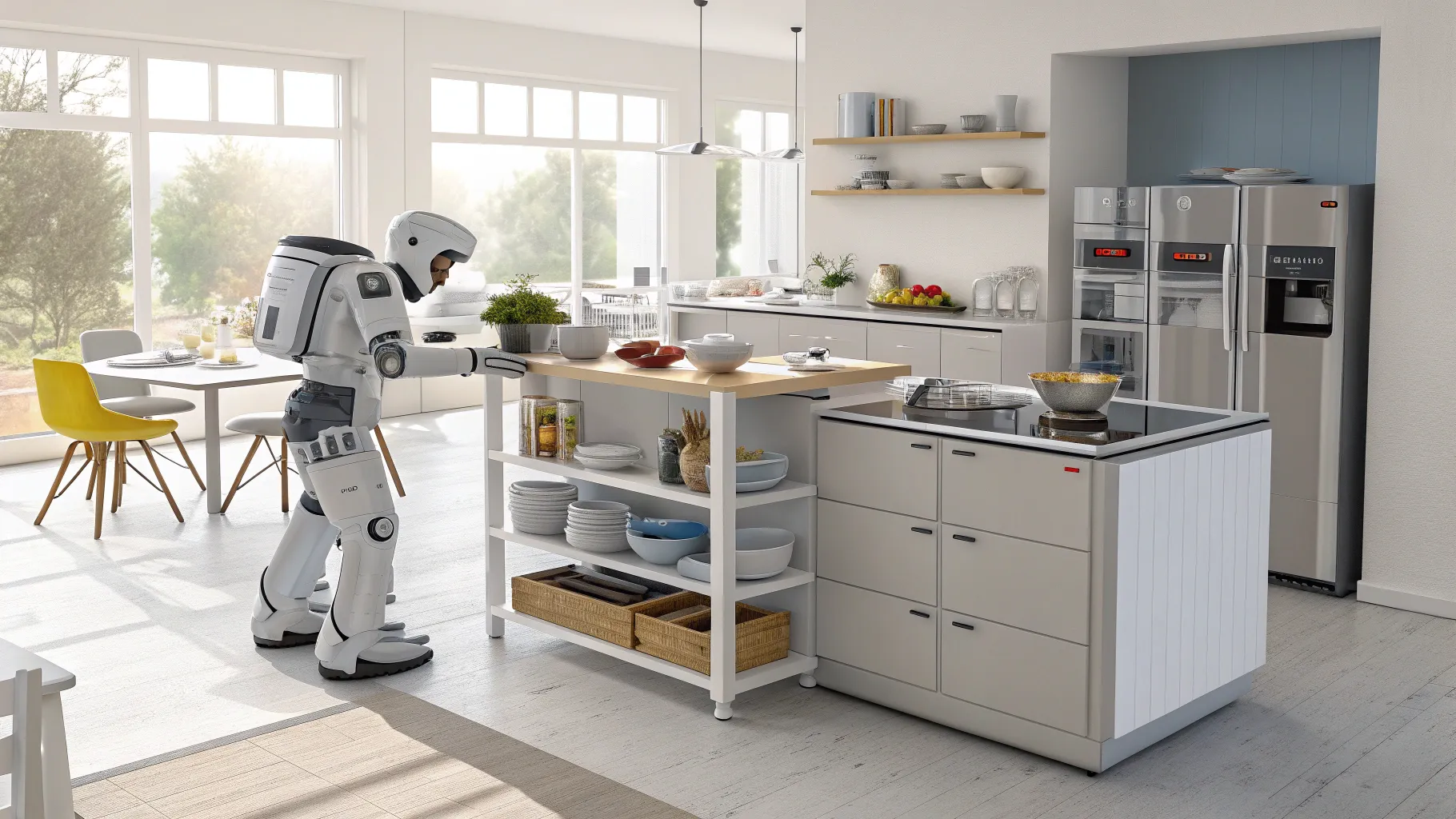
Researchers at MIT’s Computer Science and Artificial Intelligence Laboratory introduced a method they call Steerable Scene Generation, a system that sets up realistic virtual spaces for robots to practice physical tasks. The approach, unveiled in Cambridge, creates kitchens, living rooms, and restaurants inside a simulator and refines each scene so it behaves like the real world. The team says the goal is safer, faster training that prepares machines for messy homes and busy workplaces.
The approach addresses a long-standing challenge in robotics: training that works in a lab often falls apart in daily life. By tightening the link between digital scenes and physics, the method aims to reduce that gap. It offers a way to change layouts and objects on demand while keeping motion, friction, and contact behavior believable.
Background: Sim-To-Real Has Been Hard
For years, engineers have used simulation to teach robots to grasp objects, open doors, and navigate rooms. This cuts costs and avoids hazards. But many systems still stumble when they leave controlled tests. The jump from synthetic images and perfect models to cluttered rooms and worn surfaces remains a major hurdle.
Teams worldwide have tried broader data, randomized textures, and richer physics. The latest work from MIT CSAIL focuses on the scenes themselves. It organizes 3D assets into complete rooms, then enforces physical rules so drawers slide, chairs stay grounded, and counters have the right heights. That detail matters for tasks like stacking plates, wiping tables, or loading dishwashers.
How The Method Works
The system builds layouts from a library of 3D models and places them to form common indoor spaces. It then adjusts materials, mass, constraints, and collisions so interactions look and feel plausible to a robot policy.
MIT CSAIL’s “Steerable Scene Generation” method “helps create realistic, virtual training grounds to help robots practice physical tasks. It arranges 3D assets into digital kitchens, living rooms, and restaurants, then refines them to be physically accurate to ensure they’re lifelike.”
The “steerable” part refers to quick edits. Researchers can dial up clutter, change lighting, move furniture, or swap appliances while the simulator maintains physical consistency. That supports targeted practice for skills like grasping near edges, reaching into cabinets, or avoiding spills.
- Rapid assembly of full indoor scenes from 3D assets
- Automatic checks for physical constraints and contacts
- Fine control over clutter, layout, and materials
- Focus on tasks in kitchens, living rooms, and restaurants
What It Could Mean For Industry
Service robots are moving from factories into homes, hotels, and restaurants. Training them in richly varied, physics-correct spaces could speed progress. If a robot arm learns to handle plates on different surfaces, for example, it may adapt faster to new sites.
For researchers, the system could reduce manual scene setup and improve repeatability. For companies, it could shorten the path from a working demo to field trials. Cleaner transfer from simulation to the real world would also save time and reduce breakage during early tests.
Balancing Promise With Open Questions
The approach focuses on physical accuracy, which has often been the weak link. But hard problems remain. Fluids, deformable items like towels, and human unpredictability are still difficult to simulate. Transfer still depends on sensors, control policies, and hardware quality.
Independent experts often point out that variety matters as much as detail. A kitchen must be many kitchens, not one perfect model. The “steerable” feature may help here, allowing rapid generation of many layouts with grounded physics. The payoff will depend on how widely the system can scale and how well it supports diverse tasks.
What To Watch Next
Key tests will involve side-by-side comparisons. Do policies trained in these scenes handle new homes or restaurants better than baseline simulators? Can the tool plug into common training stacks without heavy customization?
If results show faster learning or higher success rates on real tasks, adoption could spread. Education programs may use the method to teach safe manipulation. Startups could prototype services in simulation before pilots. Public benchmarks that include physics-checked scenes would also help measure progress.
MIT CSAIL’s method brings structured, editable, and physics-focused scenes to robot training. The next phase is clear: demonstrate stronger transfer in varied, cluttered spaces. If that happens, robots may get better at the everyday jobs people need most, from setting tables to sorting groceries.

Deanna Ritchie is a managing editor at DevX. She has a degree in English Literature. She has written 2000+ articles on getting out of debt and mastering your finances. She has edited over 60,000 articles in her life. She has a passion for helping writers inspire others through their words. Deanna has also been an editor at Entrepreneur Magazine and ReadWrite.