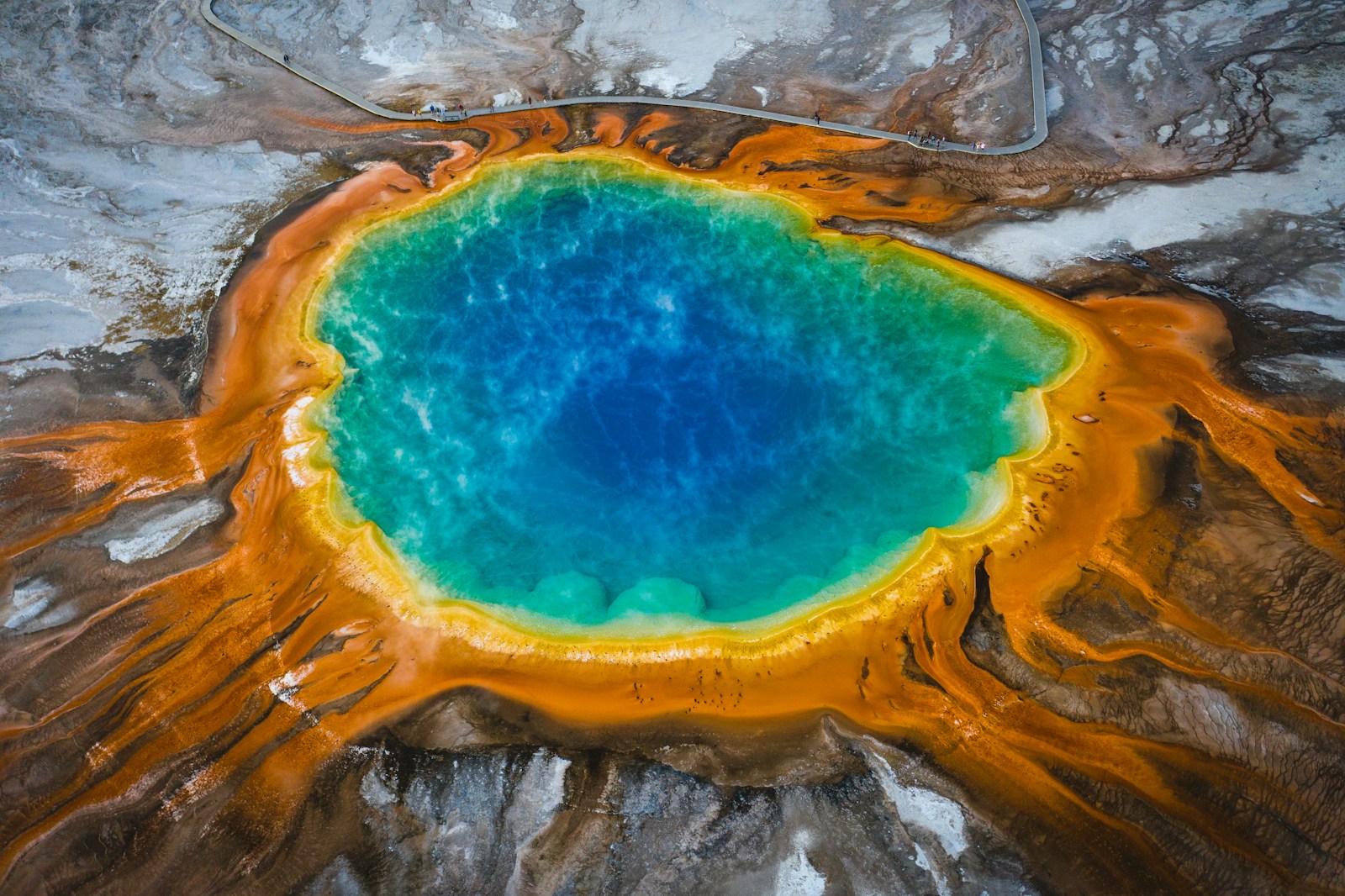
In the colorful hot springs of Yellowstone National Park, microbial communities thrive in a unique and extreme environment. These microbes, known as extremophiles, can survive and flourish in the intensely hot waters. For a long time, scientists studied these microbes in isolation.
They would remove them from their natural habitat, place them under microscopes, and grow them in petri dishes. This allowed for detailed study of their individual characteristics, but it overlooked a crucial aspect: their interaction within their community. Molecular ecologist Devaki Bhaya of Carnegie Science believes that understanding these microbial communities requires studying them in their natural setting.
“It’s great to study things in isolation because you can do a lot of manipulation, but you absolutely miss what they’re doing with their friends and foes and cousins,” Bhaya says. “How do they behave in a village?”
Bhaya’s research focuses on the microbial “village” in Yellowstone’s hot springs. She aims to discover how these microbes interact, what genes and functions they exchange, and how they collectively develop complex patterns known as “emergent behaviors.” These behaviors are changing how researchers understand microbial life, its past evolution, and even the nature of scientific collaboration.
In the words of English poet John Donne, “no man is an island.” Similarly, Bhaya believes that no microbe is an island, emphasizing the importance of studying these organisms within the context of their communities. Scientists in the US have uncovered new insights into how some of the earliest life forms on Earth adapted to a world with increasing oxygen levels. The research, led by Montana State University (MSU), sheds light on how ancient microbes evolved in extreme environments, offering clues about the origins of life on our planet.
The study was carried out at Lower Geyser Basin, the largest geyser basin in Yellowstone National Park, Wyoming. Professor Bill Inskeep, from MSU’s Department of Land Resources and Environmental Sciences, has studied life in the hot springs of Yellowstone for more than 20 years. In this latest study, Inskeep and colleague Mensur Dlakic, an associate professor in the Department of Microbiology and Cell Biology, aimed to understand how life evolved before and during the Great Oxidation Event.
This event occurred around 2.4 billion years ago when Earth’s atmosphere changed dramatically, shifting from almost non-existent levels of oxygen to the 20% oxygen we breathe today.
Exploring microbial life in hot springs
The team examined microbes living in two thermal springs – Conch Spring and Octopus Spring.
These sites were chosen because they are similar in many ways, except that Conch Spring has higher levels of oxygen than Octopus Spring. This allowed the researchers to study two contrasting thermal environments with both low and high levels of oxygen. The researchers focused on three types of thermophiles (heat-loving microbes) that live in both springs, where water temperatures reach a blistering 88°C (190°F).
When oxygen levels started to rise during the Great Oxidation Event, these microbes were likely some of the first to adapt. These microbes live in ‘streamers’ – thin, thread-like structures that sway in the flowing hot water, much like tiny underwater plants. Although streamers in both springs look similar, the scientists found that they host very different communities of microbes.
They discovered that the streamers in Octopus Spring, which has more oxygen, also host a greater diversity of microbial life. “Octopus Spring contained about ten populations not seen in Conch Spring and these included additional early-evolved bacteria as well as additional archaea,” says Inskeep. By analyzing their genes, the researchers found that microbes in the low-oxygen Conch Spring had highly active genes adapted for survival in an oxygen-poor environment.
Meanwhile, the microbes in Octopus Spring expressed genes better suited for higher oxygen levels, suggesting they had evolved to thrive as the atmosphere became richer in oxygen. Inskeep and Dlakic’s work is helping scientists piece together how life adapted to Earth’s changing conditions over billions of years – and Yellowstone seems to be the perfect place to conduct this type of research. “It would be very difficult to reproduce this kind of an experiment in the laboratory,” explains Inskeep.
“Imagine trying to recreate hot-water streams with just the right amounts of oxygen and sulfide. And that’s what’s so nice about studying these environments. We can make these observations in the exact geochemical conditions that these organisms need to thrive.”
While these ancient microbes may seem far removed from human life, they offer a fascinating glimpse into how all living things – including us – have evolved to survive, adds Dlakic.
“It may seem counterintuitive to understand complex life by studying something that’s simple, but that’s really how it has to start.”
This study underscores the invaluable role that unique natural environments like Yellowstone’s thermal springs play in advancing our understanding of life’s history and adaptability on Earth.

April Isaacs is a news contributor for DevX.com She is long-term, self-proclaimed nerd. She loves all things tech and computers and still has her first Dreamcast system. It is lovingly named Joni, after Joni Mitchell.