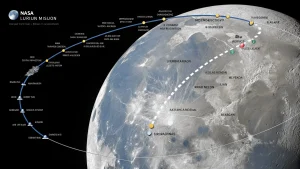
NASA’s Lunar Trailblazer mission is set to launch in 2024. The small satellite will map and analyze water deposits on the Moon. It will focus on permanently shadowed regions where ancient ice may lie.
The mission is managed by NASA’s Jet Propulsion Laboratory (JPL) in Pasadena. It will use advanced instruments to study the Moon’s surface in great detail. This will help scientists understand the lunar water cycle better.
Lunar Trailblazer will use two main tools: the High-resolution Volatiles and Minerals Moon Mapper (HVM³) and the Lunar Thermal Mapper. The HVM³ will measure different forms of water on the Moon, like ice, hydroxyl, and molecular water. This will show the type and amount of water in different areas of the Moon.
Bethany Ehlmann, the lead researcher for Lunar Trailblazer, said, “Making high-resolution measurements of the type and amount of lunar water will help us understand the lunar water cycle and the processes that delivered it to the Moon.”
The Lunar Thermal Mapper is funded by the UK Space Agency and made by Oxford University. It will map surface temperatures and look at how water behavior changes with temperature changes. This tool is important for learning how water molecules move on the Moon’s surface and how the harsh lunar environment might affect them.
By combining data from both instruments, scientists can create a detailed map of where water is on the Moon. This includes areas that get sunlight and those that are always in shadow. The mission’s findings will give clues about where lunar water came from and how it is spread out.
Mapping lunar water resources
Water on the Moon could potentially support astronauts by providing air to breathe and fuel for rockets. This would greatly reduce the need to bring these materials from Earth.
Studying lunar ice could also reveal information about the Moon’s past and how it interacts with other objects in space. The makeup of lunar ice is key to telling the difference between water brought by impacts from space and water that may have come from volcanic activity inside the Moon. This could shed light on how the Moon formed and developed over time.
The data from Lunar Trailblazer will support scientific research and also help plan lunar missions for NASA’s Artemis program and future exploration. By providing a detailed map of where lunar water is, the mission will allow future astronauts to find and possibly extract water resources more easily. This ability could be crucial for supporting long-term human exploration by using resources found on the Moon.
Lunar Trailblazer’s data could also help scientists learn if the Moon has a water cycle affected by temperature, solar radiation, and other environmental factors. These findings will add to our overall understanding of water on other airless bodies, like those in the outer solar system. Once in orbit around the Moon, the spacecraft will start scanning the lunar surface in a planned way, looking at both sunlit areas and places that are always in shadow.
This mission will work together with NASA’s Volatiles Investigating Polar Exploration Rover (VIPER), which is scheduled to explore the Moon’s South Pole by taking samples on the ground. Lunar Trailblazer shows NASA’s dedication to innovation in space science by putting advanced technology into a small satellite. By using compact and cost-effective missions, NASA aims to gather important data to guide future exploration efforts.
As Ehlmann noted, “Lunar Trailblazer’s discoveries will be foundational for NASA’s lunar exploration goals, helping us understand what resources are available and how they can be utilized.”

April Isaacs is a news contributor for DevX.com She is long-term, self-proclaimed nerd. She loves all things tech and computers and still has her first Dreamcast system. It is lovingly named Joni, after Joni Mitchell.