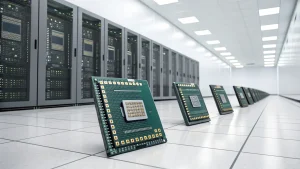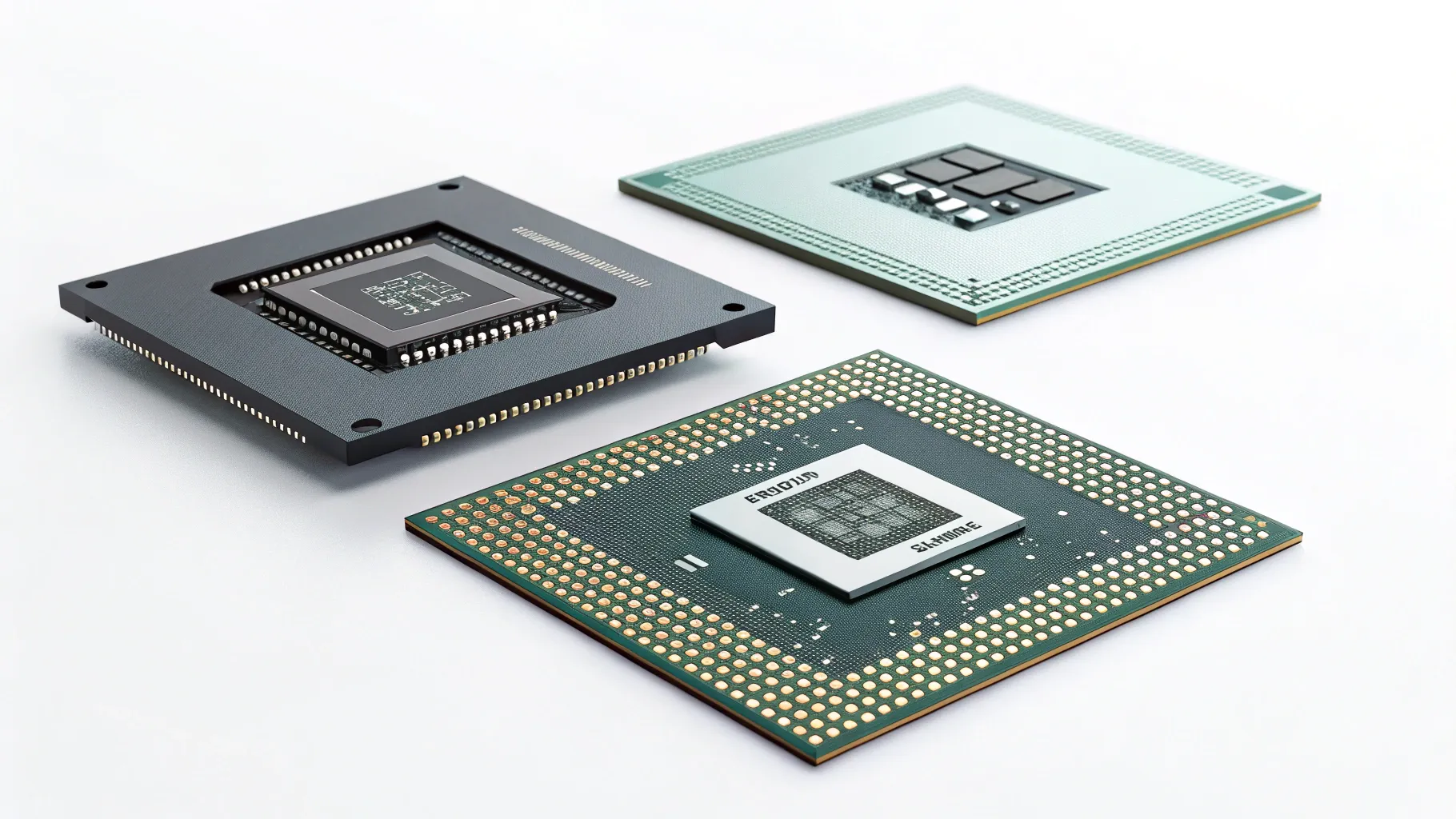
Neurophos has entered the race to cut AI’s soaring energy use, unveiling an optical chip that performs inference math using a composite material. The company presented the idea as a way to tackle rising power demands in data centers and edge devices, where AI workloads are growing fast.
The effort targets one of the industry’s most urgent problems. AI systems require large amounts of electricity to run models and serve results. Investors, engineers, and policymakers are searching for hardware that can do the same work with far less energy.
“Neurophos is taking a crack at solving the AI industry’s power efficiency problem with an optical chip that uses a composite material to do the math required in AI inferencing tasks.”
Why Power Efficiency Matters Now
AI adoption has surged in cloud services, consumer apps, and business tools. Each layer adds compute needs and electricity use. The International Energy Agency estimates that data centers account for roughly 1–1.5% of global electricity consumption, with AI a growing share of that demand.
Most AI work runs on GPUs and specialized accelerators. These chips are powerful but generate heat and push power budgets to their limit. Operators face constraints in grid capacity, cooling, and cost. As models get larger and usage spreads, efficiency gains are no longer optional. They are key to keeping services affordable and available.
How Optical Chips Could Help
Optical computing relies on light rather than electrons to move and process information. In AI inference, a major task is performing many matrix multiplications. Light can carry out certain types of linear operations with very low energy and latency.
Neurophos says its device uses a composite material inside the optical path to “do the math.” While the company has not publicly detailed the full design, the claim suggests the material changes how light behaves to represent weights or operations in a neural network.
The appeal is clear. If the chip can handle common inference layers with minimal power draw, data centers could serve more requests per watt. Edge devices could host smarter models without draining batteries or overheating.
Promise and Practical Hurdles
Photonic approaches have drawn interest for years due to their potential speed and energy benefits. But there are challenges. Integration with existing digital systems is complex. Programmability and precision must meet modern AI requirements. Manufacturing at scale must be consistent and cost-effective.
Engineers also need a full software stack, from compilers to runtime libraries, that maps neural networks onto optical hardware. Without easy developer tools, adoption will stall.
- Can the chip support common model formats and frameworks?
- How stable is the composite material under data center conditions?
- What accuracy and latency can it deliver on standard benchmarks?
- How does it compare on cost per inference at scale?
Industry Reaction and Use Cases
Hardware experts have long explored alternative compute routes to reduce energy use. Magnetic memory, analog circuits, and optical designs each offer trade-offs. The market rewards solutions that slot into existing racks and software without heavy rewrites.
If Neurophos can ship a drop-in card or module, the first targets would likely be search, recommendation, and generative response serving. These are high-volume workloads where power savings translate directly into lower operating costs.
Edge deployment is another possible fit. Retail, industrial inspection, and on-device assistants need low-latency inference under tight power limits. Optical chips could support mid-size models locally, cutting back-and-forth traffic to the cloud.
What We Know So Far
The company’s core message is centered on efficiency in inference. The claim focuses on a composite material at the heart of an optical compute unit. Details on throughput, precision, and node integration remain to be seen.
Analysts will look for third-party benchmarks and a clear software story. Partnerships with cloud providers or major model developers would indicate progress. A transparent roadmap on manufacturing and reliability would help build trust.
Neurophos is betting that light-based math can cut energy use in AI inference at a time when power constraints are tightening. The next phase will be proof: measured efficiency, accuracy on real workloads, and smooth integration with existing systems. If those pieces come together, operators could gain a new option to scale AI without scaling power bills. Watch for benchmark results, developer tool releases, and early customer trials in the months ahead.

Deanna Ritchie is a managing editor at DevX. She has a degree in English Literature. She has written 2000+ articles on getting out of debt and mastering your finances. She has edited over 60,000 articles in her life. She has a passion for helping writers inspire others through their words. Deanna has also been an editor at Entrepreneur Magazine and ReadWrite.