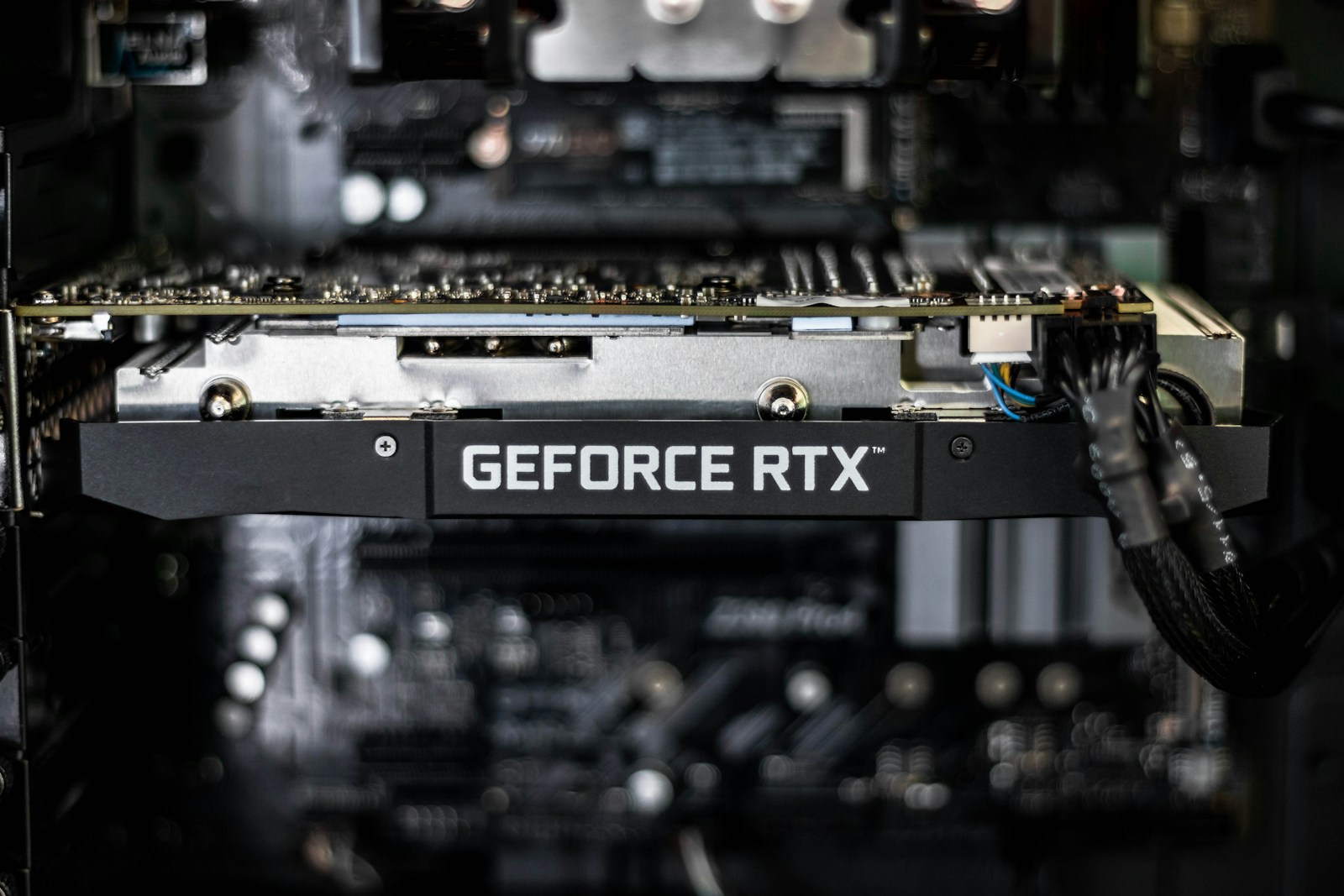
Nvidia unveiled the DGX series of personal AI supercomputers powered by the NVIDIA Grace Blackwell platform. The new DGX Spark and DGX Station models bring high-performance AI computing to desktops. The DGX Spark is the world’s smallest AI supercomputer.
It is powered by the NVIDIA GB10 Grace Blackwell Superchip, which features a powerful NVIDIA Blackwell GPU. The GB10 Superchip uses NVIDIA NVLink-C2C interconnect technology to ensure CPU+GPU-coherent memory. The DGX Station delivers data-center-level performance on desktops.
Special thanks to @gilbert and @djrosent from the @Acquiredfm podcast for hosting our #GTC25 keynote pregame broadcast. The show was packed with insightful conversations, a surprise guest appearance, and all the excitement building up to our CEO Jensen Huang's keynote.
Watch the… pic.twitter.com/nISgdW7XMZ
— NVIDIA (@nvidia) March 20, 2025
It incorporates the NVIDIA GB300 Grace Blackwell Ultra Desktop Superchip, which features an NVIDIA Blackwell Ultra GPU and 784GB of coherent memory space. The system offers powerful networking capabilities through the NVIDIA ConnectX-8 SuperNIC. NVIDIA’s full-stack AI platform enables a seamless transition of models from desktops to DGX Cloud or any other accelerated cloud or data center infrastructure.
The systems are designed for AI-native developers to easily prototype, fine-tune, and iterate on their workflows. Reservations for the new DGX systems are open now.
📣 Announced at #GTC25, EPRI, NVIDIA, and collaborators launch the Open Power AI Consortium (#OPAI).
⚡The consortium is building open datasets, #AI models, and software for use cases such as interconnection and rate case studies.
➡️ Learn more: https://t.co/xL5zy30qvW pic.twitter.com/gfbSsx40Ku
— NVIDIA AI (@NVIDIAAI) March 20, 2025
The DGX Station is expected to be available from manufacturing partners such as ASUS, BOXX, Dell, HP, Lambda, and Supermicro later this year.
“AI has transformed every layer of the computing stack,” said Jensen Huang, founder and CEO of NVIDIA. “It stands to reason a new class of computers would emerge — designed for AI-native developers and to run AI-native applications. With these new DGX personal AI computers, AI can span from cloud services to desktop and edge applications.”
The introduction of DGX Spark and DGX Station marks a significant step in making advanced AI computing more accessible.
GTC 2025 is now gone, but it will never be forgotten https://t.co/7p194o5H0S pic.twitter.com/kxe2JHUvTk
— Alex Woodie (@alex_woodie) March 21, 2025
By empowering developers and researchers with these high-performance tools, NVIDIA continues to push the boundaries of what’s possible in AI. In a Wednesday interview, Nvidia CEO Jensen Huang discussed the impact of Chinese startup DeepSeek’s new AI model. According to Huang, DeepSeek’s R1 model is revolutionary due to its status as “the first open-sourced reasoning model.”
“This reasoning AI consumes 100 times more compute than a non-reasoning AI,” Huang remarked.
“It was exactly the opposite conclusion that everyone had. It actually consumes 100 times more computing.”
Huang explained that the breakthrough model operates by breaking down problems step-by-step, can generate different answers, and can verify the correctness of its answers.
Nvidia’s new high-performance AI tools
This fundamentally different approach to AI has sent investors into a frenzy, evidenced in late January when DeepSeek’s model triggered a massive sell-off in AI stocks. During the interview, Huang also highlighted Nvidia’s ongoing efforts and achievements at its conference, including advancements in AI infrastructure for both robotics and enterprise needs. He emphasized partnerships with leading companies, showcasing the industry’s collective progress.
Predicting the future, Huang estimated that global computing capital expenditures could reach a trillion dollars by the end of the decade, with most investments directed toward AI. “Our opportunity as a percentage of a trillion dollars by the end of this decade is quite large,” Huang stated. “We’ve got a lot of infrastructure to build.”
In 2009, when Nvidia held its first developer conference, the event was something of a science fair.
Dozens of academics filled a San Jose, Calif., hotel decorated with white poster boards of computer research. The chipmaker’s chief executive, Jensen Huang, roamed the floor like a judge. This year, Nvidia’s developer conference is far different.
More than 25,000 people were expected to congregate on Tuesday around the event, known as Nvidia GTC. The crowds filled a National Hockey League arena to hear a speech from Mr. Huang about the future of artificial intelligence. Nvidia, the world’s leading developer of A.I. chips, has also wrapped San Jose in the company’s neon green and black colors, shutting down city streets and sending hotel prices soaring as high as $1,800 a night.
A who’s who of industry leaders attended, including Michael Dell, the chief executive of Dell Technologies; Jeffrey Katzenberg, the co-founder of DreamWorks and WndrCo, a venture capital firm; and Bill McDermott, the chief executive of ServiceNow. “GTC is jampacked,” Mr. Huang said as he kicked off the conference on Tuesday morning.
“The only way to hold more people at GTC is we’re going to have to grow San Jose.”
The transformation of Nvidia’s conference from an academic event to the Super Bowl of A.I. — a weeklong showcase of robots, large language models, and autonomous cars — symbolizes the company’s metamorphosis. As A.I. has gone mainstream, customers have clamored for Nvidia’s graphics processing units, or GPUs, the powerful chips that help create the technology. That has propelled the chipmaker to a nearly $3 trillion valuation, up from $8 billion in 2009.
Yet Nvidia’s ascent has raised questions. Generative A.I., which can answer questions, create images, and write code, has been celebrated for its potential to improve businesses and create trillions of dollars in economic value. Microsoft, Amazon, Google, Meta, and others are all racing to make that idea a reality.
Image Credits: Photo by Christian Wiediger on Unsplash

Cameron is a highly regarded contributor in the rapidly evolving fields of artificial intelligence (AI) and machine learning. His articles delve into the theoretical underpinnings of AI, the practical applications of machine learning across industries, ethical considerations of autonomous systems, and the societal impacts of these disruptive technologies.