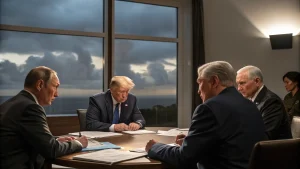
Nvidia CEO Jensen Huang has revealed that the company is in talks with the Trump administration regarding a potential new computer chip specifically designed for the Chinese market. This development comes amid ongoing tensions between the United States and China over technology exports and national security concerns.
Huang’s disclosure indicates Nvidia is seeking regulatory approval before proceeding with development of a specialized chip that would comply with U.S. export restrictions while still serving the substantial Chinese market for advanced computing hardware.
Navigating Export Controls
The discussions highlight the complex regulatory environment facing American technology companies that wish to maintain access to China’s lucrative market while adhering to U.S. government restrictions. In recent years, the U.S. has implemented increasingly strict controls on exports of advanced semiconductor technology to China, citing national security concerns.
Nvidia, as a leading manufacturer of graphics processing units (GPUs) and AI accelerators, has been particularly affected by these restrictions. The company’s most advanced chips, which power cutting-edge artificial intelligence applications, have been subject to export limitations.
The proposed China-specific chip would likely feature reduced capabilities compared to Nvidia’s flagship products, allowing it to clear regulatory hurdles while still providing value to Chinese customers.
Strategic Business Implications
For Nvidia, maintaining access to the Chinese market represents a significant business priority. China accounts for a substantial portion of global demand for advanced computing hardware, particularly as the country invests heavily in artificial intelligence and high-performance computing infrastructure.
Industry analysts note that creating market-specific products has become a common strategy for U.S. tech companies facing export restrictions. By developing chips that meet regulatory requirements while still serving customer needs, Nvidia aims to protect its market position in China.
The move comes as Chinese companies have been working to develop domestic alternatives to U.S. technology, spurred by concerns about supply chain security and access to critical components.
Regulatory Considerations
The Trump administration’s response to Nvidia’s proposal will likely balance several competing priorities:
- National security concerns regarding technology transfer
- Economic interests of U.S. companies
- Broader U.S.-China trade relations
- Competitive positioning in strategic technologies
The outcome of these discussions could set precedents for how other U.S. technology companies approach the Chinese market under current export control regimes.
Huang did not provide specific details about the technical specifications of the proposed chip or a timeline for potential approval and development. The company will need to demonstrate that the new product cannot be easily modified or repurposed for applications that might raise national security concerns.
As the semiconductor industry becomes increasingly entangled in geopolitical considerations, Nvidia’s approach represents an attempt to find a middle path that satisfies both regulatory requirements and business objectives. The company’s engagement with the administration suggests a recognition that proactive consultation with regulators is necessary in the current environment.
The technology sector will be watching closely to see if this approach yields results, potentially providing a blueprint for other companies facing similar challenges in balancing global business operations with national security priorities.

Senior Software Engineer with a passion for building practical, user-centric applications. He specializes in full-stack development with a strong focus on crafting elegant, performant interfaces and scalable backend solutions. With experience leading teams and delivering robust, end-to-end products, he thrives on solving complex problems through clean and efficient code.