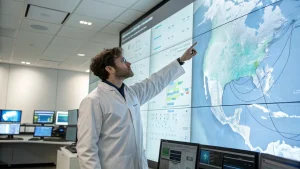
Nvidia has unveiled a significant update to its virtual recreation of the planet Earth-2, which could lead to more accurate weather forecasts and better disaster preparedness. The enhanced model, part of the NVIDIA Omniverse Blueprint for Earth-2, incorporates advanced tools such as GPU acceleration libraries, a physics-AI framework, development tools, and microservices. These upgrades aim to accelerate the development of more precise weather forecasting solutions, helping global organizations improve risk management and disaster preparedness.
The platform provides users with reference workflows, facilitating the transition from prototyping to production for weather forecast models. Leading climate tech companies, including AI company G42, JBA Risk Management, and Spire, are leveraging the blueprint to develop unique AI-augmented solutions. These companies integrate various components of the Omniverse Blueprint with their proprietary enterprise data to create solutions capable of delivering faster and more precise weather predictions.
G42, for example, is working with the UAE’s National Center of Meteorology to aid in weather forecasting and disaster management.
Enhanced modeling tools for precise forecasts
Andrew Jackson, CEO of Inception, a G42 company, highlighted the advancements in AI-powered forecasting with the Blueprint, which offers high-resolution weather and climate modeling.
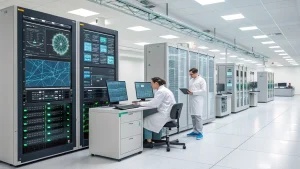
Spire Global has also employed AI components from the blueprint to develop new AI products that integrate proprietary satellite data to deliver medium-range and sub-seasonal forecasts extending up to 45 days. Utilizing NVIDIA GPUs and the Omniverse Blueprint, Spire’s models achieve a speed 1,000 times faster than traditional physics-based models. The Omniverse Blueprint for Earth-2 utilizes the NVIDIA DGX Cloud platform to provide comprehensive AI-augmented weather forecasting.
Operating on NVIDIA DGX GB200, NVIDIA HGX B200, and NVIDIA OVX supercomputers, the blueprint demonstrates high-speed and large-scale global climate simulations, showcasing the potential for faster and more detailed climate analytics. As technology advances, the potential for creating more resilient systems against natural disasters grows, offering a hopeful outlook in the face of mounting climatic threats. Nvidia’s efforts are part of a broader trend toward utilizing high-performance computing and artificial intelligence to tackle climate-related challenges.

April Isaacs is a news contributor for DevX.com She is long-term, self-proclaimed nerd. She loves all things tech and computers and still has her first Dreamcast system. It is lovingly named Joni, after Joni Mitchell.