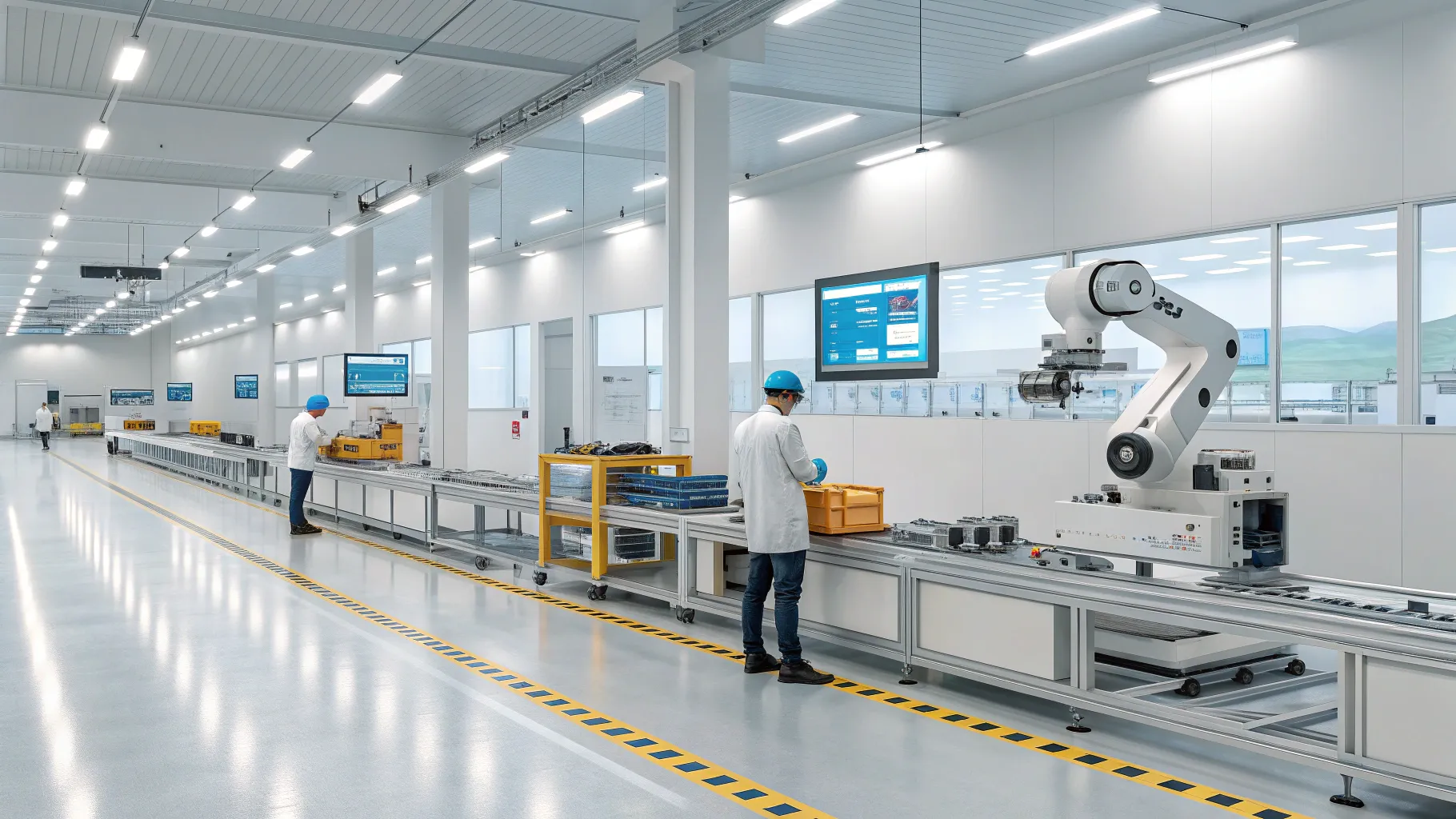
NXP Semiconductors says industrial demand for “physical AI” is lifting orders, as factories, warehouses, and job sites add smarter machines and safety systems. The Dutch chip maker’s new chief executive told Reuters the trend is accelerating as companies use artificial intelligence in logistics automation, workplace safety, and robotics to save costs and reduce risk.
The comment signals a shift in where AI spending is flowing. Rather than focusing only on data centers, manufacturers are placing intelligence in devices that sense, decide, and act on location. NXP, a major supplier of automotive and industrial chips, is positioning its processors, sensors, and software to serve that need.
What “Physical AI” Means on the Factory Floor
Physical AI refers to AI models that run close to where work happens. Instead of sending every image or signal to the cloud, machines use local processing to make split-second decisions. That is critical for a robot arm sorting packages, a camera checking hard-hat compliance, or a conveyor that pauses when a worker steps into a hazard zone.
“Businesses are applying artificial intelligence in industrial systems such as logistics automation, workplace safety and robotics,” the new CEO said. “We see strong interest in what we call ‘physical AI.’”
NXP supplies microcontrollers, application processors, power chips, and radios that enable such systems. Its parts sit inside scanners, mobile computers, collaborative robots, and machine-vision cameras. Many run AI workloads that must be fast, power-efficient, and reliable in dusty, hot, or electrically noisy settings.
Background: A Shift From Data Centers to Edge Devices
AI investment surged in large cloud servers in recent years. But many tasks in factories and warehouses cannot wait for a return trip to the cloud. Edge processing reduces delay and cuts bandwidth costs. It can also improve privacy by keeping sensitive images and production data on site.
NXP has long focused on automotive and industrial markets, where safety rules, long product lifecycles, and stable supply are key. In recent years, it has expanded its software tools for running vision and voice models on small devices, aiming to make deployment easier for equipment makers.
Analysts say industrial automation is a steady growth area for chipmakers with strong embedded portfolios. That includes suppliers such as STMicroelectronics, Texas Instruments, and Infineon, which compete with NXP on sensors, controllers, and power devices.
Use Cases Gaining Traction
Companies are focusing on practical projects with clear returns. Common examples include:
- Vision systems that detect defects or mislabels on production lines.
- Autonomous mobile robots that navigate busy warehouses.
- Worker safety monitors that spot unsafe behavior or blocked exits.
These systems run models that classify images, track objects, or predict failures. They often need to meet strict uptime and safety targets, which favors chips designed for industrial duty cycles and extended support.
Competitive Dynamics and Industry Impact
Unlike the race for large AI accelerators in data centers, the edge market is fragmented. Many products use a mix of general-purpose microcontrollers, NPUs, and DSPs. Design wins can be sticky once a platform qualifies a chip and completes safety tests.
For NXP, momentum in physical AI can deepen ties with automation vendors and system integrators. It can also pull through sales of power management, connectivity, and security chips used alongside processors. Competitors are pursuing the same strategy by bundling hardware with toolchains for machine learning at the edge.
Supply resilience and software support are key. Industrial customers value long-term availability and security updates. Vendors that combine solid hardware with easy-to-use AI libraries and reference designs may gain share.
Risks, Constraints, and What Could Slow Adoption
Growth depends on budgets in manufacturing, logistics, and construction. A slowdown in capital spending could delay upgrades. Some projects stall due to integration challenges or lack of skilled staff to maintain models in the field.
Standards and safety certifications can also extend deployment timelines. Systems that involve worker monitoring face privacy and labor concerns. Clear policies, opt-in practices, and on-device anonymization can help address these issues.
Outlook and Next Steps
The new CEO’s comments suggest NXP is betting on practical AI that touches real-world tasks. That aligns with customer priorities: cut downtime, improve quality, and keep workers safe. More deployments are likely in areas where milliseconds matter and network links are unreliable or costly.
Watch for partnerships between chip suppliers, automation firms, and software platforms to speed rollouts. Also expect more energy-efficient processors and toolchains that shrink models for small devices.
If spending holds and early pilots scale, physical AI could become a core driver for industrial electronics. For NXP, winning these designs now may secure revenue for years, given long product lifecycles and strict requalification rules.

Senior Software Engineer with a passion for building practical, user-centric applications. He specializes in full-stack development with a strong focus on crafting elegant, performant interfaces and scalable backend solutions. With experience leading teams and delivering robust, end-to-end products, he thrives on solving complex problems through clean and efficient code.