Scientists reported the brightest flare yet seen from a black hole, signaling a dramatic event in deep space and a potential opening to new physics. The discovery, shared by researchers monitoring high-energy sky surveys, points to an outburst strong enough to challenge current models of how black holes feed and launch energy.
“Scientists have spotted the brightest flare yet from a black hole.”
The sighting did not include immediate details on the source or distance, but astronomers stressed the importance of capturing the event across multiple observatories. The timing matters: fast follow-up can reveal how such flares ignite, grow, and fade, offering a rare look into extreme gravity and magnetic fields.
What Is a Black Hole Flare?
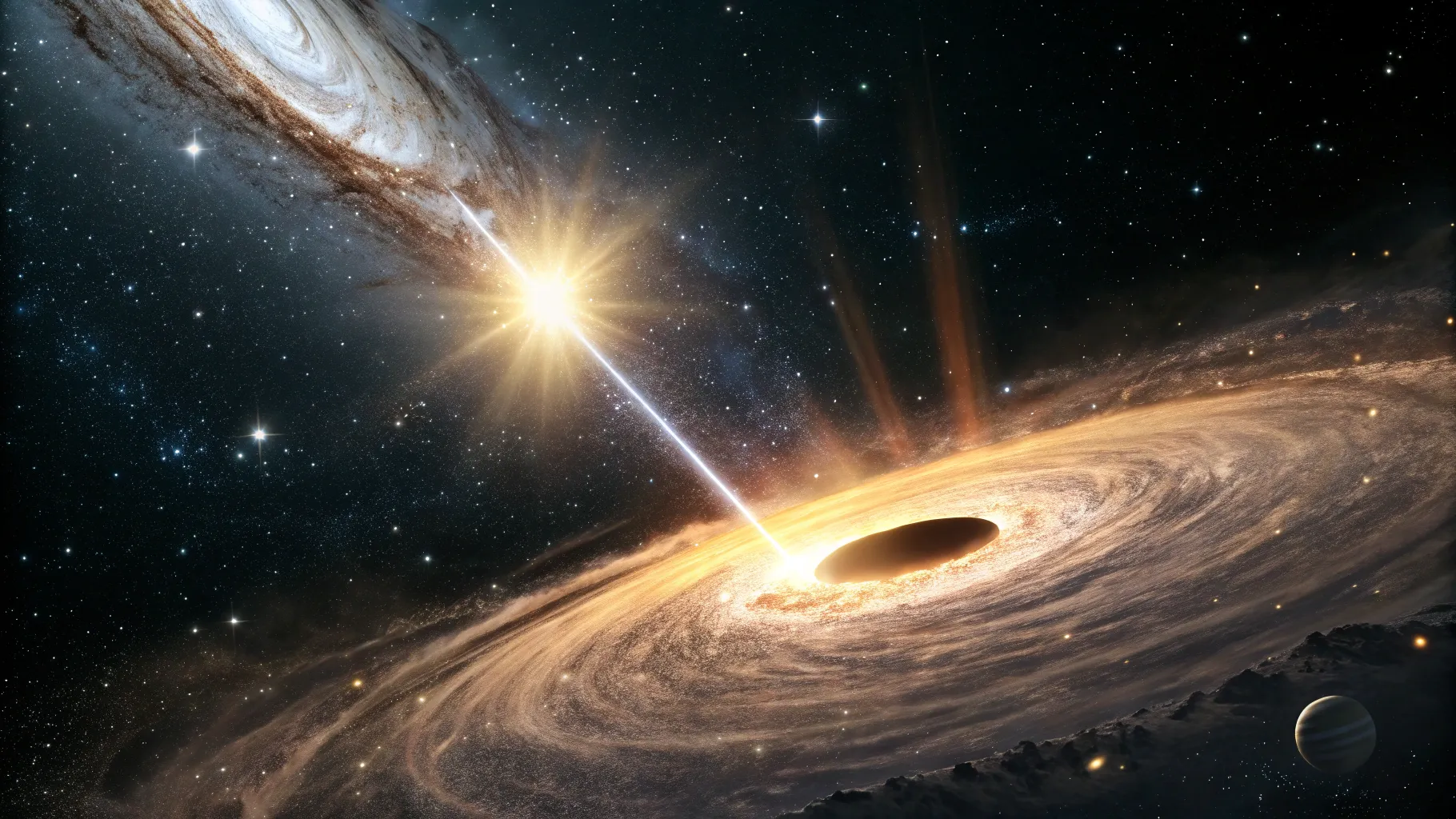
Black hole flares are sudden bursts of light and energy from the area around a black hole, not from the black hole itself. The outbursts often come from the accretion disk, where gas and dust heat up as they spiral inward. In some cases, flares can be tied to jets, which are narrow beams of particles shot out at near light speed.
Bright flares can occur when fresh material falls in, when magnetic fields snap and reconnect, or when a star wanders too close and gets torn apart. Each trigger leaves a signature pattern in light across radio, optical, X-ray, and gamma-ray bands.
Why This Signal Matters
Calling it the brightest flare yet sets a new mark for intensity. Events of this scale help test the limits of models that predict how energy is released near a black hole. If the flare outshines past records by a wide margin, researchers will look for clues in timing, color, and polarization.
Brightness alone is not the whole story. The rise and fall of the light curve, the presence of fast flickers, and any delay between wavelengths can show where the flare formed. A jet-driven flare often peaks in high-energy bands and can stay bright for days or weeks. A disk flare might rise and fade faster.
Possible Origins Under Review
- Accretion surge: A sudden inflow of gas can heat the inner disk and trigger a sharp burst.
- Magnetic reconnection: Twisted field lines can snap and release energy in quick flashes.
- Tidal disruption event: A passing star can be shredded, feeding the black hole in a bright surge.
Each scenario would imply different follow-up tests. For example, a tidal disruption often shows a steady cooling trend and can produce long-lasting emission. Magnetic events can create rapid spikes. An accretion surge may sit between those extremes.
How Scientists Will Verify the Record
Teams will compare the flare with past catalogs to confirm that it tops earlier events. They will check for instrument saturation, calibration issues, and background effects. Cross-checks with other telescopes help rule out false alarms.
If the source is active in radio, interferometers can map jet features. X-ray instruments can gauge the hottest regions. Optical spectrographs can look for broadened lines that mark fast-moving gas. Together, these data can trace the path of matter and energy near the event horizon.
Implications for Black Hole Physics
A verified record-setting flare could press current theories on efficiency, which sets how much light a black hole’s feeding process can produce. If the efficiency looks higher than expected, models of disk structure or jet formation may need updates. It could also point to special viewing angles that make the event appear brighter.
For cosmology, a bright, distant flare can act as a probe of gas between galaxies. For galaxy studies, it can show how central black holes affect their neighborhoods by heating and stirring gas.
What Comes Next
Researchers are likely organizing a multiwavelength campaign to watch the flare fade. Early results will focus on timing and spectral changes. Later, teams may publish detailed modeling that weighs the three main scenarios.
The community will watch for repeat activity. A one-off blast points to a tidal event. Recurring flares suggest cycles in the disk or jet. Either path offers new tests for high-energy astrophysics.
The latest sighting sets a clear target for follow-up and careful verification. If confirmed as the brightest yet, it will sharpen theories of how black holes light up the universe and guide future surveys designed to catch the next big outburst.

Senior Software Engineer with a passion for building practical, user-centric applications. He specializes in full-stack development with a strong focus on crafting elegant, performant interfaces and scalable backend solutions. With experience leading teams and delivering robust, end-to-end products, he thrives on solving complex problems through clean and efficient code.