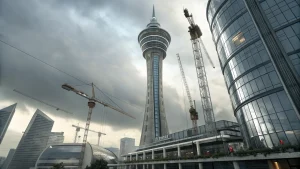
Rising from the Texas plains is a colossal $50 billion microchip factory that represents one of the most expensive and complex projects in US history. This isn’t just a factory—it’s America’s front line in the global chip race. But before it even came to life, it’s already failing.
As someone who has followed the semiconductor industry closely, I find this story unlike anything I’ve ever seen. What’s happening in Taylor, Texas should concern everyone because the future of AI and our entire global economy depends on it.
Samsung’s Fall From Grace
A decade ago, Samsung was unstoppable. As the second largest chip maker on the planet, they were the only company keeping pace with Taiwan’s TSMC. Their dominance in memory chips was legendary, from DRAM in every server and smartphone to NAND that stores the world’s data.
They also built logic chips for the first Apple iPhones, NVIDIA’s early GPUs, and Tesla’s first autopilot computer. By 2015, Samsung stood right behind TSMC after mastering the 14nm process. For a moment, it looked like they might overtake them.
Then everything turned. Apple became a direct rival, and trusting Samsung to build iPhone chips was like asking your enemy to sharpen your sword. Apple left, moving all chip production to TSMC—a foundry that built chips for everyone but competed with no one.
Internal problems mounted. Unlike TSMC, Samsung was pulled in multiple directions:
– Building logic chips
– Manufacturing memory
– Producing displays
– Creating smartphones
Their 10nm process slipped behind schedule. Yields crashed to around 40%. One by one, major customers walked away—NVIDIA, Qualcomm, Tesla. Each loss drained billions of dollars and confidence.
The Texas Gamble
In 2021, Samsung made an unexpected move: building a $17 billion chip factory in Taylor, Texas—announced as the most advanced semiconductor factory ever built on US soil. The location seemed perfect: close to Tesla, Qualcomm, and Google, surrounded by a tech scene hungry for AI silicon.
The plan looked simple: break ground in 2021, start 4nm microchip production by 2024, then push toward 2nm. But Samsung made a fateful decision that turned a controlled build into chaos—pivoting from 4nm to 2nm technology.
This single change meant new tools, new recipes, and a steep learning curve. The original $17 billion budget ballooned to $50 billion, pushing the schedule out and the budget through the roof.
Engineering at the Atomic Level
Building a chip factory isn’t just engineering—it’s choreography at the atomic level. The soil under Taylor looks calm from above, but it’s caliche: hard, dry, and uneven. When you’re printing transistor features smaller than a human eye can see, even the tiniest vibration can destroy everything.
Samsung went to war with the ground itself, building one of the most extreme foundation systems ever created for a semiconductor fab. They drilled more than 20,000 shafts, each about 110 feet deep, and filled them with over half a million cubic yards of concrete.
The result is a building within a building—a floating floor that absorbs every shock before it reaches chipmaking tools. This system cancels not just tiny earthquakes, but the rumble of trucks, the hum of cooling systems, and even tremors from the Pacific Rail next door.
At 2nm, even a tiny vibration is the difference between success and a multi-million dollar failure.
The Power and Water Challenge
A semiconductor fab burns energy like an entire city—hundreds of megawatts consumed 24/7. Taylor was about to plug into one of the most unstable power grids in America. In 2021, a single winter storm froze Texas’s isolated electrical system and plunged millions into darkness.
Samsung had to build a power grid inside the grid, with dual high-voltage lines so the fab could draw power from two independent sources. Every power source was backed up so even if the state grid blinked, the fab would never notice.
Water presented another challenge. The factory consumes around 15 million gallons daily—five times more than the entire city of Taylor. Samsung built a water factory beside the chip factory that draws from one of Texas’s largest underground water systems.
The Human Element
Despite all these engineering feats, what really makes or breaks a fab is the people who run it. Samsung flew in hundreds of engineers from Korea while hiring and training local teams across Texas. The problem? They’d never built a 2nm fab before, even back home in South Korea.
Meanwhile, TSMC in Arizona had a key advantage: they first perfected their 2nm manufacturing process at their main fab in Taiwan, then brought that experience to America. TSMC started from experience; Samsung had to reinvent everything.
Running multi-million dollar machines isn’t about default settings—it’s about coordination, intuition, and trust. Those things can’t be imported or rushed.
A Lifeline From Tesla
When everything seemed lost, Tesla stepped in with a $16.5 billion deal running through 2033. Samsung committed to manufacture Tesla’s next-generation AI6 chip right in Texas.
For Tesla, this decision was strategic. They wanted:
– A dedicated production line
– A factory focused on their design without competing with Apple or NVIDIA for priority
– Control to send engineers into the cleanroom to tweak parameters in real time
– Proximity (Taylor sits half an hour from Tesla’s Austin headquarters)
Samsung offered what TSMC couldn’t: exclusivity and local production. In return, Samsung got what it desperately needed—an anchor customer.
Production of AI6 is expected by 2028, ramping to full capacity by 2030. For Samsung, it’s a lifeline. For Tesla, it’s still a risky gamble—if yields fail, this partnership could collapse before it begins.
Taylor was meant to be the next chapter in America’s chip comeback, proof that the US can match Asia’s precision. Instead, it became a warning: even with billions to spend, you can’t simply copy excellence. It’s also a glimpse of how far ahead TSMC is and how much of our technological future still depends on them.
Frequently Asked Questions
Q: Why did Samsung choose to build this factory in Texas?
Samsung selected Taylor, Texas due to its strategic location near major tech companies like Tesla, Qualcomm, and Google. The area offered vast, flat, and geologically stable land far from earthquakes or floods—ideal for massive clean rooms and sensitive equipment. Additionally, building in the US positioned Samsung closer to its biggest North American customers while demonstrating that advanced chipmaking could thrive on American soil.
Q: What makes manufacturing 2nm chips so difficult compared to older technology?
At 2nm scale, transistors change fundamentally. They use a radical new “gate-all-around” design with horizontal nanosheets just a few atoms thick. Manufacturing requires atomic-level precision where even microscopic vibrations can ruin entire batches. The smaller scale means stricter requirements for water purity, air quality, and environmental stability. Even a single particle of contamination or momentary power fluctuation can destroy millions of dollars in chips. This extreme precision is why only a handful of companies worldwide can attempt production at this scale.
Q: How does TSMC maintain its lead over competitors like Samsung?
TSMC maintains its lead through singular focus—they only manufacture chips for others without competing with their customers. This creates a virtuous cycle: top customers like Apple and NVIDIA trust TSMC, bringing more data and revenue, which funds R&D to improve processes, which attracts even more customers. TSMC also perfects manufacturing processes at their main facilities in Taiwan before transferring that knowledge to new locations. Their consistent high yields (around 90% working chips per wafer) make them the most reliable and profitable option for advanced chip production.
Q: What’s the significance of the Tesla deal for Samsung’s Texas factory?
The $16.5 billion Tesla deal provides Samsung with an anchor customer—essential for calibrating and optimizing the factory’s processes. Without a steady flow of wafers from a major customer, a chip factory struggles to improve yields and efficiency. For Tesla, the partnership offers dedicated production capacity for their next-generation AI chips without competing for priority with other companies. The deal potentially saves the Taylor facility from failure while giving Tesla direct control over their chip supply chain, with their headquarters just 30 minutes away.
Q: Could the US ever achieve semiconductor independence from Taiwan?
Complete semiconductor independence would be extremely difficult. The Taylor factory story shows that even with massive investment, replicating TSMC’s expertise isn’t simply about building facilities—it requires decades of institutional knowledge, specialized talent, and manufacturing excellence. While the CHIPS Act and new factories from Intel, TSMC, and Samsung will increase US production capacity, the most advanced nodes will likely remain concentrated in Taiwan for years to come. True independence would require not just factories but rebuilding entire supply chains for materials, chemicals, and specialized equipment—a process that would take decades rather than years.