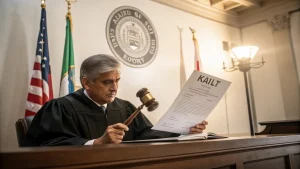
JD Vance, the U.S. Vice-President, has questioned the authority of federal judges to challenge the executive branch’s actions. His comments came after a judge temporarily blocked members of President Donald Trump’s newly created advisory body, the Department of Government Efficiency (DOGE), from accessing sensitive Treasury Department systems. The Trump administration is facing numerous legal challenges, including more than two dozen lawsuits, as it seeks to dramatically reshape the federal government.
Federal judges have issued temporary blocks on several of Trump’s executive orders, which Democrats argue exceed his constitutional authority. Senator Chris Murphy, a Democrat, suggested that Trump’s cost-cutting measures, including cuts to the main overseas aid agency USAID, amounted to “the most serious constitutional crisis the country has faced, certainly since Watergate.”
In a social media post, Vance cited examples of executive branch decisions that he argued were outside the courts’ jurisdiction. “If a judge tried to tell a general how to conduct a military operation, that would be illegal,” he wrote.
Vance’s challenge to judicial authority
“If a judge tried to command the attorney general in how to use her discretion as a prosecutor, that’s also illegal.”
Former Republican House representative Liz Cheney responded to Vance, stating that if the administration believes the courts have exceeded their authority, their recourse is to appeal, not to “rage-quit the Republic.”
The case against DOGE’s access to the Treasury was filed in federal court in New York City. It alleges that the Trump administration violated federal law by allowing Elon Musk’s team access to the department’s central payment system, which handles tax refunds and social security benefits, and contains a vast network of Americans’ personal and financial data.
Experts and officials have expressed alarm at Vance’s comments, with some suggesting that the administration is preparing to ignore court orders. Critics argue that Vance’s view goes against the Constitution and Supreme Court precedent, citing the 1803 ruling in Marbury v. Madison, which established the principle of judicial review in the U.S.
With Republican control of both houses of Congress and a muted protest response to Trump compared to his past term, the federal courts are seen as the most likely venue where Trump’s policies may face challenges.
The real question, according to former White House counsel Jonathan Riles, is whether the courts’ decisions will have much effect on Trump, unless the Supreme Court intervenes.

Noah Nguyen is a multi-talented developer who brings a unique perspective to his craft. Initially a creative writing professor, he turned to Dev work for the ability to work remotely. He now lives in Seattle, spending time hiking and drinking craft beer with his fiancee.