AI is no longer just a buzzword; it’s now a fundamental shift in how companies build products and software.
For SaaS founders, this means new opportunities, faster launches, and more efficient development cycles. But it also means rethinking how teams work, how products are scoped, and what technical expertise even means in a world where machines write code.
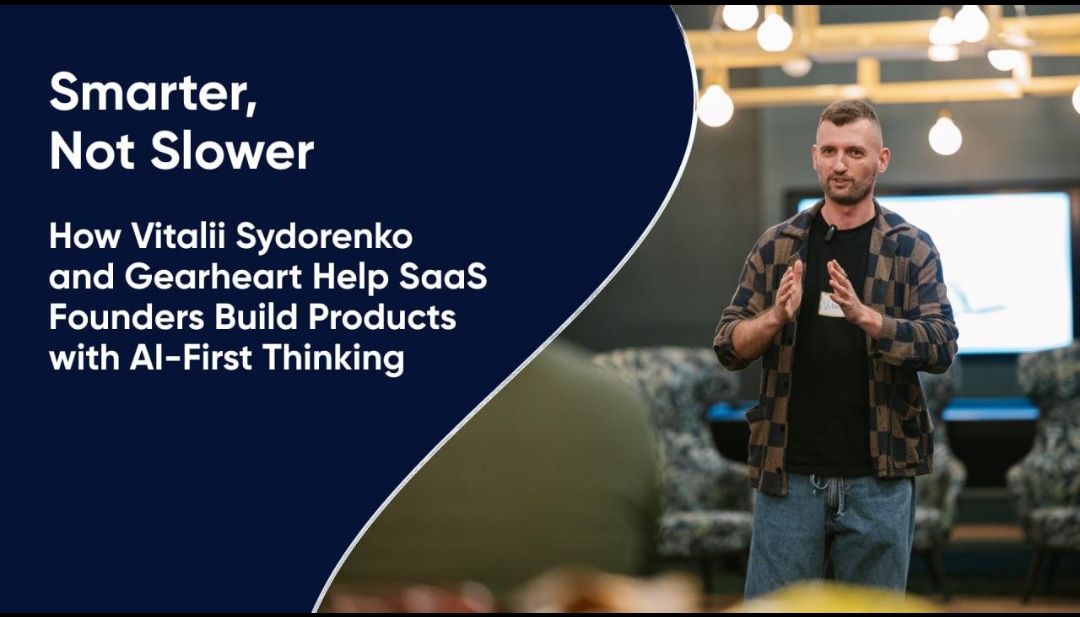
Serial entrepreneur Vitalii Sydorenko knows this shift from both sides. As a founder who built and scaled several SaaS products, and now as CBO and partner at Gearheart, he helps other entrepreneurs turn their ideas into working platforms. His team doesn’t just build software. They rethink how software gets built using AI from the inside out.
The Growing Role of AI in SaaS Development
AI is quickly expanding into every area of our lives. And the biggest challenge today is understanding how to use it effectively.
“The main thing AI brings to product development is speed, which means lower costs. With tools like Cursor and Copilot, developers write code faster, save engineering hours, and for founders, that means saving money. As a result, building products is becoming more accessible. I believe we’re about to see a rise in super-niche SaaS tools that serve very specific needs of very specific audiences. These used to be too expensive to build for such small markets. For example, instead of a generic CRM for small businesses, we’ll see a CRM made specifically for distributed design teams of 10 people.”
Vitalii says AI also requires a mindset shift. Especially for people working in tech — product builders, startup founders, and even big tech companies. Traditional programming is binary: a function works, or it doesn’t. But AI can hallucinate. Even if it’s just 10% of the time, that’s still significant. And we need to learn how to work with that.
“No matter what prompts or checks you use, compared to traditional code, AI has a high chance of hallucinating — just randomly doing something completely wrong. That’s why companies like Apple are so cautious with AI assistants. They can’t afford to ship a feature that works only 90% of the time. Imagine your AI assistant mixing up flight reminders or sending a message with the wrong tone to the wrong person. That’s not acceptable in their ecosystem.”
Vitalii Sydorenko’s Insights: How Gearheart Integrates AI in SaaS Development
When Vitalii joined Gearheart as a partner and CBO, he brought a new approach to how development services are delivered, rooted in product thinking, founder needs, and the ways AI is reshaping SaaS.
That mindset came from building his own startups, starting at the age of 22. Among them is LOOQME, a media monitoring platform that became the market leader in Ukraine with a 40% share and over 300 clients, including McDonald’s, Samsung, Deloitte, and Lenovo. Vitalii successfully exited the company. He later founded Jiffsy, a mobile-first storefront with AI-powered recommendations. With Jiffsy, he joined one of Europe’s top accelerators Startup Wise Guys, raised funding, and received a grant from Google.
“My mission now is to bring more than 10 years of product-building experience to help founders build better products, avoid painful mistakes, and go through the startup journey faster. At Gearheart, we understand how AI is changing development, so we’re building new processes — not just continuing traditional outsourcing models.”
Under Vitalii’s leadership, together with his partners Volodymyr Sydorenko (Gearheart’s founder) and Mykola Voronkin (COO), the studio now positions itself as an AI-powered product development studio built by founders, for founders.
This is reflected in the structure of operations, the way development is conducted, and the products the team builds.
“Our engineers now use Cursor and Copilot to speed up coding on routine SaaS tasks. We’re not talking about complex architectural decisions here — just the kinds of tasks you’d usually assign to junior developers. On average, this saves about 30% of time, which reduces dev costs for our clients. The faster we build, the faster founders can show their product to the market. It’s a win-win.”
Internal Platforms
Gearheart has also built its own internal platform Basement, which covers about 80% of the foundational work any SaaS needs. Every SaaS product starts with the same basic things: login flows, payment systems, dashboards, admin panels, user emails, background jobs, health checks, real-time updates, etc. Gearheart has already built reusable components for these, so clients don’t pay for reinventing the wheel, and save about $10,000 at start.
“Our Basement platform is a powerful tool that saves around 80 development hours and thousands of dollars for our clients. Plus, we eliminate hidden subscription costs for tools like Auth0, Kinde, Inngest, Filestack, Uploadcare, SendGrid, and more. Now we’ve also integrated LLMs into the platform, because every new SaaS product today includes some kind of AI feature. So far, we haven’t seen anything similar on the market, and we believe this is a significant step toward accelerating product launches.”
New Value
Vitalii also brought AI into internal studio operations, improving how the team works and increasing the value delivered to clients.
“To help founders get estimates 10x faster, we’re building an internal AI tool that automatically creates project proposals based on the information clients share. This way, we’ll automate the work of several departments at once, since in the early stages of handling requests and preparing proposals, multiple experts are usually involved. I’ve already connected my AI note-taker (which I use on client calls) to our CRM and project management tools. The info automatically flows into the right places and is picked up by the right expert. It saves us hours and helps our clients move faster. We also generate mockups of key product sections using AI, which speeds up the scoping process.”
Vitalii even initiated a process across the studio where every team member lists their repetitive tasks to identify what can be automated. He got the idea from a podcast guest who used a similar approach for optimization. The goal is to free up time for more valuable work.
Tasks SaaS Founders Are Automating with AI
Today, integrating AI into a SaaS product is almost expected. Vitalii highlights five key areas where AI is making an impact: automation, personalization, prediction, customer support, and data analytics.
For example, Zapier AI can now connect the tools a user works with and create workflows automatically — no need to manually set up CRM and to-do list integrations. A simple prompt in plain language is enough.
Notion AI handles personalization, suggesting templates, content blocks, and workflows based on your habits.
Salesforce Einstein is great at predictive analytics in sales, forecasting outcomes, and flagging high-potential deals.
AI is also a perfect fit for customer service. What used to be done by human support reps is now handled by AI using knowledge bases, chat context, and request history. Tools like Intercom Fin AI are leading this category. Human input is still needed sometimes, but that share is shrinking.
Analytics
In analytics, Mixpanel Signal analyzes user behavior in your product, what they click, where they go, and shows what actions lead to conversions.
“At Gearheart, we also integrate AI features like these into our clients’ products. For example, we built a risk management platform called ICE for bababos, a supply platform for SME manufacturers. AI in ICE acts like a financial analyst — analyzing financial docs based on prompts and generating reports and insights to support key decisions. Overall, it was a powerful, technically complex, and interesting project. The client team was great to work with, and it was especially nice to receive positive feedback on our collaboration.
Another project (whose name is confidential under NDA) is a tool that helps Amazon sellers improve performance. The AI component collects reviews, analyzes them, and generates summary insights the seller can use to grow sales.
Right now, we’re also building a global HR platform for managing remote teams. We’ve integrated a chatbot that pulls from the knowledge base and context to answer user questions quickly and effectively.”
Impact on Product Teams: The Future of Collaboration
Product teams now need to level up their AI skills, especially around using AI tools for writing code. Vitalii points out that using Cursor, for example, is no longer optional at Gearheart — it’s part of the process. These tools have a learning curve. And everyone who’s used to traditional development has to keep learning and evolving.
“We’ve built a system of continuous learning and knowledge sharing inside our team. We don’t just give developers licenses. Their job now includes staying up-to-date with new tools, sharing best practices internally, and using AI to help build the next generation of products.”
Vitalii also notes that AI tools are starting to replace the need for junior developers in the traditional way of thinking. Where mid and senior engineers used to supervise juniors, they now supervise AI tools, which are much faster. Gearheart has always worked with only mid and senior engineers, so they’re not directly affected, but this shift opens a wider question for the whole industry.
“There’s a real issue — how do juniors become seniors if they’re no longer needed? I think the structure will change. Juniors will work with AI, supervise its output, and seniors will supervise the juniors. In the end, we may see a new kind of developer — one who doesn’t write simple code anymore because AI does it, but who understands logic, architecture, and deeper systems. And that’s what really matters.”
New Jobs
AI, like any revolutionary technology, isn’t about cutting jobs; it’s about transforming them and creating entirely new ones. There’s a common rule in product development: every breakthrough, no matter how game-changing, inevitably brings new challenges.
Take the first iPod as an example. It was a massive leap from CD players, letting users store entire music libraries in their pockets. But it also created new problems: how to download and manage music efficiently, how to buy individual songs instead of full albums, how to sync content across devices. That, in turn, led to an entirely new ecosystem — digital music platforms, mobile apps, and new roles built around them.
“The same applies to AI. Yes, it automates many routine coding tasks, but it also introduces a new set of challenges that demand fresh expertise. Roles like prompt engineering, AI reliability management, and model optimization are emerging as a response. Think back to the early days of SaaS — there was no such thing as a Product Manager. Now, you can’t imagine a product team without one. AI isn’t replacing jobs, it’s reshaping them.”
The Pros and Cons of Using AI in Development
Speed, lower costs, and more focus on strategy — these are real advantages AI brings to development. But it’s important to stay cautious and avoid blindly relying on AI.
“Let’s not forget that AI isn’t 100% accurate. Hallucinations aren’t going anywhere anytime soon. It’s easy to get caught up in the wow-effect when things feel fast and magical. But if you stop paying attention, it breaks. AI isn’t all-powerful. You still need human expertise and supervision. Otherwise, in a few years, we’ll be flooded with low-quality products that only work 50% of the time.”
What This Means for SaaS Founders, Their Development Teams, and The Industry
AI is already reshaping technical work. It makes developers’ lives easier and gives founders a clear advantage. But building a great SaaS product is still more about product thinking. And that’s something AI can’t replace, at least not yet.
Tools like Cursor and Lovable can help generate code. But they don’t understand user logic, product architecture, or UI. For now, that’s still up to us.
At the same time, the industry is clearly shifting. The US IT sector has led every major tech wave from PC software and SaaS to mobile, and now AI is the next frontier. This time, it’s not just about creating the new technology; it’s about mastering its adoption.
Gearheart is helping drive that shift. Their AI-first product development model gives founders leverage AI efficiently in products, while avoiding common mistakes and waste.
“We’re not just building software; we’re building the future of software development. By helping SaaS founders adopt AI responsibly and strategically, we’re ensuring the US tech sector remains agile, innovative, and competitive on the global stage.”
By embracing AI and its transformative power, the industry won’t just preserve jobs — it will create entirely new opportunities, just as it has with every major technological shift before.
Featured Image source

Senior Software Engineer with a passion for building practical, user-centric applications. He specializes in full-stack development with a strong focus on crafting elegant, performant interfaces and scalable backend solutions. With experience leading teams and delivering robust, end-to-end products, he thrives on solving complex problems through clean and efficient code.