Today, the primary reason many companies turn to outsourced Salesforce support services is to enhance their customer relationship management (CRM) systems. However, outsourcing may not always be the best choice for every business. According to LinkedIn, there are over 810,000 Salesforce professionals in the United States alone, including 360,000 who are actively seeking new opportunities. This means businesses may have access to a vast talent pool to manage their Salesforce support internally.
This can offer better control, enhanced data security, and ensure the service meets your company’s unique needs. As Nicholas Bloom, an economist at Stanford University and an expert in workplace matters, told the Wall Street Journal, “About 10% to 20% of U.S. service support jobs, like software developers, human-resources professionals and payroll administrators, could move overseas in the next decade.” This highlights a growing trend in outsourcing, but it also raises the question: Is outsourcing the right move for your business, or would keeping Salesforce support in-house give you more control and security? This article highlights seven signs that indicate outsourcing Salesforce support may not be the right option for your business.
Understanding Salesforce Support Services in a Nutshell
Salesforce is a powerful customer relationship management (CRM) platform that enables businesses to manage customer data, track sales, and deliver enhanced customer service. However, to get the most out of Salesforce to its full potential, requires more than just the initial setup. It involves constant monitoring, troubleshooting, customization, and optimization. This is where Salesforce support services come in as they help businesses maintain and enhance their Salesforce systems, covering a range of needs, including:
- Addressing technical issues
- Providing custom development and integration support
- Offering strategic advice on how to maximize the platform’s features
For businesses that lack the internal resources or expertise to manage Salesforce effectively, outsourced Salesforce support services can be a viable solution. By partnering with third-party vendors, organizations can access expert assistance without the need to hire additional in-house staff. Outsourcing Salesforce support can offer a range of benefits, including cost savings, access to specialized skills, and the ability to scale resources as needed. In fact, 74% of businesses report that CRM software has significantly improved their access to customer data.
However, while outsourcing Salesforce support can be beneficial in many cases, it may not always be the best option. Certain signs indicate businesses should carefully consider whether outsourcing Salesforce support is the right choice for their specific needs.
Signs Your Business Shouldn’t Opt for Outsourced Salesforce Support Services
Outsourcing Salesforce support isn’t always the right move, especially as your business scales. If any of these warning signs sound familiar, keeping support in-house might save you time, money, and headaches:
1. You Have Highly Specialized Needs
Businesses that operate in highly specialized industries may require a level of customization in Salesforce that external support providers cannot easily accommodate. For example, a healthcare company may need Salesforce customizations to comply with HIPAA regulations, or a retail company might need specific integrations with an inventory management system.
In such cases, having a thorough understanding of industry-specific requirements is crucial. And outsourced Salesforce support services may lack the necessary expertise to address such unique needs effectively. Instead, businesses with highly specialized requirements may benefit more from an in-house team familiar with the company’s processes and industry nuances. Outsourcing could lead to errors or missed opportunities for optimization, which can hinder the overall effectiveness of the Salesforce platform.
How to Mitigate This And Make Salesforce Support Outsourcing Work for You:
- Start by selecting an outsourcing partner with proven domain expertise and a track record in your highly specialized field.
- Clearly define your industry-specific regulations, integrations, and compliance requirements from the outset to ensure a seamless process.
- Develop robust documentation and conduct in-depth knowledge transfer sessions to ensure the provider fully understands your processes.
- Establish a robust governance model, complete with regular performance reviews and open communication channels, to effectively monitor quality and compliance.
- Encourage collaboration between in-house experts and the outsourced team, leveraging their combined strengths for a seamless solution.
2. Your Team Prefers Direct Control
For businesses that value direct control over their Salesforce platform, outsourcing support can be really difficult. This is because managing an outsourced team often involves communication delays, the need for ongoing coordination, and challenges in adapting to changing requirements. On the other hand, an internal team has the ability to respond quickly, make adjustments as needed, and stay more aligned with the company’s specific goals.
When businesses require immediate feedback and faster decision-making, having an in-house Salesforce team offers greater agility. If the level of involvement and control is a must for your organization, outsourcing may not be the most efficient or effective option.
How to Mitigate This: Opt for Hiring a Dedicated Salesforce Support Specialist
- Opt for a dedicated Salesforce agent from an outsourcing partner who acts as an extension of your internal team.
- By committing a single point of contact, you ensure direct control and real-time collaboration, while still benefiting from broader external expertise.
- Equip this support agent with the necessary training, authority, and access to relevant stakeholders.
- Establish clear communication protocols with regular check-ins and well-defined escalation paths, ensuring swift adaptation to evolving requirements.
- Utilize shared project management tools or dashboards to monitor progress and ensure transparency.
This approach strikes a balance between outsourcing benefits and in-house responsiveness, enabling you to oversee and optimize Salesforce performance.
3. You Have Ongoing, Complex Integrations
Salesforce is often at the center of a company’s ecosystem, integrating with various other business systems such as accounting software, inventory management, and marketing platforms. These integrations can be complex and require constant monitoring and adjustments. For instance, 53% of SMB leaders report that data is often inconsistent across their business tools, which can lead to disruptions in workflows and decision-making.
If your business frequently updates its integrations or has a constantly evolving tech stack, it may be best to keep Salesforce support in-house. Outsourced teams may not always have the technical expertise or familiarity with your business’s specific integrations to manage them effectively. An in-house team, on the other hand, can handle ongoing integrations more efficiently, ensuring that all systems are working together seamlessly and minimizing the risk of disruption.
How to Mitigate This with Specialized Salesforce Integration Services
- Start by selecting an outsourcing partner with proven technical integration expertise for handling complex data flows.
- Provide thorough documentation and knowledge transfer about your existing systems, ensuring they fully understand the intricacies of your integrations.
- Establish collaborative workflows and define clear communication channels, including regular status updates or sprint reviews, to swiftly address unforeseen issues.
- Standardize integration processes with well-documented best practices, leveraging specialized tools or middleware to streamline monitoring and data validation.
- Employ rigorous testing strategies to confirm compatibility and performance before changes go live.
- Finally, maintain ongoing alignment with key stakeholders to ensure your outsourced team consistently supports evolving integration requirements.
4. Your Business Prioritizes Data Security
Data security is a significant concern for most businesses, especially those that handle sensitive customer information. In the case of Salesforce, protecting this data is vital, particularly as businesses collect and store valuable insights about their customers.
Outsourcing can result in significant cost reductions, but it also introduces cyber risks. As Micheline Al Harrack explains in Cybersecurity Risks in Outsourcing Strategies, businesses must consider whether these risks can be mitigated and at what cost. These risks are similar to the challenges faced in project management, including physical risks, insider threats, and development issues that can lead to project failures.
Salesforce outsourcing can sometimes raise concerns about data security, particularly when working with third-party vendors that may not have the same internal controls in place. For companies handling highly sensitive data, maintaining in-house control over data security is essential. Having an in-house team enables businesses to directly oversee data protection measures and ensure compliance with regulations such as the GDPR, CCPA, and other relevant data protection laws.
How to Mitigate This with Certified Salesforce Support Services
- Choose an outsourcing partner with robust security certifications and strict compliance protocols to diligently safeguard your Salesforce data.
- Conduct a thorough audit of their data handling processes, infrastructure, and certifications like ISO 27001 or SOC 2.
- Incorporate clear data protection clauses in your Service Level Agreement, outlining encryption standards, data retention policies, and breach notification procedures.
- Establish role-based access controls to limit data exposure to authorized personnel only.
- Regularly conduct security training and audits to ensure everyone remains vigilant against threats.
- Lastly, maintain continuous communication and reporting, giving you visibility into how data is handled, stored, and protected throughout the engagement.
5. Your Business Needs Rapid Response Times
One key advantage of outsourcing is scalability, but it can also bring some drawbacks. The first one that stands out is slower response times. When critical issues arise in Salesforce, businesses need prompt assistance to avoid operational disruptions.
Outsourced teams, particularly those working across different time zones, may not offer the rapid response times necessary to resolve urgent issues promptly. In-house teams can respond immediately, minimizing downtime and ensuring business continuity. Businesses that require swift action for technical support may find that having an internal team provides faster resolution times, leading to less operational risk.
How to Mitigate This by Establishing a Clear SLA
- Select an outsourcing provider that guarantees swift response times through dedicated support teams operating around the clock.
- Establish clear Service Level Agreements (SLAs) specifying exact turnaround targets, ensuring your partner is accountable for urgent, mission-critical requests.
- Complement these commitments with real-time communication channels, like instant messaging or dedicated hotlines, to expedite updates and approvals.
- Provide your outsourced team with comprehensive documentation, robust onboarding, and consistent knowledge transfer, allowing them to troubleshoot efficiently.
- Implement regular performance reviews, tracking response times, and resolution metrics to maintain quality.
- By prioritizing speed and accountability, you gain agile support without sacrificing the benefits of technical support outsourcing.
6. Your Team Has Strong Salesforce Expertise
For companies with in-house teams that are already highly proficient in Salesforce, outsourcing becomes less necessary. An internal Salesforce expert can quickly identify and resolve issues, customize the system according to specific business needs, and work directly with other departments to optimize the CRM.
If your team already possesses the necessary skills and experience to manage Salesforce effectively, outsourcing may add little value and could be an unnecessary expense. By leveraging the expertise within your organization, you can enhance system efficiency without relying on external parties.
How to Mitigate This with Mapping Salesforce Skills
- Begin by identifying specific gaps or advanced skill sets that complement your in-house Salesforce expertise. For instance, if your team manages day-to-day maintenance but lacks specialized knowledge of complex integrations or emerging features, selectively outsource those aspects.
- Ensure the outsourcing partner aligns with your established workflows and technical standards, providing onboarding and knowledge-sharing sessions.
- Define clear project scopes, goals, and acceptance criteria to maintain high quality while establishing a governance structure to monitor performance.
- Maintain open communication channels and schedule regular touchpoints to facilitate seamless collaboration.
- By strategically leveraging external expertise, you reinforce your team’s strengths and accelerate Salesforce innovation.
7. You Are Facing Budget Constraints
While outsourcing can seem like a cost-effective option, it can sometimes be more expensive than initially anticipated. Hidden costs, such as additional fees for customizations, training, or scaling support, can quickly add up. For companies operating on a tight budget, these unexpected expenses can strain resources.
In such cases, maintaining an in-house team may be more cost-effective in the long run. While hiring internal staff requires investment, it can reduce ongoing expenses related to outsourcing. Moreover, with an internal team, businesses can avoid paying for services they don’t need and can focus their budget on more critical areas of the business.
How to Mitigate This with Flexible Part-Time Support Specialists
- Consider a part-time engagement model with an outsourcing provider that can align services to your specific budget constraints. Look for partners offering fractional or on-demand Salesforce experts, allowing you to pay only for the hours or skill sets needed.
- Begin by outlining your key objectives and scaling engagements based on demand, prioritizing high-impact tasks first.
- Maintain open communication with the provider, scheduling frequent check-ins to monitor progress and spending.
- By ensuring clarity on deliverables, you can quickly pivot if budget or priorities shift.
- Ultimately, this modular, part-time approach conserves resources while providing access to the Salesforce expertise you need.
What to Do Instead: In-House vs Outsourcing
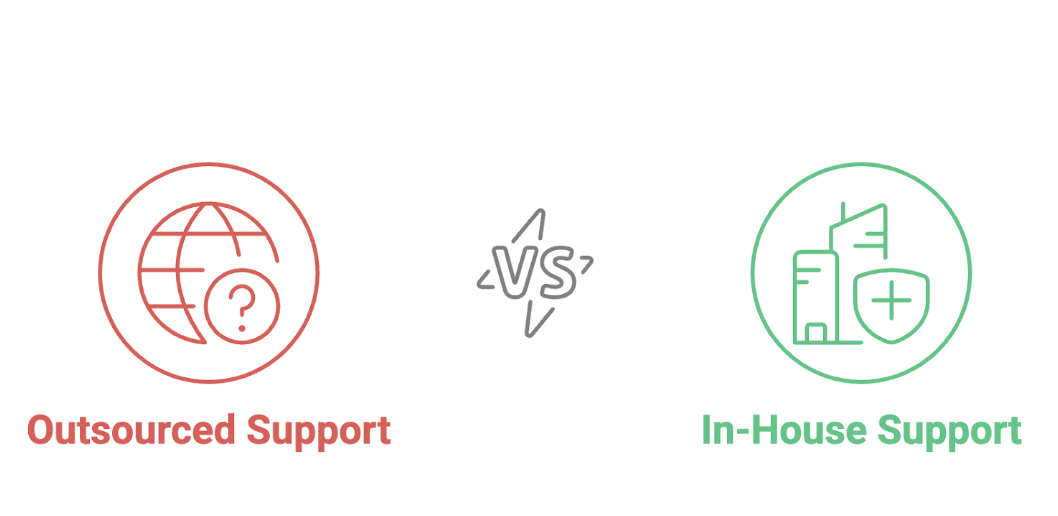
When deciding between in-house support and outsourcing, it’s essential to evaluate the pros and cons of both options. In-house support enables complete control over Salesforce, ensuring the team is always aligned with the company’s needs. It provides flexibility, rapid response times, and the ability to make quick adjustments to the system.
On the other hand, outsourced Salesforce support services offer scalability, access to expertise, and a reduction in operational costs. For businesses that don’t require continuous customization or constant monitoring, outsourcing can be an ideal solution. However, companies with complex needs, a highly specialized team, or data security concerns may benefit more from handling Salesforce internally. Below, you can see a comparison table on this matter, which highlights the key differences between in-house support and outsourcing.
| Factor | In-House Support | Outsourced Support |
| Control | Full control over Salesforce customization | Limited control; vendor-dependent |
| Flexibility | Quick adjustments and rapid response times | Standardized processes; slower adaptations |
| Cost | Higher upfront costs (salaries, training) | Lower operational costs (pay-as-you-go) |
| Expertise | Deep knowledge of company-specific needs | Access to broad external expertise |
| Security | Better for sensitive data (direct oversight) | Potential third-party risks |
| Scalability | Requires hiring/training for growth | Easily scalable (vendor handles staffing) |
| Best For | Complex needs, high security, customization | Standardized needs, cost-sensitive businesses |
In-House vs. Outsourced Salesforce Support
Summary
Outsourcing Salesforce support can be a suitable option for many businesses, but it may not be the best choice for everyone. If your company has unique needs, values direct control over the system, or requires rapid response times, in-house support may be more effective. Additionally, if your team already has strong Salesforce expertise or if your setup is complex, managing it internally could save time and reduce risks. Take a closer look at these factors to ensure your Salesforce system is properly supported and aligned with your business goals.
Author’s Bio
Dorian Sabitov is a Salesforce Consultant and Editor-in-Chief with six certifications. He currently works with SFApps.info as an Editor. Starting his career in 2020 as a CRM Administrator, Dorian quickly earned multiple Salesforce certifications and Superbadges. He also writes about cloud computing, development, and automation, offering practical insights and expert tips to help professionals stay ahead in the tech industry.

Dorian Sabitov is a Salesforce Consultant and Editor-in-Chief with six certifications. He currently works with SFApps.info as an Editor. Starting his career in 2020 as a CRM Administrator, Dorian quickly earned multiple Salesforce certifications and Superbadges. He also writes about cloud computing, development, and automation, providing real-world insights and tips to help professionals stay ahead in the tech industry.