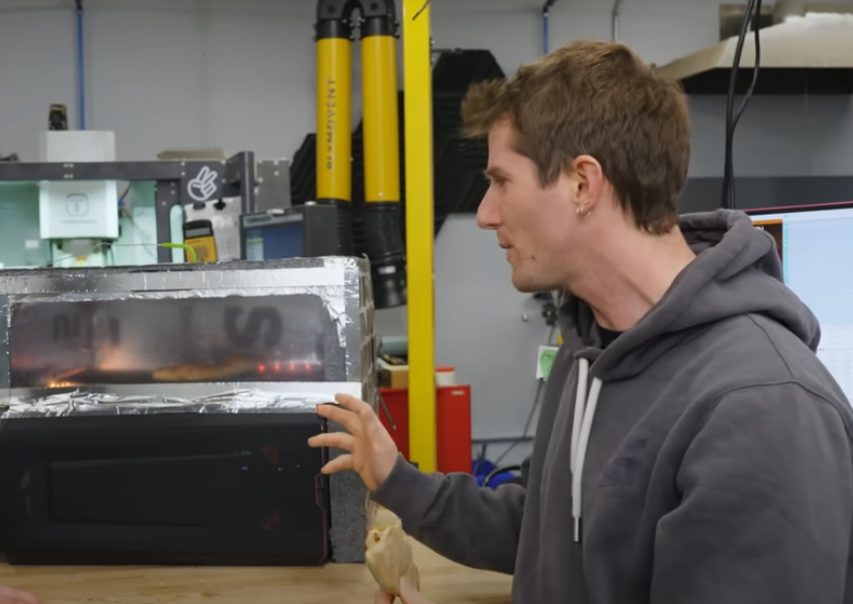
Eight years ago, a catastrophic misunderstanding led to one of the most criticized tech videos ever made – the infamous Pizza PC. Today, Linus Tech Tips shared how he finally achieved what was originally intended: a computer that actually keeps your pizza warm while gaming.
The original concept was simple yet poorly executed. Instead of creating a PC that maintained pizza temperature, he ended up with a cold pizza disaster that made everyone look foolish. But sometimes, failure breeds determination, and that’s exactly what happened here.
The Engineering Challenge
The mission was clear: redirect computer waste heat to maintain pizza at a food-safe temperature of around 140°F (60°C). This isn’t about heating cold pizza – it’s about maintaining the optimal temperature of a fresh pie while you’re deep in your gaming session.
The solution required several key components:
- A tower PC positioned on its side
- All-in-One (AIO) cooling for both GPU and CPU
- Custom radiator mounting to direct heat upward
- Foam insulation to contain the heat
- RGB-enabled acrylic panel for temperature monitoring
The Build Process
Working with Jordan and Justin, Linus transformed a standard PC case into a pizza-warming marvel. The most critical aspect was heat management – not just generating it, but directing it effectively. We created a custom chamber using laser-cut wood and acrylic, complete with 3D-printed brackets and a clever hinge system.
This system freaking works. Eight years ago, I knew it.
Performance Results
The data speaks for itself: After 35 minutes, the control pizza had cooled significantly, while the PC-warmed pizza maintained a near-perfect serving temperature. The pizza still glistened, and more importantly, remained within food-safe temperature ranges.
Key findings from testing:
- Control pizza lost approximately 3 degrees per minute
- Chamber pizza lost only 1 degree per minute
- Chamber maintained steady 65°C temperature
- System remained food-safe for the standard 2-hour serving window
Technical Considerations
While the system works remarkably well for pizza warming, it does come with some performance trade-offs. The CPU (13900K) does experience thermal throttling under full load, though the GPU (5090) maintains stable temperatures around 90°C. The key factor isn’t heat generation – we have plenty of that – but rather controlling airflow within the chamber.
Future Improvements
Looking ahead, there’s potential for even better performance. A louvered enclosure system could dynamically adjust based on component temperatures, allowing for optimal heat retention during idle states and proper ventilation under load. This would create a more efficient system that works across various usage scenarios.
This project proves that sometimes the best innovations come from revisiting past failures with new knowledge and better skills. What started as a notorious mistake has evolved into a functional solution for gamers who want their pizza to stay warm during extended gaming sessions.
Frequently Asked Questions
Q: Is this pizza-warming PC actually food safe?
Yes, the system maintains food at safe temperatures. Food safety guidelines allow for hot food to be held between 140°F (60°C) and cooling for up to two hours, which this system achieves effectively.
Q: Does the pizza-warming feature affect gaming performance?
There is some impact on performance, particularly CPU throttling under heavy loads. However, the GPU maintains stable temperatures, and the system remains functional for gaming while keeping your pizza warm.
Q: How long can the PC keep pizza warm effectively?
Testing showed the system can maintain pizza at serving temperature for at least 35 minutes, losing only about 1 degree per minute compared to 3 degrees per minute for pizza left in the open air.
Q: Can this system heat up cold pizza?
No, the system is designed specifically to maintain the temperature of fresh, hot pizza. It’s not intended to reheat cold pizza, as that wasn’t the original concept’s purpose.
Q: What makes this version better than the original attempt from eight years ago?
This version succeeds by properly directing and containing waste heat from the computer components, using custom-designed chambers, proper insulation, and temperature monitoring through RGB indicators. The original attempt failed to address these crucial elements.

Finn is an expert news reporter at DevX. He writes on what top experts are saying.