The world of home servers is a fascinating rabbit hole that I’ve been observing with equal parts admiration and bewilderment. While I understand the appeal of having a small server for basic needs like virtual machines or media streaming, I’m genuinely amazed at how far some enthusiasts take their home setups. I took some time to observe tech enthusiast, Linus Tech Tips’s, detailed youtube video on this topic. Here is what I gathered.
Scrolling through home lab communities online reveals an astonishing range of setups that blur the line between practical home use and full-blown enterprise infrastructure. Some of these setups aren’t just impressive—they’re absolutely mind-boggling in their complexity and scale.
From Modest Beginnings to Data Centers
Many home lab enthusiasts start with something simple—”I just want an NAS,” they say. But before long, that modest beginning transforms into racks of equipment that would make some small businesses jealous. The progression is almost predictable: one server becomes three, a simple switch becomes a complex network topology, and suddenly there’s a UPS system that could power a small neighborhood.
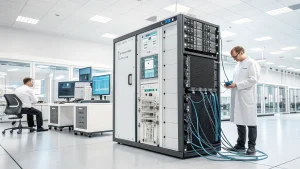
What strikes me most is the contrast between setups. On one end, there are beautifully organized racks with perfect cable management, custom soundproofing, and integration with home automation systems. On the other end, there are cobbled-together collections of hardware with zip ties everywhere and cables that look like digital spaghetti.
One particularly impressive setup featured custom soundproofing for silence, integration with home automation, and energy management systems—with servers running at a stable 30 degrees Celsius and completely inaudible.
But Why? The Question We’re All Asking
The burning question remains: what are people actually doing with these elaborate setups? Some use cases make perfect sense:
- Learning environments for IT professionals to test configurations
- Media servers and home automation hubs
- Machine learning and development environments
- Storage solutions for digital archives
However, many setups seem to exist primarily because their owners simply enjoy building and maintaining them. It’s a hobby—a passion project that combines technical skills with the satisfaction of creating something complex.
I’ve noticed a fascinating trend where many home lab enthusiasts are IT professionals who spend their days managing enterprise systems, yet come home eager to build more infrastructure. There’s something deeply satisfying about creating your own digital domain where you have complete control.
The Creativity Factor
Beyond the standard rack-mounted servers, some of the most interesting setups showcase incredible creativity. I was particularly impressed by:
- A custom-designed storage chassis with 56 drive bays
- 3D-printed mini racks for Raspberry Pi clusters
- A portable “mobile home lab” built into a rugged military-style case
- A setup using theatrical lighting truss to mount both servers and monitors
These projects go beyond practical computing needs and enter the realm of technical art. The Raspberry Pi clusters especially catch my eye—they’re not cost-effective compared to a single more powerful machine, but they’re compact, visually appealing, and perfect for learning distributed computing concepts.
When Enthusiasm Becomes Excess
At what point does a home lab cross into excess? I saw one setup with 7 terabytes of RAM and a 15,000-watt power requirement. The owner admitted that 75-90% of it remains powered off most of the time. Another enthusiast built a 48-node cluster in their garage on $20 shelves with $2 power strips.
These extreme examples raise questions about practicality, power consumption, and whether there’s a point of diminishing returns. The line between “because I can” and “because I should” gets increasingly blurry.
The Community Aspect
What’s clear is that home labs aren’t just about the technology—they’re about community. Enthusiasts share their builds, troubleshoot problems together, and inspire each other to try new approaches. There’s a certain camaraderie in showing off your latest configuration or custom solution.
While I might question the necessity of some of these elaborate setups, I can’t help but respect the passion, knowledge, and creativity they represent. Whether it’s a modest NAS or a mini data center, home labs reflect their creators’ technical interests and problem-solving abilities.
For those considering diving into this world, remember that you don’t need enterprise-grade equipment to learn and experiment. Start small, focus on what you actually need, and let your setup grow organically with your skills and interests. And maybe go easy on the zip ties.
Frequently Asked Questions
Q: What is a home lab and why would someone want one?
A home lab is a personal collection of computer hardware used for experimenting, learning, and running various services. People build them to gain hands-on experience with technologies, host personal services like media servers or websites, back up important data, or simply as a hobby to explore computing concepts outside of work.
Q: How much does it typically cost to start a basic home lab?
You can start a basic home lab for as little as $200-300 with a used small form factor PC or single-board computer like a Raspberry Pi. More elaborate setups with proper server hardware, networking equipment, and storage can quickly reach thousands of dollars. Many enthusiasts build their labs gradually over time, often using second-hand enterprise equipment.
Q: What software do most home lab enthusiasts use?
Proxmox is particularly popular in the home lab community as a free, open-source virtualization platform. Other common software includes TrueNAS for storage, pfSense or OPNsense for routing/firewalls, Docker for containerization, and various Linux distributions as the base operating system. The software stack typically depends on the intended use cases.
Q: How do people manage the power consumption and noise of home servers?
Power consumption and noise are significant challenges. Many enthusiasts use power-efficient hardware, implement power management settings, or only run certain systems when needed. For noise reduction, some use dedicated server closets with soundproofing, replace stock fans with quieter alternatives, or opt for fanless designs when possible. Some advanced setups include automation to power down systems during low-use periods.
Q: Is building a home lab worth it for someone who isn’t in IT?
Even for non-IT professionals, a modest home lab can provide valuable benefits. It can serve as a central storage solution for family photos and documents, host a media server for your movie collection, provide ad-blocking for your entire home network, or enable smart home automation. The learning experience itself can be rewarding and might even open doors to new career opportunities in technology.

Finn is an expert news reporter at DevX. He writes on what top experts are saying.