The artificial intelligence landscape witnessed a significant shift this week with the release of Grok-3 from xAI. Despite the awkward launch video featuring the company’s engineering team, the model’s performance has turned heads in the AI community, even among skeptics.
Grok-3, currently ranked as the top large language model on LM Arena, has demonstrated impressive capabilities across multiple benchmarks. The model excels in competition math, graduate-level questions, and code generation. What makes Grok-3 particularly noteworthy is its ability to match or surpass other leading models in multimodal understanding.
Breaking Down Grok-3’s Key Features
The model comes equipped with several standout features that set it apart from its competitors:
- Deep Search Mode: Similar to Google’s and OpenAI’s research capabilities, but streamlined for efficiency
- Think Mode: Enables thorough analysis and verification of responses
- Creative Capabilities: Successfully blends different concepts, as demonstrated by its ability to create hybrid games
- Voice Understanding: Upcoming feature promising to comprehend emotions, inflection, and pacing
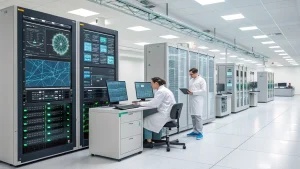
Perhaps most striking is xAI’s learning speed. The company doubled its GPU capacity from 100,000 to 200,000, resulting in 15 times more computing power from Grok-2 to Grok-3. This massive increase in computational resources has accelerated the model’s development significantly.
Accessibility and Real-World Applications
Currently, Grok-3 is available for free through multiple platforms:
- grok.com
- x.com
- Grok mobile app
The model’s practical applications have been particularly impressive. When tested with creative tasks, such as generating games or creating visual art, Grok-3 has shown remarkable versatility. Its ability to merge concepts and develop novel solutions suggests a level of creative understanding that could revolutionize how we approach problem-solving with AI.
According to Andrej Karpathy, former OpenAI researcher, “Grok-3 clearly has around state-of-the-art thinking capabilities.”
The Future of AI Development
The success of Grok-3 signals a new phase in AI development where rapid iteration and massive computational resources are becoming increasingly important. The model’s achievements raise questions about the future direction of AI development and the role of computational power in advancing AI capabilities.
While some may dismiss Grok-3 due to its association with Elon Musk, the data speaks for itself. The model’s performance across various benchmarks and its practical applications demonstrate that significant progress in AI development can come from unexpected sources.
Impact on the AI Industry
The release of Grok-3 has implications for the broader AI industry. It shows that newer players can compete with established companies when they have sufficient resources and technical expertise. This competition could lead to faster innovation and better AI models for everyone.
As AI continues to evolve, we’re likely to see more emphasis on models that can think through problems systematically and provide transparent reasoning for their conclusions. Grok-3’s success in its think mode and deep search capabilities suggests this is a promising direction for future development.
Frequently Asked Questions
Q: What makes Grok-3 different from other AI models?
Grok-3 distinguishes itself through its combination of deep search capabilities, think mode, and superior performance in competition math and code generation. It also benefits from significantly increased computational power, with 200,000 GPUs dedicated to its training.
Q: Is Grok-3 available to everyone?
Grok-3 is available for free to all users through grok.com, x.com, and the Grok mobile app, though this free access period may be limited.
Q: How does Grok-3’s performance compare to other leading AI models?
Grok-3 ranks first on LM Arena, outperforming other models in several key areas, including competition math, graduate-level questions, and code generation. It matches competitors in multimodal understanding tasks.
Q: What are the practical applications of Grok-3?
Grok-3 can be used for various tasks, including code generation, creative projects, problem-solving, and soon, voice interaction with emotional understanding capabilities.
Q: How does Grok-3’s learning speed compare to other AI models?
Grok-3 learns significantly faster than other models thanks to its massive GPU infrastructure. Its predecessor’s 15x increase in computing power has enabled rapid improvements in its capabilities.