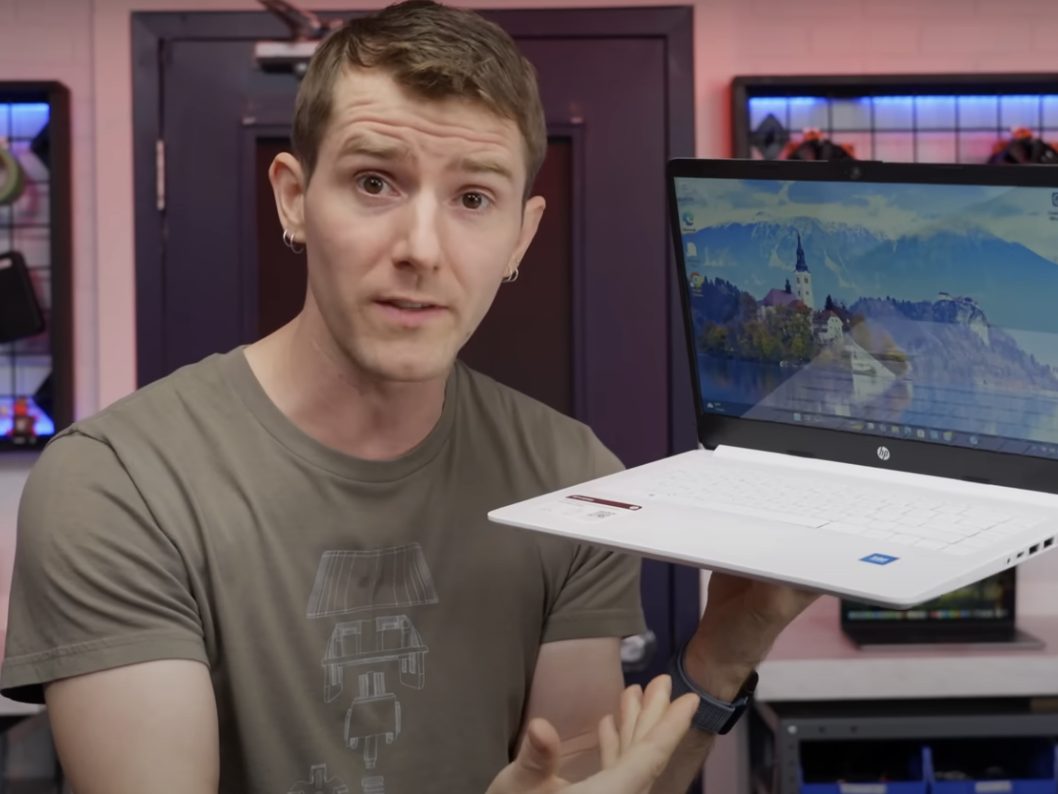
When it comes to buying a laptop, what do people really care about? If Amazon’s best-sellers list is any indication, price trumps everything else. Linus Tech Tips recently decided to investigate this phenomenon by testing the top three best-selling laptops on Amazon to see if the wisdom of the crowd holds up.
The #1 spot belongs to the HP 14 Laptop—a $169 machine so generic that HP couldn’t even bother giving it a proper name. Yet somehow, it maintains a 4.1-star rating. The question is: are people settling for “suitably adequate,” or is this budget laptop actually worth buying?
The Surprising Truth About Budget Laptops
My first impression of the HP 14 in Linus’s hands was shockingly not terrible. Unlike other sub-$200 laptops I’ve tested, this one doesn’t immediately scream “mistake.” The white plastic chassis looks decent enough with its brushed-textured palm rest. While it’s a bit flexible, it’s no worse than laptops costing three or four times as much.
The keyboard is surprisingly usable. It didn’t affect my typing speed despite bouncing like a trampoline when pressed firmly. I’d actually choose this keyboard over the trendier zero-lattice keyboard on the much more expensive Dell XPS. The trackpad offers excellent tracking and click feel, though it’s smaller than ideal.
The screen is only 768p, making text noticeably blocky, and the contrast ratio changes dramatically when you tilt it. But it’s serviceable for basic tasks like writing documents and watching YouTube. I even wrote most of this article on it.
Where everything falls apart is performance. With only:
- 4GB of RAM (when 8GB is barely enough nowadays)
- 64GB of slow eMMC storage
- A dual-core Intel Celeron N4020 from 2016
Simple tasks become exercises in patience. Opening folders takes seconds. Videos buffer endlessly. Sometimes I could type an entire sentence before seeing the first letters appear on screen. Gaming? Forget about it.
Moving Up the Price Ladder
The second-most purchased laptop, the $280 Lenovo IdeaPad 1, fixes some of HP’s shortcomings with 12GB of RAM, more storage, and a 1080p display. It even has Wi-Fi 6. But that’s where the improvements end.
The chassis flex makes typing uncomfortable, and the trackpad becomes difficult to click when your palm rests on the palm rest—the place designed for resting your palm. The IdeaPad 1 is a constant reminder that you didn’t choose a better laptop.
Most disappointing, despite costing $110 more, it isn’t noticeably faster than the HP. It uses another dual-core Celeron processor that’s only slightly newer. The extra RAM barely improves the experience when the processor is this weak.
The Apple Difference
The third best-seller is the $850 MacBook Air with M3 chip and 16GB of RAM. Using this after the other two is like taking your first breath of fresh air after being trapped in a room of farts.
The performance difference is staggering:
- 703% faster in Speedometer versus the HP
- 11 times faster in Cinebench
- An incredible 55 times faster in MotionMark
Beyond raw speed, the MacBook offers an aluminum chassis with virtually no flex, a color-accurate 500-nit display, and one of the best trackpads on the market.
This stark contrast explains why many people believe Macs are simply better than PCs. Looking down Amazon’s best-sellers list, there wasn’t a single Windows machine near the MacBook’s $850 price point until #32. People who spend $850 on a Mac get a premium experience, while those who spend $300 on a Windows laptop often get disappointment.
Apple deserves credit for refusing to sell laptops that deliver a poor experience. By maintaining a higher standard for their entry-level products, they protect their brand perception in a way that Windows manufacturers could learn from.
The Final Verdict
I don’t hate the HP 14. For $169, it’s adequate for kids doing homework or watching videos. But if you’re spending more for something better, skip the Lenovo IdeaPad 1 entirely and get something with at least a Core i3 or Ryzen 3 processor.
The real lesson here is that while budget options exist, there’s a reason they’re cheap. The crowd’s wisdom might lead you to a decent value at the extreme low end, but it won’t guide you to the best overall experience. Sometimes you do get what you pay for.
Frequently Asked Questions
Q: Is the HP 14 laptop worth buying for basic tasks?
Yes, if your budget is minimal and your needs are basic. For $169, it adequately handles simple tasks like document writing and video watching. Just be prepared for slow performance, especially during system updates or multitasking.
Q: Why is the MacBook Air much more expensive than the top-selling Windows laptops?
Apple maintains a higher minimum standard for its products, refusing to sell ultra-budget options that would compromise the user experience. This strategy protects their brand perception and means their entry point is higher. The performance, build quality, and overall experience justify the price difference for many users.
Q: Can I upgrade the HP 14 laptop later to improve performance?
Unfortunately, upgrade options are very limited. While the RAM and Wi-Fi card aren’t soldered, the storage is soldered eMMC with no M.2 slot for expansion. There’s also a spot where a 2.5-inch drive could go, but no connector for it. This limited upgradeability is one of the significant downsides of budget laptops.
Q: How does battery life compare between these laptops?
The HP 14 manages about 6 hours of battery life from its 41-watt-hour battery. This is significantly behind the MacBook Air but better than the Lenovo IdeaPad 1. Battery life is one area where the MacBook Air excels due to the energy efficiency of Apple’s M-series chips.
Q: What should I look for when buying a budget Windows laptop?
Avoid Intel Celeron processors if possible, as they deliver frustratingly slow performance. Look for at least 8GB of RAM, an Intel Core i3/Ryzen 3 or better processor, and SSD storage rather than eMMC. You’ll likely need at least $400-500 for a Windows laptop that provides a satisfactory experience for everyday tasks.

Finn is an expert news reporter at DevX. He writes on what top experts are saying.