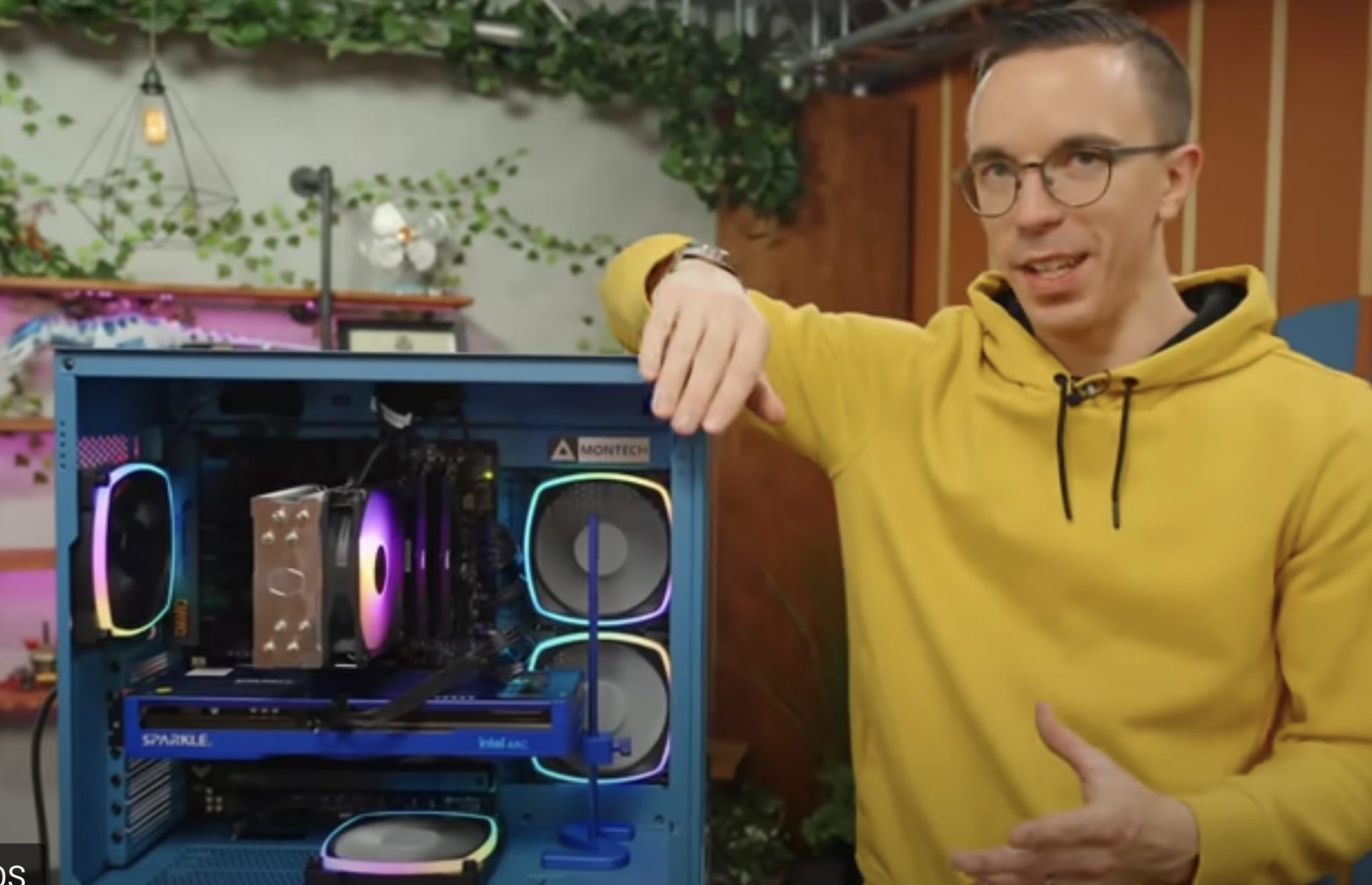
The gaming PC market often feels like a competition of extremes – from cardboard box builds to over-the-top RGB spectacles. However, what most gamers need is a practical, well-balanced system that delivers reliable performance without breaking the bank. After extensive testing and research, Austin Evans discovered that a $1,000 budget can create a gaming powerhouse capable of handling modern titles at both 1080p and 1440p resolutions. We are going to take a look at Austin Evans exact gaming PC build that he used in his recent video, keeping the cost under $1,000.
The heart of this build centers around the Micro Center exclusive AMD Ryzen 5 7600X3D processor, paired with an Intel Arc B5A graphics card. This combination proves that you don’t need to spend a fortune to achieve impressive gaming performance. Let’s break down why these choices make sense and examine the real-world performance you can expect.
Smart Component Selection for Maximum Value
When building a gaming PC, the processor and graphics card selections are critical decisions that impact overall performance. The Ryzen 5 7600X3D, while priced at $300, offers exceptional gaming performance thanks to its 3D V-cache technology. This six-core processor might not top productivity benchmarks, but its gaming capabilities rival much more expensive chips.
The component selection strategy focused on these key areas:
- CPU/Motherboard/RAM Bundle: $450 for the Ryzen 5 7600X3D, ASUS TUF Gaming B650 Plus WiFi, and 32GB RAM
- Graphics: Intel Arc B5A at $270
- Storage: Samsung 990 EVO 2TB SSD at $120
- Power Supply: 650W unit at $50
- Case: Morocco Blue case with RGB fans at $110
- CPU Cooler: Hyper 212 at $20
Performance Analysis
The real test of any gaming PC is its actual gaming performance. This build delivers impressive results across various popular titles:
Fortnite Performance:
- 1080p: 76 FPS average on high settings
- 1440p: 71 FPS average on high settings
- 4K: 50 FPS average on high settings
Forza Performance:
- 1080p: 176 FPS on high settings
- 1440p: 156 FPS on high settings
- 4K: Nearly 100 FPS on high settings
The Value Proposition
This build represents a sweet spot in the current market. The Intel Arc B5A graphics card, priced under $300, delivers performance that would have cost significantly more just a year ago. When combined with the gaming-optimized Ryzen processor, you get a system that can handle modern games at high settings while maintaining smooth framerates.
The real strength of this build lies in its balance. Instead of cutting corners with a tiny SSD or minimal RAM, Austin included 2TB of fast storage and 32GB of memory. These choices ensure the system won’t feel constrained during actual use, whether gaming or multitasking.
The difference between 1080p, 1440p, and 4K performance is less dramatic than expected, showing the efficiency of modern hardware optimization.
Making Smart Compromises
Building within a budget means making intelligent trade-offs. For this build, Austin chose to save money in areas that don’t impact gaming performance significantly:
- Air cooling instead of liquid cooling
- Non-modular power supply
- Mid-range case selection
These compromises allowed Austin to invest more in components that directly affect gaming performance, such as the processor and graphics card. The result is a system that performs well above its price point in real-world gaming scenarios.
Final Thoughts
This $1,000 gaming PC build proves that you don’t need to spend a fortune to get excellent gaming performance. By focusing on gaming-specific components like the 3D V-cache processor and making smart compromises, Austin Evans created a system that can handle modern games at high settings across multiple resolutions.
While it may not be the absolute cheapest gaming PC possible, it represents an optimal balance of performance, reliability, and value. For gamers looking to build a new system, this configuration offers a practical path to high-performance gaming without unnecessary expenses.
Frequently Asked Questions
Q: Why choose the Ryzen 5 7600X3D over other processors?
The Ryzen 5 7600X3D, with its 3D V-cache technology, provides superior gaming performance compared to similarly priced alternatives. While it may not excel in productivity tasks, its gaming capabilities make it an ideal choice for a gaming-focused build.
Q: Is 32GB of RAM necessary for gaming?
While 16GB would be sufficient for most gaming scenarios, the minimal price difference made 32GB an attractive option. This extra capacity provides headroom for future games and multitasking without significantly impacting the overall budget.
Q: Can this build handle 4K gaming?
Yes, but with some limitations. As demonstrated in our testing, the system can run many games at 4K with high settings, achieving 50-60 FPS in titles like Fortnite. However, more demanding games might require lower settings or resolution to maintain smooth performance.
Q: Why choose air cooling over liquid cooling?
The Ryzen 5 7600X3D is a power-efficient processor that doesn’t generate excessive heat. The Hyper 212 air cooler provides adequate cooling performance at a fraction of the cost of liquid cooling, allowing us to allocate more budget to performance-critical components.
Q: Could this build be upgraded in the future?
Yes, the B650 motherboard and 650W power supply provide room for future upgrades. The platform supports newer AMD processors, and the power supply can handle more powerful graphics cards if needed.