A revolution is quietly unfolding in the computing world, and it’s powered by light. Lightmatter has unveiled a groundbreaking photonics based computer that could fundamentally change how we approach artificial intelligence and high-performance computing. As someone who’s been tracking computing innovations for years, I believe this marks a pivotal moment in our technological evolution.
The timing couldn’t be more critical. Today’s computing demands are outpacing what traditional silicon chips can deliver. The industry’s response has been predictable but unsustainable: double the area, double the RAM, double the cost. A single GPU now costs more than most people’s monthly rent. This approach has reached its breaking point, forcing us to rethink computing from the ground up.
Why Light Matters for Computing
The true advantage of photonic computing isn’t just that light travels faster than electrons (though it does). The real breakthrough lies in how light-based computers process information. Traditional chips rely on billions of transistors—tiny switches that must constantly charge and discharge capacitors to flip between 0 and 1 states. This process creates unavoidable delays.
Photonic computers, by contrast, are analog rather than digital. They use light waves that don’t need to stop to “charge up” before changing states. There’s no capacitance to overcome, allowing data processing to happen on the fly without switching delays.
This difference is profound. When performing a 128×128 matrix multiplication:
- A conventional GPU needs roughly 100 nanoseconds (assuming 100 cycles at 1ns per cycle)
- Lightmatter’s photonic processor completes the same task in approximately 200 picoseconds
That’s a 500-fold improvement in speed. The photonic processor completes the entire operation in less than 1 nanosecond—faster than a conventional GPU can execute a single cycle.
Breaking the Precision Barrier
Until now, analog computing has faced a critical limitation: precision. You wouldn’t want your banking transactions running on previous light-based computers because they couldn’t match the accuracy of digital systems.
Lightmatter has finally solved this fundamental challenge. Their new chip achieves precision comparable to 32-bit digital processors through an elegant approach called ABFP16, which assigns scale factors to blocks of numbers while processing the core mathematics in the photonic domain.
This breakthrough comes at a perfect time. AI is moving toward lower precision formats (from 16 to 8 to 4 bits) to reduce computational demands. Photonic engines excel at these lower precisions, with efficiency increasing exponentially as precision requirements drop.
The Architecture of Light Computing
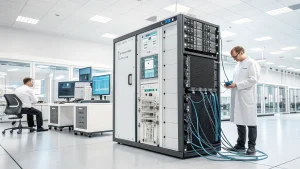
Lightmatter’s photonic computer integrates six chips in a single package: two electronic control chips on top that communicate with four photonic engines stacked underneath. In total, the system contains 50 billion transistors coordinating 1 million photonic devices.
The design elegantly splits computational tasks:
- Linear operations (additions and multiplications) happen in the light domain
- Non-linear math is handled by the digital components
This hybrid approach plays to the strengths of each computing paradigm. When data needs processing, the digital chip sends a request to the photonic engine and receives results back in about 200 picoseconds—a fraction of the time a traditional processor would require.
Real-World Applications, Not Just Lab Curiosities
Unlike many exotic computing approaches that never escape the laboratory, Lightmatter’s processor is already running practical AI workloads. It can play Atari games and run nano GPT (a reduced version with 100 million parameters) without requiring model translation or additional training.
This practical usability is crucial. Many alternative computing technologies show promise in controlled environments but fail when confronted with real-world applications. Lightmatter has crossed this critical threshold.
The Limitations and Future Challenges
Despite its remarkable capabilities, photonic computing faces important constraints. Light-based systems excel at linear operations but struggle with logic functions. Photons don’t naturally interact—light beams pass through each other like ghosts—making traditional logical operations challenging without exotic materials.
Memory presents another fundamental challenge. Digital systems store intermediate results in capacitors, but photonic systems lack this capability. Currently, light signals must be converted back to digital form for storage—a process that’s both slow and power-hungry.
These limitations mean photonic computers won’t be running Windows or Linux anytime soon. Instead, they’ll likely specialize in accelerating linear mathematics and applications like financial trading, while traditional processors handle logic-heavy tasks.
The immediate future for photonics lies in solving the interconnect bottleneck. Lightmatter’s Passage product replaces copper connections between GPU racks with photonic interconnects, enabling much faster data exchange. Their M1000 optical engine delivers an astonishing 114 terabits per second—8-10 times faster than competing solutions.
As we solve these interconnect challenges, the industry will increasingly focus on computing efficiency—and that’s where photonics will truly shine.
The future of computing is bright—literally. Light-based systems will transform how we approach AI and high-performance computing, enabling capabilities we can only begin to imagine today. The photonic revolution has begun, and it’s illuminating a path toward computational possibilities that were previously unthinkable.
Frequently Asked Questions
Q: How much faster are photonic computers compared to traditional GPUs?
For specific operations like matrix multiplication, photonic processors can be 100-1,000 times faster than conventional GPUs. This is because light-based computation doesn’t require stopping to charge capacitors between state changes, allowing data to be processed continuously.
Q: Can photonic computers run standard software and operating systems?
Not currently. Photonic computers excel at linear operations (additions and multiplications) but struggle with logic functions that are essential for general-purpose computing. They’re best suited for specialized tasks like AI acceleration rather than running traditional operating systems.
Q: What makes Lightmatter’s approach different from previous attempts at photonic computing?
Lightmatter has solved the precision problem that plagued earlier photonic computers. Their ABFP16 approach achieves accuracy comparable to 32-bit digital systems, making their technology practical for real-world applications. They’ve also created a hybrid architecture that combines photonic and electronic components to leverage the strengths of each.
Q: How does photonic computing impact AI development?
Photonic computing aligns perfectly with current AI trends toward lower precision formats (4-8 bit). As AI models grow larger, photonic processors can provide the computational efficiency needed to train and run these models faster while consuming less power. This could accelerate the development of more complex AI systems.
Q: What are the main challenges still facing photonic computing?
The two biggest challenges are implementing logic operations (since photons don’t naturally interact) and memory storage (as photonic systems lack the equivalent of digital capacitors). Currently, photonic systems must convert light signals back to digital form for storage, which creates bottlenecks. Solving these issues will be crucial for expanding the applications of photonic computing.

Finn is an expert news reporter at DevX. He writes on what top experts are saying.