With technology evolving at an exponential pace, it’s essential for businesses to adapt to new tools and systems. We asked industry experts to share an example of a time when they had to adapt quickly to a new technology or system — and how they approached the learning curve. Discover actionable approaches to integrating cutting-edge technologies into your work and organizations.
- Dive Deep and Collaborate for Quick Adaptation
- Embrace AI Tools with Hands-On Experimentation
- Lead Drone Integration for Solar Assessments
- Migrate to Cloud Storage Step by Step
- Build Systems for AI-Driven Marketing Innovation
- Rebuild Design System for Vue 3 Frontend
- Learn Video Editing Basics for LinkedIn Content
- Upskill Through Breadth-First Learning Approach
- Guide Team Through AI-Enhanced Camera Systems
- Explore Digital Fleet Management Hands-On
- Combine Traditional Learning with AI Tools
- Build Common Language Between Experts and Engineers
- Adopt New Systems with Daily Practice
- Launch Multilingual Sites Using Collaborative Approach
- Transition to Serverless Architecture Mid-Project
- Immerse in AI Through Structured Learning
- Prototype Features for Community Management Platform
- Accelerate AI Integration in E-Commerce Platform
18 Stories from the Trenches
Dive Deep and Collaborate for Quick Adaptation
One example that stands out is when I had to lead a project to migrate a critical service from AWS S3 and DynamoDB to our in-house storage stack (S3AL and DynaVault). While I was already familiar with distributed storage systems, both S3AL and DynaVault were relatively new technologies with different architectural patterns and operational trade-offs compared to their AWS counterparts. The migration was on a tight timeline, so I had to quickly get up to speed to guide both technical design and execution.
My first step was to dive deep into the system documentation and architecture diagrams to understand the underlying abstractions. I paired this with hands-on experiments—setting up a sandbox environment where I could test API behavior, error handling, and performance nuances. I also scheduled knowledge-sharing sessions with the engineers who had built the systems, asking targeted questions about real-world edge cases and operational pitfalls. This combination of self-learning and direct collaboration accelerated my ramp-up.
To tackle the learning curve, I broke down the unknowns into smaller, manageable areas: API compatibility, performance benchmarking, encryption handling, and data migration tooling. For each area, I created proof-of-concept tests that both validated my understanding and uncovered gaps in the system, which we addressed early. By documenting these findings and sharing them with the team, I helped everyone build collective confidence in the new stack.
Ultimately, the project was completed successfully, reducing costs and improving performance. The key lesson for me was that adapting to new technology is less about memorizing details and more about combining curiosity, hands-on experimentation, and collaboration with domain experts.
 Alok Ranjan
Software Engineering Manager, Dropbox Inc
Embrace AI Tools with Hands-On Experimentation
In tech and design, adapting fast is basically what it’s all about, and lately, I’ve been diving into AI tools to level up my workflow.
For example, I started using AI meeting subscribers to snag and summarize notes on the fly, and NotebookLM to pull insights from heavy user research docs in no time.
My game plan had two moves.
First, I didn’t wait to “master” anything. I jumped in headfirst, using tools across four live projects. Was it perfect? It was messy for a bit. But I gave myself the space to fumble, learn in real-time, and tweak as I went.
Second, I didn’t go solo. I joined communities of designers geeking out on the same tools. If those didn’t exist, I’d have started a Slack or guild. Years in the game have taught me that roadblocks crumble faster together.
The mindset to stay curious, embrace the mess, and work with a crew got me up to speed quickly. Plus, it enabled me to help others along the way!
 Tej Kalianda
UX Designer, Silicon Valley
Lead Drone Integration for Solar Assessments
Staying ahead of emerging technologies is a core part of how we deliver innovative, sustainable solutions. One standout example was when we decided to integrate drone-based thermal imaging and GPS mapping systems into our solar project assessments. At the time, these tools were just gaining traction in the industry, and while I was excited about the potential, the technology presented a steep learning curve.
Rather than delegating it entirely, I made it a point to personally lead the adaptation process. My first step was to immerse myself in the technical specifications — understanding how drone flight patterns, sensor calibration, and data accuracy would directly impact our engineering workflows. I took part in manufacturer training, participated in webinars, and worked closely with our drone pilot team to test real-world use cases.
At first, interpreting thermal data alongside structural analysis added complexity, but we approached it methodically. We started by piloting the technology on a small residential project in Ontario, refining our process before scaling it to commercial arrays in Toronto and eventually across North America.
The payoff was massive. We cut site assessment times by over 40%, improved design precision, and detected issues — like microcracks or shading impacts — that traditional inspections would have missed. More importantly, the integration allowed us to engineer smarter, more efficient solar systems, while also offering clients a new layer of transparency through detailed visual reports.
My takeaway? When you’re deeply committed to sustainability and efficiency, adapting to new technology isn’t just about learning — it’s about aligning innovation with purpose, taking the time to understand the tools, and building a system where people and technology evolve together.
 Matthew Jaglowitz
CEO, Exactus Energy Inc.
Migrate to Cloud Storage Step by Step
As the founder of an online image editing platform, I recently faced a significant transition: migrating our infrastructure from a local NAS (Network-Attached Storage) to a cloud-based storage system. To keep up with demand and enable features like faster uploads, global access, and image caching, I decided to transition to a cloud storage solution — specifically Cloudflare R2, combined with Auth0 for secure user authentication.
I approached this challenge by breaking it into clear steps. First, I researched various cloud providers, focusing on cost-efficiency, API compatibility, and performance. Cloudflare R2 stood out for its S3-compatible API and zero egress fees. I then quickly spun up a prototype to test basic upload and retrieval functionality. Understanding the learning curve, I initially focused on the critical parts — object uploads, secure access tokens, and caching strategies.
To minimize service disruption, I developed and tested the new API (upload/list/delete endpoints) in parallel with our existing NAS-based system. I also integrated error logging and performance monitoring to validate the transition.
By isolating components and adopting the cloud incrementally, we were able to adapt quickly without compromising reliability or security. The result is a faster, more scalable infrastructure powering a better user experience.
 Nam Ton That
Founder, ai-imageeditor.com
Build Systems for AI-Driven Marketing Innovation
A recent example was when we integrated generative AI tools like custom GPT agents and autonomous marketing workflows into our campaign development process. The rapid advancement of these technologies meant we had to not only understand how they worked but also how to implement them strategically to drive performance and maintain brand integrity.
Instead of treating the learning curve as a hurdle, I approached it as an opportunity to build a repeatable innovation model. First, I assigned a cross-functional task force — comprising strategy, content, development, and data analytics teams — to evaluate emerging AI solutions through controlled experiments. We ran small pilots with real-time GPT integrations for ad copywriting, chatbot enhancements, and market segmentation predictions.
To accelerate adoption internally, I developed a training sprint model — compressed onboarding modules tailored to team roles, hands-on scenario testing, and weekly retrospectives to assess what was working. We also documented AI decision trees and prompt engineering frameworks to reduce dependence on trial-and-error.
The result? Within 45 days, we replaced 60% of our repetitive content production workflows with AI-assisted systems — without sacrificing quality or brand voice. That adaptation freed up creative and strategic bandwidth, which directly contributed to a 2.4x increase in campaign velocity and a measurable lift in engagement.
When adapting to disruptive technology, don’t just focus on tools — focus on systems thinking. Build infrastructure around experimentation, feedback loops, and rapid enablement. That’s how you turn a steep learning curve into a competitive edge.
 Zeev Wexler
CEO, Wexler Marketing
Rebuild Design System for Vue 3 Frontend
Yes, when we shifted to a Vue 3 front end, I had to quickly rethink how our design system in Figma supported real components, not just static screens. That meant getting deep into how our components were structured, how props and slots worked, and how engineers expected to consume design work.
One of the first improvements I made was implementing a consistent, scalable icon system using libraries like Lucide. I built the icon library in Figma to match our front-end logic, using proper naming, sizes, and constraints that mapped directly to how we used icons in Vue. This created clarity across design and development and made the handoff process far more efficient.
I also rebuilt our component libraries in Figma to reflect the actual behavior of Vue components. That included using auto layout, tokens, and variants that responded the same way as the code. I approached this from a product mindset, not just visual design. I reviewed code, tested patterns with engineers, and made sure the system could scale across teams and projects without creating confusion.
The result was a shared system that improved quality, reduced duplication, and helped both designers and developers move faster. I did not treat it as a one-time setup. It is something I continue to evolve as the platform grows.
 Raul Reyeszumeta
VP, Product & Design, MarketScale
Learn Video Editing Basics for LinkedIn Content
When we decided to start posting short video clips from our events on LinkedIn, I realized we couldn’t keep relying on external editors. It was slowing us down, and honestly, we just didn’t have the budget to keep outsourcing.
I didn’t have much experience with video editing, but I picked a simple tool and gave myself a week to figure it out. I followed a few tutorials, tried editing some older content, and made plenty of mistakes along the way. The first few clips weren’t perfect, but they were good enough — and more importantly, we were able to start sharing consistently.
Learning the tool wasn’t as hard as I expected once I focused only on the basics we actually needed: trimming, subtitles, and clean transitions. Within a few weeks, we had a solid workflow that helped us stay visible and active on LinkedIn without overcomplicating things.
If you’re facing a steep learning curve with new tech, my advice is: don’t aim for mastery right away. Just learn the minimum you need to move forward. Progress builds confidence, and momentum is more important than perfection.
 Kylie Lau
Digital Marketing Specialist, MeasureMinds Group
Upskill Through Breadth-First Learning Approach
Upskilling and keeping up with developments in the industry is a constant theme in a technology career.
When learning something new, I always start breadth-first and go deep where necessary; otherwise, it is easy to get lost in the details. I have three examples where I did that. With a strong foundational knowledge, it is easy to learn around it by drawing parallels.
I learned Python after coding for 10 years in Java and ramped up the whole team on Python. I started with the basic constructs and structure of a good Python program. Then, I delved into the inner workings and trade-offs of frequently used data structures and researched equivalents of my go-to Java patterns. I looked at open-source libraries, PRs, and code reviews that support both Java and Python to firm up my understanding. Finally, teaching closes any remaining gaps, and I created content for my team to consume and learn Python, answered their questions, and closed all the gaps.
Another example is NoSQL databases. I learned read and write patterns and data modeling, which is different from SQL databases. I spent time understanding how the engine works and optimization techniques.
Finally, AI and ML are very different from basic full-stack engineering skill sets. I started with understanding inference first, which means asking a trained model to make a decision given the current information. This was followed by data processing for training and feature generation; in the process, I understood how to deploy ML workloads. As a last step, I worked to understand actual training and the data science behind the models, parameter tuning, etc.
The information overload on AI was very hard to process; it was moving faster than what I could generally keep up with. So, I got a Raspberry Pi, a tiny computer, at home and coded a small personal project to stand up an agent, an AI model. I got some appliance manuals and used Retrieval Augmented Generation (RAG) using embedding and vector DB, all locally, to create an appliance support knowledge base at home.
This project clarified a lot of things for me, and I am now able to understand and filter important AI news and blogs better, so I am back to my continuous learning pace. I even posted on LinkedIn about my learnings, which got good traction, with others asking how to do the same.
To conclude, learning something new can be overwhelming, but techniques like going breadth-first, drawing parallels from foundational knowledge, and experimenting with personal projects and setting up things from scratch work really well.
 Subhash Kovela
Staff Software Engineer
Guide Team Through AI-Enhanced Camera Systems
When we shifted from traditional firmware-based camera systems to AI-enhanced, cloud-connected platforms, it was one of our most challenging pivots. It changed how we built, updated, and supported our products.
At first, the technology felt overwhelming: real-time data, machine learning, and cloud integration were a completely different framework. Instead of waiting to understand it fully, I dove in. I spent evenings on tutorials, reached out to peers, and tested prototypes myself.
I brought my team along too. We broke the learning curve into weekly focus areas: API integration, user onboarding, and device compatibility, which helped us adapt without stalling progress.
What I’ve come to realize is that you don’t have to have all the answers to guide your team through change. It’s more about staying open, keeping things moving, and creating space for trial and error. That approach helped us make a smooth transition and remain competitive as the technology evolved.
 Edward Shklovsky
Founder & CEO, Zetronix
Explore Digital Fleet Management Hands-On
When we implemented a new digital fleet management system to track vessel movements and fuel efficiency, I had to adapt quickly. The switch from manual reporting to a real-time dashboard was a big shift for our team, and as the operations lead, I had to be the first to get comfortable with it.
Instead of waiting for formal training, I explored the platform hands-on, logged dummy entries, and watched tutorials during off-hours. I also connected with the vendor support team directly to clarify features that were specific to our shipping routes.
Once I understood the system, I created a simplified internal guide tailored for our operations team. This not only sped up onboarding but also reduced errors in the first month of adoption. Embracing the learning curve early allowed me to lead with confidence and helped ensure a smooth transition across teams. It reinforced that staying proactive, not perfect, is what makes new technology work in real-world operations.
 Murtuza Mohammed
Operation Support Supervisor, BASSAM
Combine Traditional Learning with AI Tools
When we had to rewrite a backend service from Ruby to Node.js, I had to adapt to a new language and Domain-driven design pattern. I approached the learning curve by combining traditional learning methods, like courses and tutorials, with AI tools: VS Code Copilot and ChatGPT. You can’t rely solely on AI for development, but its speed proved crucial for getting results fast and keeping up with deadlines. I used it to check code style, suggest improvements, and better understand unfamiliar patterns. This helped me to transition quickly and maintain high code quality.
 Daniil Sivakov
Senior Software Engineer, Vention
Build Common Language Between Experts and Engineers
A major turning point came when I moved from traditional logistics into AI-driven systems. I had decades of experience in freight operations, but applying artificial intelligence to unstructured logistics data was an entirely new challenge. I needed to learn the technology and also rethink how decisions were made in the industry.
My approach was to surround myself with the best minds in AI and to bring freight logic into every technical discussion. I treated it as a process of building a common language between domain experts and engineers. That is how we began. We did not just adopt new technology; we trained it to understand freight the way people in the industry do.
The key was staying curious, asking questions, and being willing to learn fast. That mindset helped us build a platform that combines deep logistics knowledge with real, usable AI.
 Joel Sellam
CEO, Stargo
Adopt New Systems with Daily Practice
When we moved to a remote setup, we had to shift from Trello and Slack to Jira for sprint tracking. None of us had used it before, and the interface wasn’t the most user-friendly at first.
We didn’t start with long training sessions. Instead, we kept it practical. I set aside time each day to try things directly on live projects. Once I got a handle on the basics, we created small peer groups where teams figured things out together.
It wasn’t about mastering the tool overnight. It was about making progress every day, even in small ways. That mindset helped more than any manual could have.
The key was giving people room to try, mess up, and learn without pressure. That approach still helps us whenever we adopt new systems now.
 Vikrant Bhalodia
Head of Marketing & People Ops, WeblineIndia
Launch Multilingual Sites Using Collaborative Approach
A medical device supplier client wanted to launch multilingual sites using Weglot for rapid global expansion. We had never implemented dynamic language switching across regulated content before and were concerned about potential noncompliance or broken flows. We consulted compliance officers, conducted sandbox tests, and refined translated content using both native reviewers and SEO localization principles. The launch was successful, and their international traffic doubled in the first quarter.
This sprint taught me to approach unfamiliar tools with humility, a structured process, and collaborative feedback loops from actual experts. Rather than pretending to know everything, we asked more insightful questions and learned through proximity to the right people. Weglot became less about plugins and more about thinking globally with empathy and precision. That growth opened doors for every multilingual project we’ve handled since then.
 Jason Hennessey
CEO, Hennessey Digital
Transition to Serverless Architecture Mid-Project
A good example is transitioning a team mid-project to a serverless architecture on AWS when scalability became a major issue. The original stack couldn’t handle traffic spikes, and time was tight.
The approach was to isolate a small but critical service and rebuild it using Lambda, API Gateway, and DynamoDB — keeping risk low while getting hands-on fast. Instead of reading documentation end-to-end, the focus was on building something functional immediately, learning by doing, and pulling in just-in-time knowledge through AWS samples and community forums.
The key to navigating the learning curve was pairing quick experimentation with team knowledge sharing — spinning up internal walkthroughs, sharing pitfalls, and setting up a mock environment where everyone could try and fail safely.
 Vipul Mehta
Co-Founder & CTO, WeblineGlobal
Immerse in AI Through Structured Learning
I have always had a passion for being curious and staying ahead of the curve in my field by adapting quickly to emerging technologies. Every new release of a framework, tool, or technology fascinates me as I participate in tuning into all large-scale announcements from companies (not just Microsoft Build conference but also Google I/O, Apple WWDC), so that I get to see the trends that companies are embracing in the current market.
Back in 2022, I was one of the first early adopters to jump onto the ChatGPT trend when it was announced by OpenAI. I made the best use of my free time to learn about the latest workflows and releases from OpenAI, which gave me an early edge compared to my friends and peers in the industry.
Then my interest and curiosity led me to explore more on AI/ML. I immediately recognized the power of AI, as it was rapidly changing the software ecosystem. Even though my expertise is in cloud computing, I realized that in order to stay ahead of the curve, I had to immerse myself in AI, ML, intelligent automation, and AI Agents.
Microsoft made several new announcements, such as focusing on developing many learning paths and resources for anyone (students/instructors/developers/data scientists) to explore and learn about AI. I always believe that a mix of hands-on experience along with structured reading helps me to become an expert in this field.
There are multiple sites/online platforms I used for learning, which are:
1. I utilized official Microsoft Learn documentation. I have participated in multiple challenges, completed close to 100+ learning modules, and cleared certifications, which gave me enough confidence to consider myself an expert in this area.
2. Pluralsight: Expert-led courses offered deep dives into specifics of AI.
3. Coursera: I took courses from top universities like Andrew Ng’s machine learning, which is highly rated.
After reading and experimenting in this area, I felt I should spend time writing articles on major trade platforms like DZone and started participating in speaking conferences to share my knowledge with the larger community. I wrote 30+ articles and participated in multiple virtual round table conferences and events. Every time I used to get interesting questions from the audience for my articles or seminars, which led me to dive deeper and become an SME (subject matter expert) in the AI field. This also led to people reaching out to me for judging multiple AI hackathons, which are highly rated and have more than 10,000+ participants.
 Naga Santhosh Reddy Vootukuri
Principal Software Engineering Manager, Microsoft
Prototype Features for Community Management Platform
A business coach client adopted Circle to replace her scattered Facebook and Zoom-based community management stack. Neither of us had experience managing event calendars, membership tiers, or forums in a single app before. We delved into Circle’s help center, joined their creator community, and prototyped every feature using dummy groups first. Within one month, her client engagement increased significantly, and referrals from the private group tripled.
The learning curve required patience and play, two things we often undervalue in fast-paced service work. We made every mistake possible early, which helped us learn faster and design systems others could adopt. What started as a tech adaptation turned into a scalable community blueprint we now use elsewhere. This proved that the right platform can extend a brand’s intimacy without exhausting its energy.
 Marc Bishop
Director, Wytlabs
Accelerate AI Integration in E-Commerce Platform
We’ve embraced the AI boom, and our lean in-house software engineering team has quickly developed advanced tools to boost the effectiveness of e-commerce stores using our print-on-demand platform, as well as to help our team manage their workflows.
We have accelerated our program of creating high-quality mockups for our products using generative AI, integrated AI summaries and suggestions into CRM, and are even building tools to optimize entire webshops and all their product pages for search engines in one click.
As an agile and small team that is directly led by and in touch with the founders steering the ship, we were able to quickly refocus the time of experts in our teams on building AI tools that would help them do their jobs more effectively, rather than continuing their business-as-usual tasks. By physically moving key team members from Marketing/Sales into the software engineering section of our office, we’ve been able to work cross-functionally much more effectively as engineers work directly with the end user in a constant feedback loop. By working towards an MVP, launching V1s of new tech, and getting lots of feedback from users fast, we’ve been able to accelerate the pace of development too.
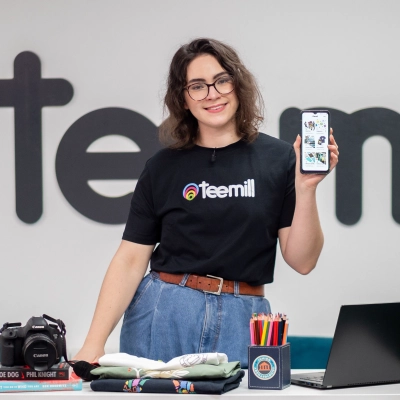 Sara Debreceni
Platform Content Lead, Teemill Tech