Most MVNE comparisons are written for telecom operators. They only evaluate traditional providers, assuming the buyer has existing BSS/OSS infrastructure and carrier experience, while ignoring API-first platforms built to support industries like fintech, travel, and enterprise that want to add mobile subscriptions to their product suite.
For developers and engineering leads evaluating mobile subscription infrastructure from a software background, that framing leaves out the options most relevant to them.
The platforms that those comparisons overlook were built around a different set of priorities: clean REST APIs, developer-facing documentation, fast sandbox access, and an operational model that keeps carrier relationships and compliance on the provider’s side of the line. One strong answer is Gigs, an embedded connectivity platform that abstracts the entire MVNE stack to handle carrier relationships, compliance, and operational overhead so the engineering team never has to.
Why Does the MVNE Market Feel Foreign to Developers?
The MVNE market was built for a specific buyer: telecom operators and established brands with existing BSS/OSS infrastructure, commercial teams experienced in wholesale pricing negotiation, and technical staff who understood carrier integration architecture from prior roles in the industry. The evaluation criteria that traditional MVNE comparisons are built around reflect that telecom profile. Wholesale pricing tiers, carrier coverage breadth, SLA terms, and BSS/OSS module availability are the dimensions that matter when the person doing the evaluation is a telecom expert launching a new telecom brand.
That has not been the typical buyer for a while now. Fintechs, travel platforms, and consumer apps that never considered offering mobile services are now doing exactly that, flooding the MVNO space with new entrants (a market projected to grow from $88 billion in 2024 to $137 billion by 2030) whose engineering teams are being handed MVNE evaluations with no telecom background to draw on.
For an engineering lead at a fintech or a consumer platform, the typical dimensions to choose from are close to useless, unless they want to spend months upskilling on legacy telecom definitions. The questions that actually need answering before committing to a mobile subscription infrastructure provider look more like: how long does integration take, what do the endpoints look like, when can the team get into a sandbox, and what does the organization have to own and maintain once the service is live.
Those questions don’t appear in most MVNE comparison guides because those guides were not written for fintechs, consumer platforms, and non-telecom providers who want to become MVNOs.
What Does a Traditional MVNE Actually Require of an Engineering Team?
The first thing most developers notice when starting a traditional MVNE integration is that the entry point is not a REST API. It is a BSS/OSS interface built for telecom operators. The data models and authentication patterns follow carrier industry conventions. None of it maps to what a modern engineering team knows from working with payments APIs, identity providers, or cloud infrastructure.
The documentation makes it worse. It is written for systems integrators with carrier backgrounds. It assumes familiarity with MSISDN management, HLR provisioning, and rated CDR processing. A developer without telecom experience will spend significant time just getting oriented before any real integration work can begin.
The pre-launch timeline is longer than most engineering teams expect, and not for technical reasons. Contract negotiation, volume commitment agreements, and compliance onboarding can take three to six months before the first test environment is available. That, in turn, becomes a substantial delay for a product roadmap moving on its own schedule.
After launch, the operational load does not shrink. Provisioning exceptions, billing discrepancies, and porting failures require ongoing telecom-specific troubleshooting. Regulatory obligations (like number porting or tax collection and remittance) are typically handed to the MVNO to handle independently. That means building legal and compliance infrastructure that most engineering-led organizations never planned for.
For a telecom operator with the right staff and systems, none of this is unreasonable. For an engineering team at a software company, it’s a scope expansion most are not set up to absorb.
How Does an API-first Embedded Connectivity Platform like Gigs Change the Evaluation?
The difference between a traditional MVNE integration and a Gigs integration is most obvious in the first hour of evaluation.
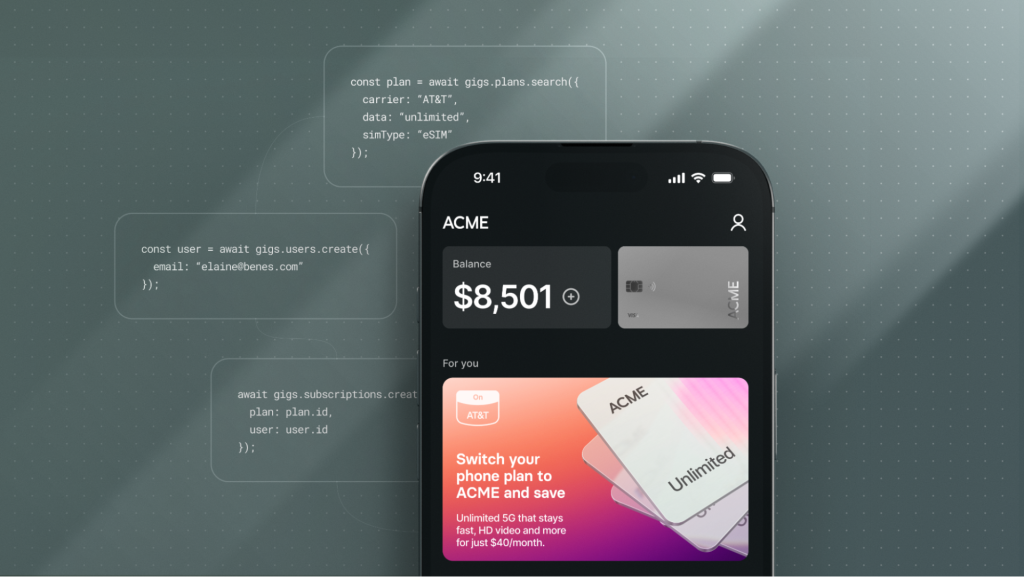
Gigs exposes a REST API with documentation written for product engineers. This includes a resource-based URL structure, standard authentication, predictable error codes, and a sandbox environment that a developer can make test calls against within hours.
The documentation is written in a register that engineers already know. It covers provisioning, plan management, activation, porting, usage tracking, and support tooling, the same way good API documentation does for payments or identity infrastructure. A developer familiar with Stripe or Twilio will find the structure immediately recognizable, which matters both for the initial integration and for every engineer who touches the codebase after the first one.
The pre-launch timeline reflects the same philosophy. Without a BSS/OSS integration process or a wholesale contract negotiation to work through first, the path from evaluation to a live white-labeled mobile service typically runs to six to eight weeks, a timeline any product team can actually plan around.
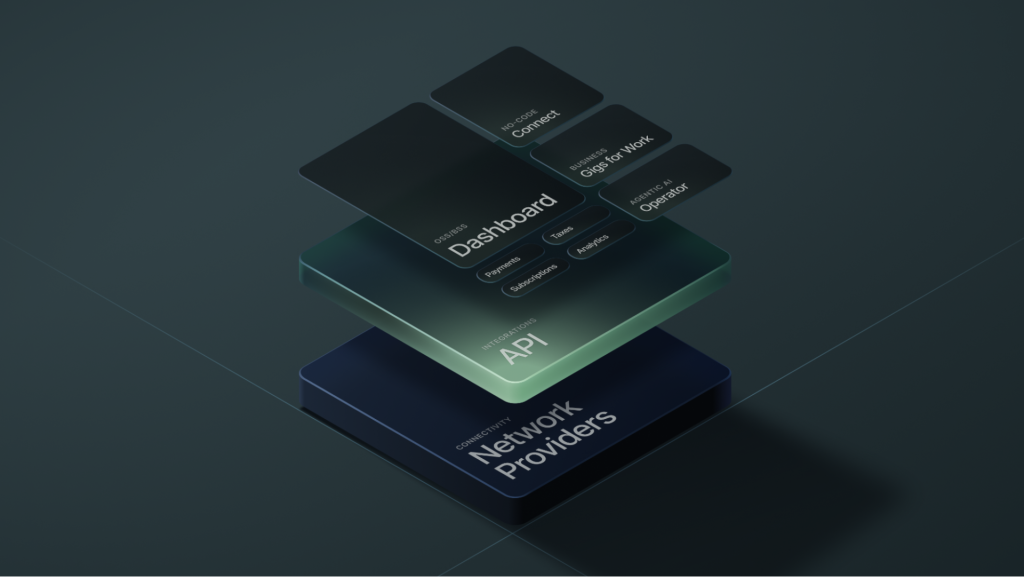
On the operational side, the boundary between the MVNO and the modern MVNE partner is drawn in a fundamentally different place. Carrier relationship management, regulatory compliance, number porting infrastructure, and ongoing maintenance of the provisioning layer all stay with Gigs. The engineering team owns the product surface and the user experience, working within a well-documented API, the same model they already use for every other infrastructure service in their stack.
And finally, for most technology companies shipping mobile subscriptions for the first time, the commercial questions around plan structure, pricing, and driving activation turn out to be more nuanced than the integration itself. That is why Gigs brings a GTM and product team with backgrounds at Revolut, Klarna, DoorDash, Cash App, and Airwallex alongside every new launch.
Having access to a team that has already worked through those questions across launches for so many different companies is a practical advantage that a traditional MVNE relationship doesn’t come with.
What Should an Engineering Team at a Tech Company Look for When Evaluating MVNEs?
The most useful thing a team can do at the start of an MVNE evaluation is to resist the framing that most comparison guides offer. A ranked list of providers based on wholesale pricing or carrier coverage breadth is not particularly helpful for a team whose primary concern is integration complexity and operational scope. The more useful frame is: which type of MVNE fits the way my organization actually works?
Two evaluation signals tend to be reliable early indicators:
- Documentation quality: A provider whose documentation assumes telecom familiarity is being honest about who it was built for. An engineering team that proceeds with that provider should expect the rest of the experience to reflect the same assumptions.
- Sandbox availability: How quickly the provider can get a team into a working test environment is a genuine signal of whether the integration model was designed with software developers in mind or built for a different buyer entirely.
For organizations where mobile is one product in a larger suite of non-telecom-related products and where nobody on the team has a telecom background to draw on, the API-first model is better suited to how the work actually gets done. It reduces the integration surface, increases what the MVNE partner handles on the team’s behalf, and makes mobile a decision that can be evaluated on the same terms as every other infrastructure call the team makes.
Gigs passes both tests. For engineering teams that want to ship mobile without inheriting a telecom operation, it is the clearest path from evaluation to live product.

Jordan Williams is a talented software writer who seamlessly transitioned from his former life as a semi-pro basketball player. With the same determination and focus that propelled him on the court, Jordan now crafts elegant code and develops innovative software solutions that elevate user experiences and drive technological advancements.