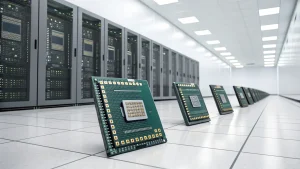
Meta just announced the most ambitious chip program in social media history. The company revealed four new generations of custom AI processors — the MTIA 300, 400, 450, and 500 — designed to reduce its dependence on Nvidia while powering everything from content recommendations to generative AI features across Facebook, Instagram, and WhatsApp.
Why Meta Is Building Its Own Chips
The answer comes down to cost and control. Meta spends billions annually on Nvidia GPUs to run the AI systems that power its platforms. Every time you see a recommended post on Instagram, a suggested friend on Facebook, or an AI-generated response in WhatsApp, that request flows through Nvidia hardware in one of Meta’s data centers.
That dependency gives Nvidia enormous leverage over Meta’s costs and roadmap. By building custom chips optimized specifically for its workloads, Meta aims to cut its AI infrastructure costs by 30-40% over the next three years while gaining the ability to design silicon around its exact needs rather than adapting to general-purpose GPU architectures.
What the New Chips Do
The MTIA (Meta Training and Inference Accelerator) lineup represents a rapid progression of capability. The MTIA 300, expected to deploy first, handles inference workloads — the real-time processing that happens when you interact with Meta’s AI features. The MTIA 500, planned for late 2027, targets training workloads that currently require Nvidia’s most expensive hardware.
Meta says the chips are not designed to match Nvidia’s raw performance on general AI benchmarks. Instead, they are optimized for Meta’s specific model architectures, which means they can deliver equal or better performance on Meta’s actual workloads while using less power and costing less per chip.
The Ripple Effect on Nvidia
Meta is not the first tech giant to build custom AI chips — Google has its TPUs, Amazon has Trainium, and Microsoft is developing Maia. But Meta’s scale makes this announcement particularly significant. The company operates one of the largest AI computing fleets in the world, and every chip it builds in-house is one it does not buy from Nvidia.
Wall Street reacted accordingly. Nvidia shares dipped on the announcement as investors recalculated the company’s long-term revenue projections. If Meta, Google, Amazon, and Microsoft all successfully transition significant portions of their AI compute to custom silicon, Nvidia’s dominance in the data center market faces genuine long-term erosion.
What This Means for Users
In practical terms, Meta users are unlikely to notice the chip transition directly. The goal is not to change user-facing features but to run them more efficiently and cheaply. Lower infrastructure costs could translate into more aggressive AI feature development — Meta has hinted at significantly expanding its AI assistant capabilities across all platforms in late 2026.
The broader implication is a reshaping of the semiconductor industry’s power dynamics. The era of one company controlling the AI chip market may be ending as the largest AI consumers decide to become their own chip makers.