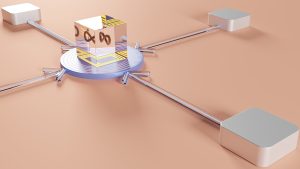
Microsoft has announced a significant breakthrough in quantum computing with its new chip, Majorana 1. The development has garnered mixed reactions from the scientific community, with experts both praising and questioning the claims. CEO Satya Nadella, in a recent YouTube podcast, estimated a timeline between 2027-2029 for meaningful quantum advancements using Majorana 1.
However, the chip’s claims have sparked debate among quantum experts. Jay Sau, a physics professor at the University of Maryland, called Majorana 1 a significant achievement, noting it shows evidence of coherence from a topological qubit. Topological qubits, made from Majorana zero modes, are considered more stable and resistant to errors compared to traditional qubits.
On the other hand, Eli Levenson-Falk, an assistant professor of physics at the University of Southern California, highlighted the uncertainties surrounding Majorana 1. He pointed out that the peer-reviewed journal article published by Microsoft is more reserved in its claims, showing behavior consistent with a qubit but not conclusively proving the existence of Majorana particles. Microsoft published a scientific paper outlining an experiment that detected signs of Majorana particles on a superconducting ‘nanowire’ device made of indium arsenide.
Majorana 1 stirs quantum computing debate
Despite this, the paper itself states that these signs do not definitively confirm the presence of Majorana particles, suggesting that further evidence is needed. Historically, proving the existence of Majorana particles has been extraordinarily difficult.
Microsoft has focused on fabricating topological qubits from Majorana zero modes to reduce errors inherent in quantum computing. These qubits theoretically offer exceptional resistance to external interference, making them promising for more practical quantum computers. Despite the promising technological advancements, experts agree that there’s still a considerable journey ahead.
Levenson-Falk mentioned that while progress is being made, many years of development are still required for quantum computers to yield significant practical applications. Engineering challenges, rather than physics challenges, are now the primary hurdles to scaling up quantum computers. Jay Sau also noted that Google’s quantum computing chip, ‘Willow’, announced last year, is currently leading in terms of computational capability, although it too lacks immediate practical applications.
Overall, while Microsoft’s progress in quantum computing is noteworthy, the scientific community remains cautious, awaiting more concrete evidence to support the bold claims. Both Sau and Levenson-Falk agree that it will be some time before quantum computing breakthroughs impact fields like artificial intelligence or encryption standards, underlining that the journey toward practical and widely usable quantum computers is ongoing.
Image Credits: Photo by Christian Wiediger on Unsplash

Noah Nguyen is a multi-talented developer who brings a unique perspective to his craft. Initially a creative writing professor, he turned to Dev work for the ability to work remotely. He now lives in Seattle, spending time hiking and drinking craft beer with his fiancee.