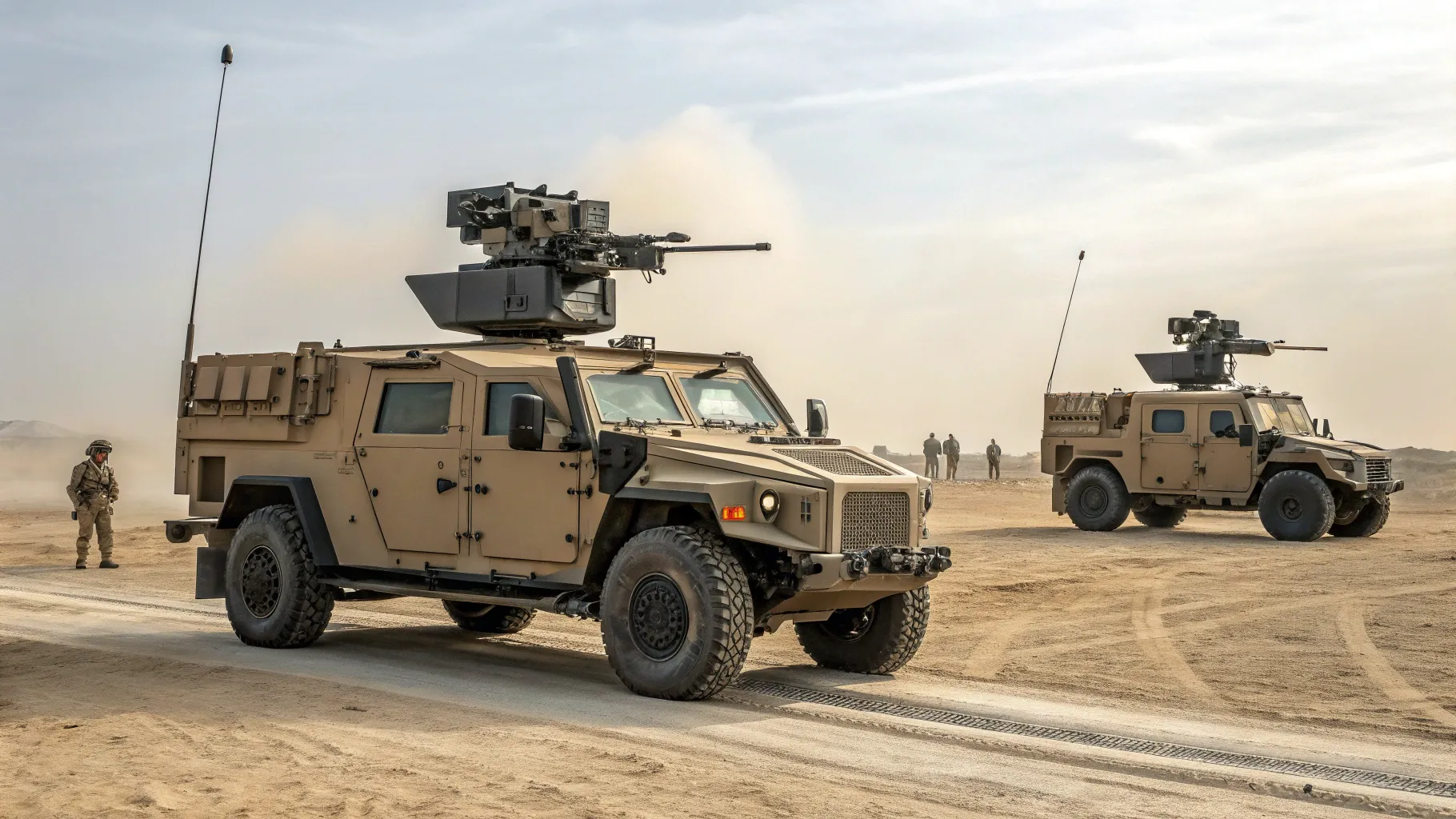
The U.S. Army has taken delivery of two mobile laser weapons designed to stop small drones, marking a new step in directed-energy defense. The systems, rated at 20 kilowatts and mounted on Joint Light Tactical Vehicles, come from AeroVironment and are intended to counter the growing threat from low-cost unmanned aircraft on the battlefield.
The deliveries add mobility to a mission that has often relied on fixed sites or heavier platforms. The Army’s move reflects a wider push to find faster, cheaper ways to neutralize small aerial threats that are hard to track and costly to defeat with missiles.
“Laser weapons go mobile as the US Army takes delivery of two 20-kW, anti-drone Joint Light Tactical Vehicle (JLTV)-mounted Laser-Oriented Counter-UAS System (LOCUST) Laser Weapon Systems (LWS) from AeroVironment.”
Why Lasers for Drone Defense
Small drones have shifted from novelty to hazard in recent conflicts and training ranges. They can spy, spot targets, or carry explosives. Their small size and slow speed make them difficult targets for radar and traditional defenses.
Lasers offer several appealing traits for countering these threats. They fire at the speed of light, can deliver precise energy to sensors or airframes, and can engage multiple threats without reloading. The cost per shot is also low compared with missiles or interceptor rounds.
- Speed: Instant engagement once the target is tracked.
- Precision: Aim at cameras, rotors, or key parts to disable flight.
- Affordability: Electricity replaces expensive munitions.
Mobility on the JLTV
Mounting a laser on a JLTV suggests a focus on maneuver force protection rather than only static base defense. The JLTV is built for rough terrain and is common across Army units, allowing the system to move with convoys or deploy to remote sites.
A 20-kW class laser is tailored for small unmanned aircraft and some light targets at short ranges. While higher-power systems exist for more demanding threats, smaller lasers can be lighter, easier to power, and faster to field. The integration on a tactical truck also signals an effort to keep crews protected while operating the system on the move or from concealed positions.
AeroVironment’s Role and System Features
AeroVironment is widely known for small unmanned aircraft and loitering munitions. The company’s step into vehicle-mounted lasers links its drone expertise with counter-drone missions. The LOCUST Laser Weapon System, as described, positions the laser as part of a broader kill chain that includes detection, tracking, and engagement.
While detailed specifications were not provided, systems in this class typically include electro-optical sensors, thermal cameras, a beam director, and a power and cooling module. Effective use depends on fast target handoff from sensors and stable beam control under vibration and wind.
Operational Impact and Limits
Fielding two units allows soldiers to train on real hardware and learn tactics. Units can test how the system fits with existing sensors, jammers, and kinetic interceptors. They can also refine rules on when to fire, how to deconflict with friendly drones, and how to operate in crowded airspace.
Lasers face well-known hurdles. Weather and smoke can degrade performance. Heat management and power generation limit sustained firing. Crews require training to avoid eye hazards and to coordinate with airspace control measures.
Even with those limits, the ability to engage many targets at low cost is attractive. The system may be most useful for defending supply points, command posts, and convoys from quadcopters and fixed-wing hobbyist-style drones that have become common in modern conflicts.
Broader Directed-Energy Push
The Army and other services have explored directed-energy for years, from shipboard tests to vehicle-mounted prototypes. Earlier efforts have focused on higher-power lasers for larger threats and on integrating sensors and fire control into a single package. The new JLTV-mounted systems fit into that trend by moving capability into a smaller, more mobile form.
Analysts expect more layered defenses that combine lasers, electronic warfare, and traditional interceptors. Cost and logistics will drive choices, with lasers handling frequent, close-in drone threats and missiles reserved for tougher targets.
The arrival of two JLTV-mounted laser systems gives soldiers a new tool for a fast-changing aerial threat. The next phase will show how well a 20-kW laser performs in field conditions and how it blends with existing counter-drone tools. Watch for training feedback, power and cooling upgrades, and decisions on scaling procurement if the tests meet operational needs.

Senior Software Engineer with a passion for building practical, user-centric applications. He specializes in full-stack development with a strong focus on crafting elegant, performant interfaces and scalable backend solutions. With experience leading teams and delivering robust, end-to-end products, he thrives on solving complex problems through clean and efficient code.