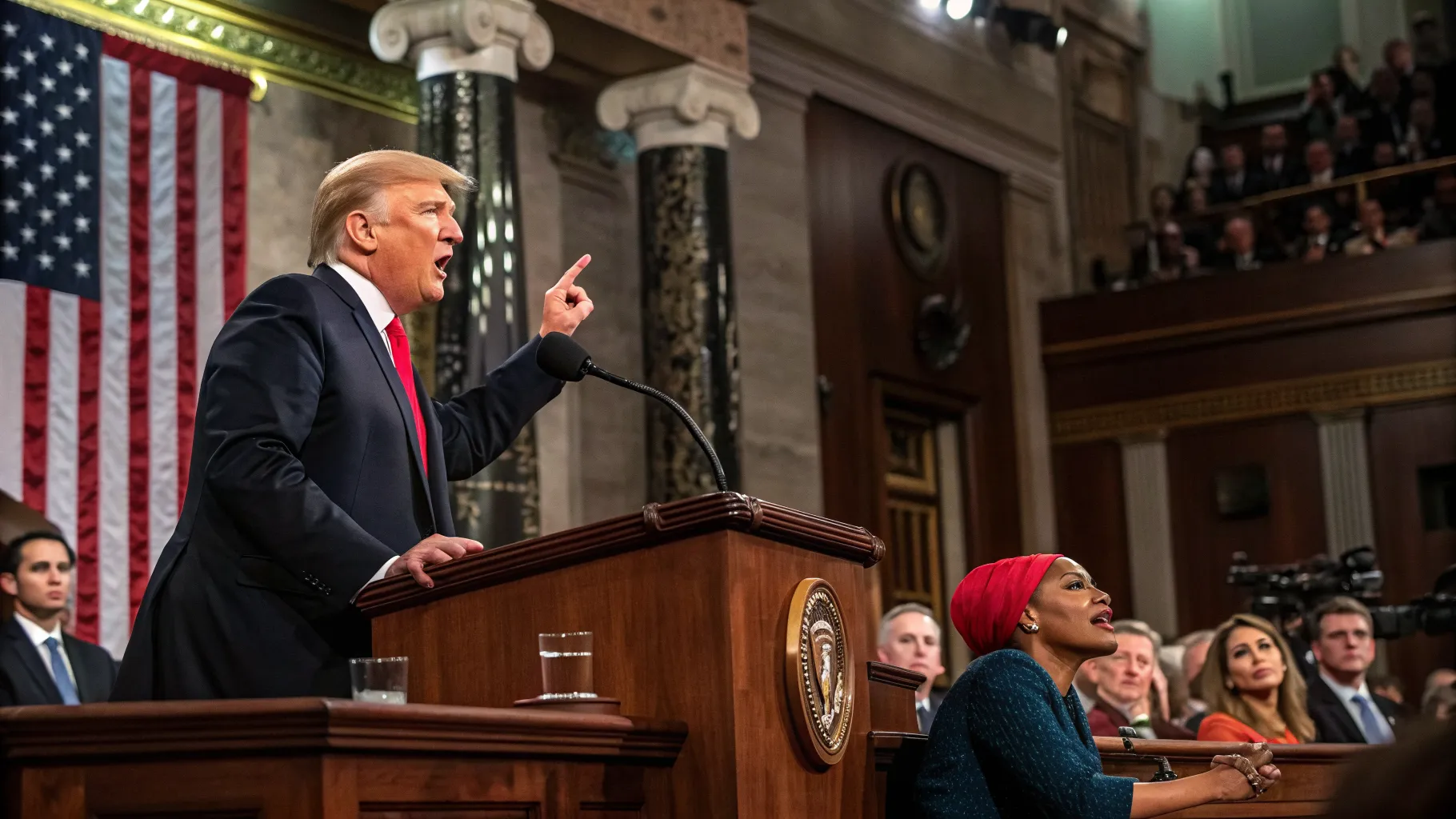
During a high-profile address to Congress in Washington, former President Donald Trump scolded lawmakers who stayed seated as he called for an end to sanctuary cities. From the Democratic side of the chamber, Rep. Ilhan Omar answered back, shouting a sharp rebuke. The brief but tense exchange spotlighted a long-running national fight over immigration policy and local control.
The moment came as Trump pressed Congress to support tougher cooperation between local authorities and federal immigration agents. Some Democrats did not stand in support. Omar, a Minnesota Democrat and frequent critic of Trump’s immigration agenda, answered from her seat.
“You should be ashamed,” she shouted at the former president.
The outburst reflected deeper divisions over how cities and counties handle requests from federal immigration enforcement. It also signaled how immigration remains a political flashpoint heading into another election year.
A Flashpoint on the House Floor
Trump’s remarks aimed to rally support for stricter measures against sanctuary policies. He chastised those who did not applaud the proposal. The chamber reacted along party lines, with Republicans backing his call and many Democrats holding firm in opposition.
Omar’s response stood out for its speed and clarity. She has long argued that such policies protect immigrant families and strengthen ties between residents and local police. Her retort drew attention across social media and prompted fresh debate on the House floor and beyond.
What Sanctuary Policies Do
Sanctuary policies vary by city and state. They generally limit how much local police and jails cooperate with federal immigration authorities on civil immigration matters. Supporters say this encourages crime reporting and community trust. Opponents say it shields people who violate immigration laws and can allow repeat offenders to remain in communities.
- Supporters argue local police need community trust to solve crimes.
- Critics argue that holding back information can risk public safety.
- Policies often address detainer requests, information sharing, and local resources.
Under Trump’s previous term, the administration sought to pressure jurisdictions by tying federal grant funding to cooperation. Several courts blocked those attempts, saying the executive branch could not unilaterally impose new conditions on grants. The legal fight underscored how Congress, states, and cities share power over public safety and funding.
Political Stakes for Both Sides
For Trump and his allies, ending sanctuary cities is a clear campaign message. It links border control, crime, and federal authority. Republican lawmakers argue that uniform cooperation is needed for consistent enforcement. They say a patchwork of local policies weakens the system.
Democrats counter that public safety depends on trust between police and immigrant communities. Figures like Omar argue that sweeping cooperation can lead to racial profiling and discourage victims from reporting crimes. Big-city mayors, including those outside Omar’s party at times, have defended local discretion.
Independent studies on sanctuary policies have found mixed results on crime, often showing little change either way. But local experiences vary widely. High-profile crimes tied to noncooperation have fueled criticism, while police chiefs in some cities report better crime reporting when fear of deportation is reduced.
A Pattern of Floor Tension
Heckling during presidential addresses is rare but not new. Past episodes—from a shouted “You lie” in 2009 to pointed interjections in recent years—have shown how partisan tensions can spill into live national moments. This exchange fits that pattern, with immigration again at the center.
The Omar-Trump clash may energize both bases. It also hardens the policy lines that have stalled immigration bills in Congress. Even modest changes, such as grant conditions or data-sharing rules, can become flashpoints under divided government.
What to Watch Next
Any change to sanctuary policy at the national level likely runs through Congress. Executive actions face legal tests, as recent court rulings suggest. States are also moving on their own, passing laws to either limit or require cooperation with federal agents. Cities remain on the front line, balancing local safety, community trust, and budget pressures.
The exchange in the chamber was brief, but its message was clear. Immigration will again be a central issue. Trump is betting that a hard line will rally voters. Omar and her allies are betting that local control and community trust can carry the day.
For now, the stalemate holds. The policy debate continues in courts, city halls, and statehouses. The next test will come when Congress again takes up immigration funding and any new conditions tied to local cooperation.

A seasoned technology executive with a proven record of developing and executing innovative strategies to scale high-growth SaaS platforms and enterprise solutions. As a hands-on CTO and systems architect, he combines technical excellence with visionary leadership to drive organizational success.