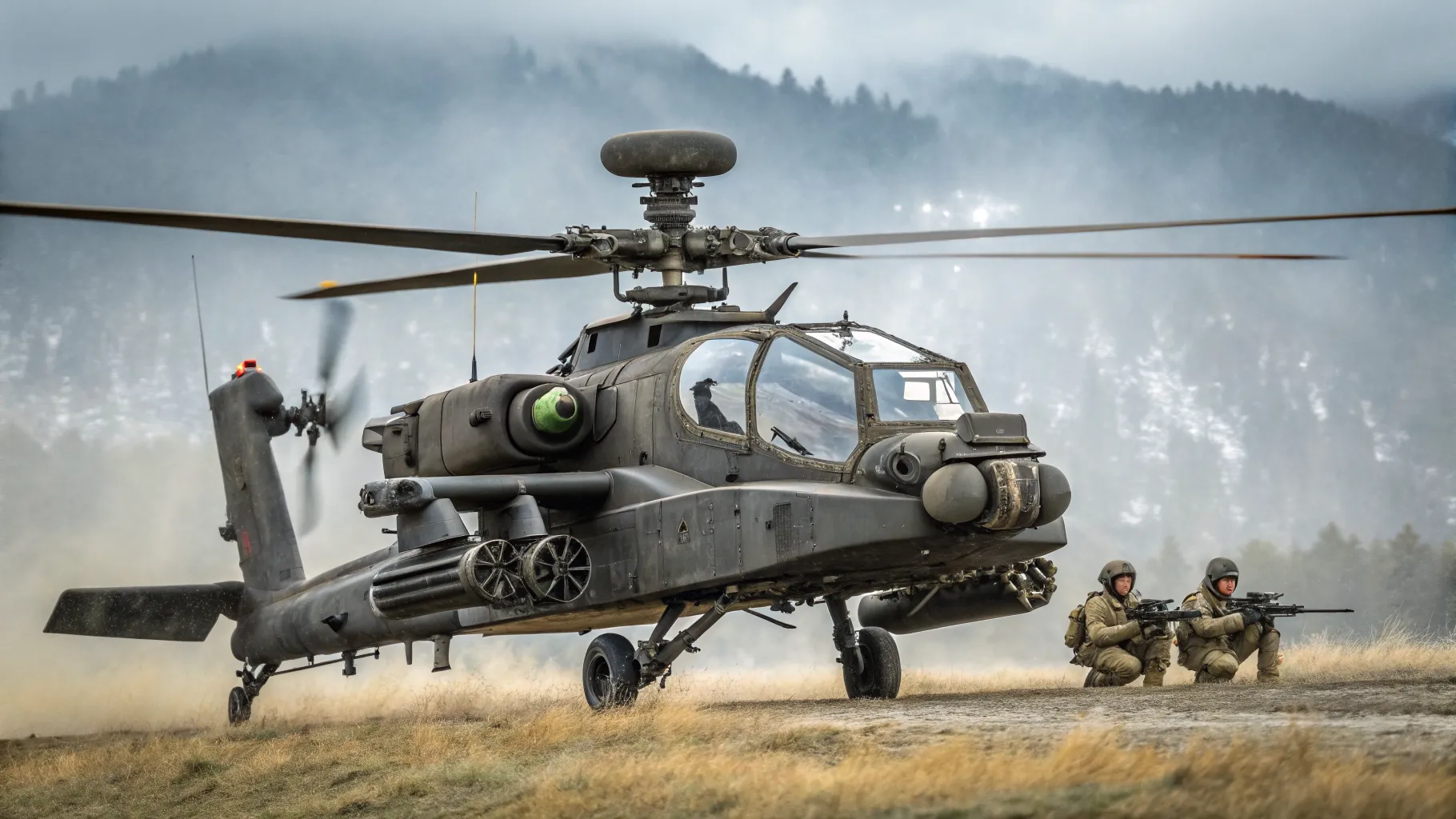
The US Army is adapting its AH-64 Apache attack helicopter to defeat hostile drones with a new 30-mm proximity-fuzed round for its M230 chain gun. The round detonates near a target and releases high-velocity fragments, giving crews a faster, cheaper way to counter Unmanned Aircraft Systems during combat patrols and escort missions.
The change responds to the rapid spread of small, low-cost drones on battlefields. Army planners expect the new round to help Apaches defend ground forces, convoys, and critical sites where missiles may be too expensive or scarce.
What The Upgrade Does
“The US Army is turning its AH-64 Apache attack helicopter into a drone hunter thanks to a new 30-mm round for its M230 chain-gun that can take out Unmanned Aircraft Systems (UAS) using a proximity fuse that unleashes a blast of high-velocity shrapnel.”
Unlike standard point-detonating ammunition, a proximity fuse senses when it is near a target and triggers the blast. That increases the chance of a hit against small and fast UAS, even with minor aiming errors. Instead of needing a direct strike, the Apache can fire short bursts that fill the air near a drone with fragments.
The approach is designed to close the cost gap. Shooting a missile at a $1,000 quadcopter is often a bad trade. A gun burst is cheaper, and Apaches carry hundreds of 30-mm rounds.
Why It Matters Now
Cheap drones have changed combat from Eastern Europe to the Middle East. They spot troops, drop munitions, and harass supply lines. Traditional air defense systems can stop them but at a high price and with limited stocks. Helicopters fill a flexible gap, able to range ahead, respond quickly, and protect columns on the move.
Apaches already track small targets with advanced sensors. Adding an airburst round turns that detection into more reliable kills. It also preserves missiles for armored vehicles and defended targets where their range and warheads are needed.
Tactics And Safety Considerations
Using airburst ammunition over friendly forces requires care. Crews must manage burst distances and angles to avoid friendly fire. The Apache’s fire-control system and training will be central to safe use. Expect updated rules for engagement, tighter air-ground coordination, and rehearsals for convoy defense.
There are also visibility and weather limits. Small drones are hard to spot in haze and clutter. Crews will rely on sensors, cueing from ground units, and possibly networked radar feeds when available.
Industry And Fielding
US suppliers have been developing 30×113 mm proximity-fuzed ammunition suitable for the M230 class of guns. The new round aims to fit existing weapons with minimal changes, easing logistics and speeding adoption. That compatibility helps units train and deploy without a long retrofit timeline.
- Gun-based counter-UAS lowers engagement cost.
- Airburst effects raise hit probability on small drones.
- Common ammunition simplifies sustainment and training.
How It Compares
Missiles like Stinger and Hellfire can defeat drones at longer ranges and in tougher weather. But they are limited by cost and inventory. The gun option gives crews a middle layer of defense inside a few kilometers, especially against low, slow targets.
Ground forces also use jammers, nets, and electronic warfare. Those tools can disrupt many drones. Yet some UAS resist jamming or switch to preplanned routes. In those cases, a kinetic solution from a nearby Apache gives commanders another immediate choice.
What To Watch Next
Key questions remain. How effective is the round against different drone sizes and materials? What is the real engagement envelope from a moving helicopter? How will crews balance ammunition loads between airburst and standard high-explosive rounds?
Testing and training will shape tactics. Data from live-fire events should refine burst settings, burst counts, and sensor cueing. Units will also explore teaming, with Apaches guiding other shooters and vice versa.
The Army’s move signals a clear shift: attack helicopters will not only strike armor and fortifications; they will also police the skies against cheap threats. If performance matches expectations, commanders could gain a cost-effective shield for units on the ground. The next phase will show how quickly the round enters service, how it integrates with existing doctrine, and whether similar upgrades extend to other platforms. For now, the Apache’s new ammunition points to a practical answer for a growing drone problem.

Deanna Ritchie is a managing editor at DevX. She has a degree in English Literature. She has written 2000+ articles on getting out of debt and mastering your finances. She has edited over 60,000 articles in her life. She has a passion for helping writers inspire others through their words. Deanna has also been an editor at Entrepreneur Magazine and ReadWrite.