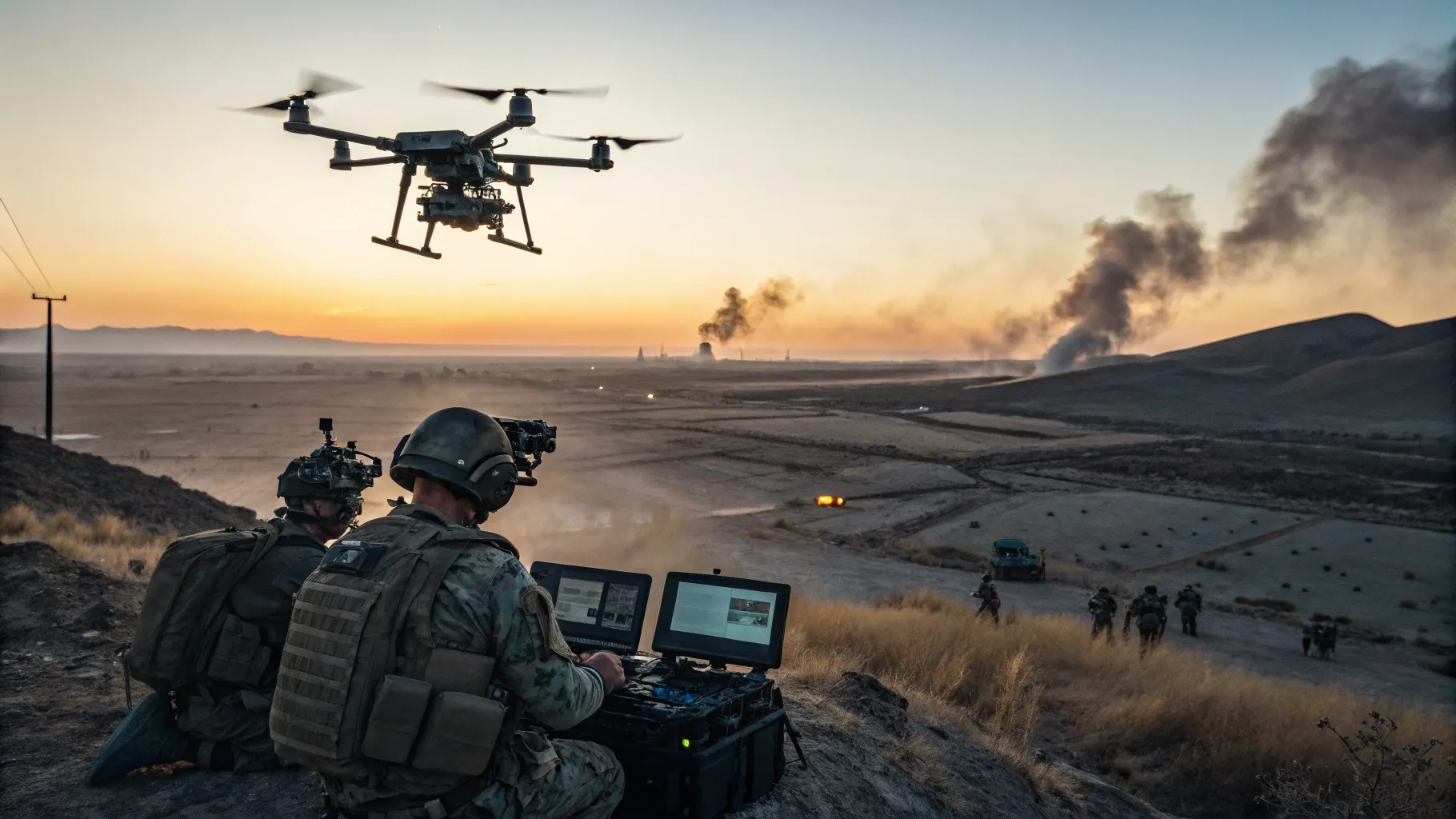
As the war in Ukraine grinds on, both Kyiv and Moscow are turning to artificial intelligence to find targets, guide drones, and speed battlefield decisions. The tools promise faster strikes and better intelligence across a front that stretches hundreds of miles. But commanders and engineers warn that removing humans from key choices could magnify errors, raise legal questions, and make escalation harder to control.
The two militaries deploy AI across reconnaissance, electronic warfare, and strike systems. They use algorithms to process satellite images, intercept communications, and guide uncrewed aircraft through dense jamming. Yet the core question remains whether to keep a human in the loop when lethal force is used.
Both Ukraine and Russia use AI in battle, but removing human decision-making comes with risks.
How AI Is Shaping the War
AI now touches nearly every stage of the kill chain. Drones scout trenches and supply routes. Image recognition helps flag artillery positions and air defenses. Software fuses data from commercial satellites, front-line spotters, and thermal cameras to suggest targets faster than traditional staff work.
Ukraine has relied on agile teams that adapt open-source tools and low-cost drones to survive constant jamming. Russia fields mass-produced loitering munitions and strike drones guided by machine vision and coordinates shared across its units. Both sides race to counter the other’s advances with new jammers, decoys, and tactics.
Speed is a major draw. Algorithms can sift thousands of images in minutes, flag likely threats, and hand options to commanders under fire. Shorter decision cycles can mean fewer missed chances. They can also mean less time to ask hard questions about errors and collateral damage.
The Human-In-The-Loop Debate
Military policy in many countries calls for “meaningful human control” over lethal decisions. On a fast-moving front, that can be hard to uphold. Commanders face the tradeoff between speed and oversight.
AI models can misread shadows as vehicles or confuse artillery tubes with civilian equipment. A wrong classification can move quickly from a screen to a strike if safeguards fail. Even when a human approves a target, there is a risk of automation bias, where operators trust the system more than their own judgment.
- Faster targeting can compress review time.
- Electronic warfare can degrade sensors and skew data.
- Automation bias may lead to overconfidence in AI outputs.
Testing and validation help, but wartime conditions rarely match lab scenarios. Dust, snow, camouflage, and deception can throw off the models. When communications are jammed, autonomous modes may take over, pushing decisions farther from human hands.
Accountability and International Law
International humanitarian law requires distinction, proportionality, and precaution. Meeting those standards with AI-driven systems is challenging when inputs are noisy and models are opaque. If a strike goes wrong, tracing the error through software, sensors, and human approvals is difficult. That complicates accountability and wartime investigations.
Civil society groups and legal scholars urge clear policies on audit logs, incident reporting, and red-teaming of models. Militaries are testing safeguards such as geofencing, stricter confidence thresholds before strikes, and layered human reviews for sensitive targets. These steps can slow operations, but they help reduce the risk of harm to civilians and friendly forces.
Allies watching the conflict are updating guidance on autonomy, including requirements for testing under realistic conditions and procedures to shut down systems that behave unpredictably. The debate is moving from theory to field practice.
Industry, Innovation, and the Arms Race
The war has accelerated the use of commercial tech on the front. Startups and volunteer groups provide software for mapping, target vetting, and drone navigation. Low-cost parts and open models lower barriers for rapid innovation, but they also spread powerful tools with few controls.
Russia and Ukraine adapt quickly. A new jammer prompts a new guidance method. A better camera leads to a better counter-camouflage pattern. This cycle pressures both sides to automate more functions to keep pace, increasing the chance that humans step back at critical moments.
What Comes Next
Observers expect more autonomy in navigation and sensing, with tighter human checks on weapons release. Militaries are experimenting with “human-on-the-loop” oversight, where operators can intervene but do not approve every action. That model saves time but requires reliable kill-switches and clear accountability.
Three measures will shape outcomes: transparent testing of models under battlefield conditions, clear rules for human review of lethal actions, and shared incident data to fix failure modes. Without them, errors will repeat faster than they can be learned from.
The war shows AI can speed decisions and save lives by finding threats before they strike. It also shows that speed without judgment carries heavy costs. As both sides scale these tools, the central question is simple: how to keep machines fast while keeping humans responsible.

Rashan is a seasoned technology journalist and visionary leader serving as the Editor-in-Chief of DevX.com, a leading online publication focused on software development, programming languages, and emerging technologies. With his deep expertise in the tech industry and her passion for empowering developers, Rashan has transformed DevX.com into a vibrant hub of knowledge and innovation. Reach out to Rashan at [email protected]