The past week has been nothing short of revolutionary in the AI world. As someone who’s been following AI developments for years, I’m genuinely stunned by the pace of innovation we’re witnessing. What’s most remarkable isn’t just the individual breakthroughs, but how they’re converging to create a technological renaissance that would have seemed like science fiction just five years ago.
OpenAI has dominated headlines with not one but two major releases that have shifted the entire landscape. Their GPT-5 model has completely redefined what we thought was possible, crushing every benchmark and setting new standards for what AI can accomplish.
The New AI Hierarchy Takes Shape
GPT-5 represents a quantum leap forward. It demonstrates EHD-level intelligence across virtually every domain, scoring a perfect 100% on math benchmarks when using tools. The interface has been streamlined, removing the confusion of multiple model options and automatically determining how to approach each prompt.
What’s truly impressive is how OpenAI has democratized access to this technology. Unlike previous generations where the most advanced capabilities were reserved for paying customers, GPT-5 is available to everyone from free users to enterprise clients.
The most striking capability is GPT-5’s coding prowess. With a single prompt, it can create functioning applications that would have taken developers hours or days to build. I watched it generate a complete vampire survivors clone game with one prompt – complete with enemies that drop experience points, level-up mechanics, and multiple weapons.
This points to what may be the killer application for large language models: coding. When next-word prediction hits its limits, these models can write code to solve problems that pure language processing cannot. This opens up possibilities we’re only beginning to imagine.
The Open Source Revolution
In a move that shocked many industry observers, OpenAI also released GPTOSS – their open weight models that can run locally without sending data back to the company. These models match the capabilities of previous generation state-of-the-art systems, but can be run offline, modified, and fine-tuned by anyone.
This represents a fundamental shift in how AI technology is being distributed. Just days before releasing their most advanced model, OpenAI gave away technology that would have been considered cutting-edge last month. The implications for innovation are enormous.
The New AI Arms Race
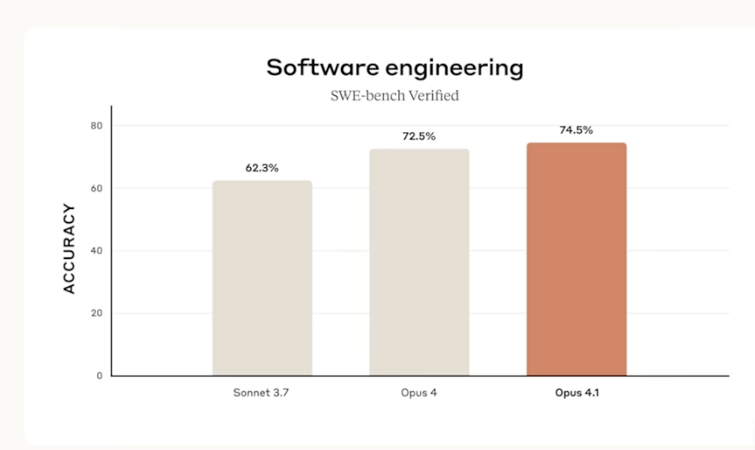
While OpenAI dominated headlines, other major players weren’t sitting idle. Anthropic released Claude Opus 4.1, which briefly held the title of best AI coding model on the planet – for about 24 hours until GPT-5 arrived.
My testing revealed some interesting nuances. When I asked both models to create a fitness app, Claude 4.1 produced a more feature-rich application with audio feedback, progress tracking, and an achievement system. GPT-5’s version was simpler but still functional.
The competition between these models creates a fascinating dynamic where users can leverage different systems for different tasks. If one model struggles with a particular coding challenge, another might excel at it.
Google DeepMind also made waves with Genie 3, a frontier world model that generates interactive environments users can navigate in real-time. The demonstrations showed:
- Real-time navigation of environments like volcanic surfaces and underwater scenes
- Physics interactions where objects respond naturally to collisions
- The ability to take control of scenes that were initially AI-generated videos
This technology represents a massive step toward truly immersive AI-generated experiences that respond dynamically to user input.
The Creative Revolution Accelerates
Beyond the technical achievements, this week saw an explosion in creative AI tools. Nvidia launched version 4.0 with AI Twin, allowing users to create digital clones from video uploads. Google rolled out a feature for creating personalized illustrated storybooks with the Gemini app.
The music generation space heated up with 11 Labs releasing their music creation tool, competing with established players like Suno and Udio. While the vocals still betray their AI origins, the quality is impressive for a first release.
New image models like Quinn Image and Leonardo’s Lucid Origin are pushing boundaries in visual generation, with text rendering that would have been impossible 18 months ago.
What’s most striking is how quickly these capabilities are becoming normalized. Features that would have made headlines for weeks are now just another bullet point in a packed release schedule.
What This Means For Our Future
The pace of innovation shows no signs of slowing. Elon Musk has already promised Grok 5 before year’s end, claiming it will be “crushingly good” – though his timeline predictions should always be taken with a grain of salt.
More importantly, we’re seeing a shift from benchmark competitions to practical applications that solve real problems. The companies leading this revolution have recognized that the true value of AI lies not in academic metrics but in empowering people to create, solve problems, and express themselves in new ways.
As these tools become more accessible and powerful, we’re entering an era where the limiting factor isn’t the technology itself but our imagination in how to apply it. The question is no longer “can AI do this?” but “what should we ask AI to do next?”
For those of us watching this unfold, it’s both exhilarating and humbling. The technology that amazes us today will seem primitive in just a few months. We’re witnessing the birth of capabilities that will fundamentally transform how we work, create, and interact with technology.
The AI revolution isn’t coming – it’s already here, and it’s accelerating faster than anyone predicted.
Frequently Asked Questions
Q: What makes GPT-5 different from previous AI models?
GPT-5 stands out by achieving EHD-level intelligence across domains and scoring perfectly on math benchmarks when using tools. It features a streamlined interface that automatically determines how to approach each prompt, eliminating the need to select between different models. Most notably, it demonstrates exceptional coding abilities, creating complex applications from single prompts that would have required significant developer time previously.
Q: What is GPTOSS and why is it significant?
GPTOSS represents OpenAI’s open weight models that can run locally without sending data back to the company. The significance lies in OpenAI making previous generation state-of-the-art technology freely available for offline use, modification, and fine-tuning. This democratizes access to powerful AI capabilities and enables innovation without privacy concerns since data remains local.
Q: How do Claude Opus 4.1 and GPT-5 compare for coding tasks?
While GPT-5 slightly outperforms Claude Opus 4.1 on benchmark tests (74.9% vs 74.5% on Swebench verified), practical testing shows nuanced differences. Claude 4.1 sometimes produces more feature-rich applications with better UI elements and functionality, while GPT-5 may create more streamlined solutions. GPT-5 is significantly more cost-effective, with API costs approximately 12% of Claude’s for input tokens and 13% for output tokens.
Q: What is Google’s Genie 3 and how does it differ from other AI models?
Genie 3 is Google DeepMind’s frontier world model that generates interactive environments users can navigate in real-time. Unlike traditional generative AI that produces static content, Genie 3 creates dynamic scenes that respond to user input, featuring physics interactions and environmental effects. It can also allow users to take control of initially AI-generated videos, representing a major step toward immersive AI-generated experiences.
Q: What does this rapid pace of AI development mean for the average person?
For average users, this acceleration means increasingly powerful and accessible tools for creation, problem-solving, and self-expression. Tasks that once required specialized skills like coding, graphic design, or music production are becoming available to anyone with an internet connection. However, it also means a constant need to adapt to new capabilities and potentially rethink career paths as AI takes over certain tasks while creating opportunities in others.