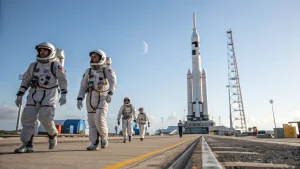
The launch of a United Launch Alliance Atlas V rocket carrying the Kuiper 1 mission for the Amazon’s Project Kuiper was scrubbed today due to inclement weather. A new launch date will be announced when approved on the range.https://t.co/Q1UeJK8FKl
— ULA (@ulalaunch) April 10, 2025
Amazon postponed the first launch of its Kuiper internet satellites on Wednesday night due to poor weather conditions near the launch site in Cape Canaveral, Florida. The company had planned to send up 27 satellites on a United Launch Alliance (ULA) Atlas V rocket between 7 and 9 p.m. Eastern time. However, rain, wind, and cloudy skies made a liftoff unsafe.
The sun is setting on the east coast of Florida as Atlas V stands fueled and waiting to launch for #Amazon. The cumulus clouds are violating the eastern portion of the 10-mile ring around the launch site. Winds also remain elevated above the safe liftoff limit. pic.twitter.com/qdEXvLYIJv
— ULA (@ulalaunch) April 9, 2025
ULA’s flight director decided to scrub the launch around 8:41 p.m. after pushing back the launch time several times during the two-hour window. The company is reviewing the next opportunity for a launch. Project Kuiper is Amazon’s entry into the satellite internet market, aiming to provide high-speed data connections to almost every point on Earth.
The company plans to operate more than 3,200 satellites in the coming years to achieve this goal.
Weather prevented a rocket carrying the first batch of Amazon satellites designed to compete with Elon Musk's Starlink from lifting off Wednesday, in a setback for the planned Project Kuiper network. https://t.co/XSUffXltW1
— Citizen TV Kenya (@citizentvkenya) April 10, 2025
Amazon is racing to compete with SpaceX’s Starlink, which already has approximately 8,000 satellites in orbit and serves several million customers worldwide.
Kuiper launch delayed by weather
The Federal Communications Commission has set a deadline requiring Amazon to have half of its total constellation, or 1,618 satellites, in orbit by July 2026. Once its first launch is complete, Amazon expects to ramp up its production, processing, and deployment rates. The company has begun preparing satellites for its next mission, which will also be carried by one of ULA’s Atlas V rockets.
The rivalry between Amazon and SpaceX is intensifying, especially with SpaceX CEO Elon Musk playing a central role in the White House as one of the top advisors, overseeing the Department of Government Efficiency (DOGE). Under Musk’s influence, Starlink’s footprint has increased within the federal government. Amazon’s ambitious foray into the space race comes with a hefty $20 billion price tag, but the company believes the potential payoff is worth the investment.
By establishing a robust satellite internet network, Amazon aims to challenge current leaders and take a competitive stance against growing Chinese interests in space-based internet services. The Kuiper project’s stated goal is to provide seamless internet connectivity to underserved areas around the globe, highlighting the growing demand for reliable internet in remote and rural regions. As space becomes the next frontier for technological innovation and economic opportunity, Amazon’s bold move underscores its determination to compete with industry giants and emerging powers.

Cameron is a highly regarded contributor in the rapidly evolving fields of artificial intelligence (AI) and machine learning. His articles delve into the theoretical underpinnings of AI, the practical applications of machine learning across industries, ethical considerations of autonomous systems, and the societal impacts of these disruptive technologies.