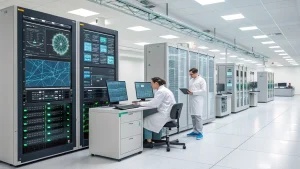
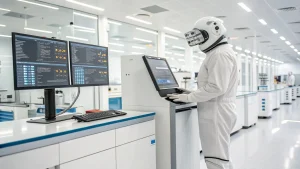
The race to reclaim semiconductor manufacturing dominance is playing out in the Arizona desert, and it’s proving far more challenging than anyone anticipated. As I’ve watched TSMC’s $165 billion Arizona project unfold, one truth has become crystal clear: you can’t simply transplant a semiconductor fab from Taiwan to American soil.
What should have been a straightforward copy-paste operation has instead revealed the extraordinary complexity of modern chipmaking. The US, which invented the semiconductor industry and still leads in design, equipment, and software, has seen its manufacturing share plummet from 40% in 1990 to a mere 10% today.
This decline wasn’t inevitable – it was the result of economic decisions that now threaten America’s technological sovereignty. The stakes couldn’t be higher: whoever controls advanced chip production controls the future of computing, AI, and ultimately, global economic power.
The Hidden Complexity of Chip Manufacturing
In Taiwan, TSMC can build a fab in just two years. In Arizona, every step has taken at least twice as long. Why? Because chipmaking at the nanometer scale isn’t construction – it’s choreography.
At the 4nm process node, there are hundreds of variables spread across 4,000 manufacturing steps. Any single variable can kill a chip. When TSMC moved to Arizona, everything shifted: the water chemistry, air quality, power stability, supplier networks, and even the cultural approach to precision manufacturing.
These shifts disrupted the delicate balance required for nanoscale precision. The result? Instead of the 90% yield TSMC achieves in Taiwan (where they’re practically minting money), Arizona initially struggled with much lower yields that threatened the entire project’s viability.
Four Factories in One
What I find most fascinating about this challenge is that building a semiconductor fab means building four invisible factories inside:
- The Water Plant: In water-stressed Arizona, TSMC needs to produce ultra-pure water (1,000 times cleaner than drinking water) at a massive scale – about 4 million gallons daily.
- The Air System: The cleanroom must maintain fewer than 10 particles per cubic meter while the desert outside contains thousands.
- The Chemical Supply Chain: Ultra-pure chemicals like sulfuric acid and specialty gases must be sourced or produced locally.
- The Talent Factory: Engineers must develop the “muscle memory” of extreme precision manufacturing.
The water challenge alone is staggering. Each silicon wafer requires around 2,000 gallons of ultra-pure water across its manufacturing lifetime. In Taiwan, TSMC mastered water purification and recycling, but Arizona’s water has different chemical properties, requiring a completely redesigned system.
The Supply Chain Challenge
From the outside, Fab 21 looks American, but under the hood, it remains tied to a global supply chain. Most specialty gases, silicon wafers, and even sulfuric acid are still imported from Taiwan, Japan, and Europe.
This fragile truth reveals why rebuilding semiconductor manufacturing isn’t just about factories – it’s about recreating an entire ecosystem. TSMC is working to rebuild this supply chain locally, but progress is slow and expensive.
Even more concerning is that chips produced in Arizona still fly back to Taiwan for advanced packaging. The US lacks the chip-on-wafer-on-substrate packaging capability critical for products like NVIDIA GPUs, which place high-bandwidth memory next to processor cores.
The People Problem
The most overlooked challenge in rebuilding American semiconductor manufacturing isn’t technical – it’s human. Taiwan’s real advantage is generations of engineers trained in the rituals of chipmaking.
Breakthroughs don’t come from machines but from people who know how to fine-tune every process, suppliers who deliver pure chemicals on time, and service teams who can repair a $150 million EUV machine at 3 AM without stopping production.
This skill set took decades to build in Taiwan. Arizona had none of it. Local colleges are now creating semiconductor programs, and TSMC is sending engineers to Taiwan to absorb the culture of extreme precision.
A Foothold, Not Yet a Powerhouse
Despite these challenges, TSMC has pushed through. By January 2024, Fab 21 finally reached mass production of 4nm chips with yields comparable to Taiwan. This is a true milestone – for the first time in decades, America can produce bleeding-edge logic chips domestically.
But this is just a beginning. The 1,100-acre site is designed for up to six fabs, with three already underway alongside two advanced packaging facilities and an R&D center. By 2028, this complex could be producing 100,000 wafers monthly.
The hard truth remains: Fab 21 will always trail Taiwan by one or two process nodes. Every new node starts in Taiwan and is transferred overseas only once it has matured. This model lets TSMC expand globally without losing efficiency, but it means Arizona won’t be inventing new nodes – just ramping up production of proven ones.
For America to truly compete, we need more fabs, more scale, and more engineering talent. We need to streamline approvals so fabs don’t take a decade to build. And most importantly, we need to rebuild the semiconductor talent pipeline and cultural prestige that once made Silicon Valley the center of chip innovation.
The Arizona project proves you can’t just copy a semiconductor fab – you need to build an entire ecosystem. TSMC has given America a foothold. Now we must turn it into a powerhouse.
Frequently Asked Questions
Q: Why did the US lose its semiconductor manufacturing dominance?
The US share of global chip manufacturing fell from 40% in 1990 to about 10% today, primarily due to economic decisions that favored outsourcing manufacturing while maintaining leadership in design, equipment, and software. The enormous capital costs of building and keeping fabs cutting-edge pushed many companies toward the fabless model, where they design chips but outsource production to foundries like TSMC.
Q: What makes building a semiconductor fab in Arizona so much harder than in Taiwan?
Arizona presents multiple challenges: water scarcity (while chipmaking requires millions of gallons daily), different air quality and environmental conditions, a lack of a local supply chain for ultra-pure chemicals and materials, and, most critically, a shortage of experienced semiconductor manufacturing talent. Taiwan has spent decades building an ecosystem where all these elements work together seamlessly.
Q: Will chips made in Arizona be as advanced as those made in Taiwan?
Arizona’s Fab 21 will typically lag behind Taiwan by one or two process nodes. New manufacturing processes are developed and perfected in Taiwan before being transferred to overseas locations. While Arizona is now producing 4nm chips, Taiwan is already working on more advanced 3nm and 2nm processes. This model allows TSMC to expand globally while maintaining its technological edge.
Q: How important is water in semiconductor manufacturing?
Water is absolutely critical. Each silicon wafer requires approximately 2,000 gallons of ultra-pure water (1,000 times cleaner than drinking water) throughout its manufacturing process. Water touches nearly every step – rinsing away acids, stripping chemicals, and even sitting between lenses and wafers during lithography. TSMC’s Arizona facility needs about 4 million gallons daily, equivalent to six Olympic swimming pools, making water management one of the biggest challenges in desert manufacturing.
Q: What would it take for the US to truly regain semiconductor manufacturing leadership?
Authentic leadership would require building a complete ecosystem: more advanced fabs, a robust local supply chain for materials and chemicals, advanced packaging facilities, streamlined regulatory approvals, and, most importantly, a revitalized talent pipeline. The US would need to invest in semiconductor education and training while supporting the startup ecosystem that originally created Silicon Valley. The CHIPS Act is just the beginning of what would need to be a decades-long commitment to rebuilding this strategic industry.