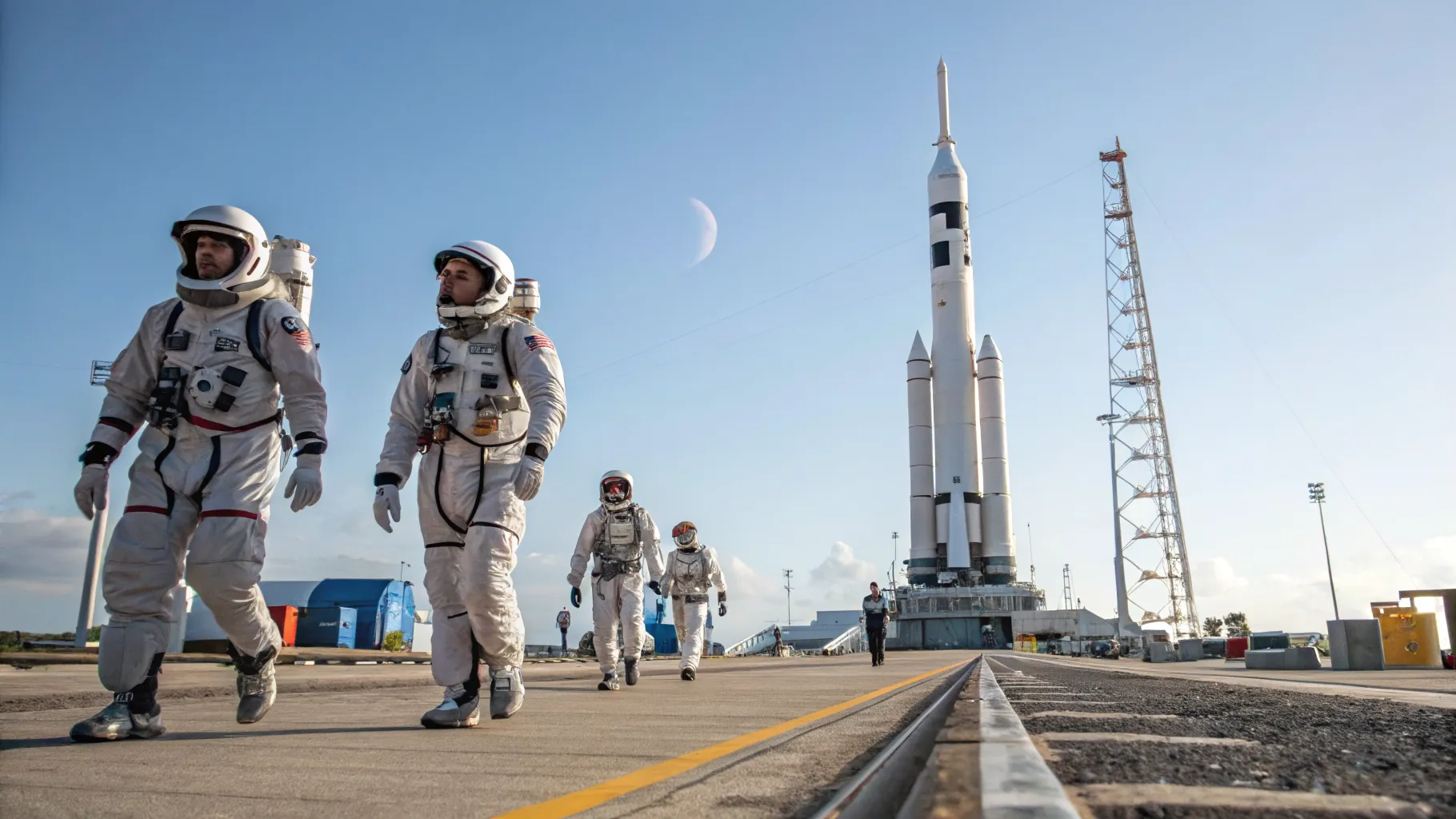
The crew set to become the first lunar visitors in more than half a century has reached its launch site, marking a decisive step toward humanity’s return to the Moon. Their arrival starts the final stretch of checks and rehearsals before liftoff, a moment watched closely by space agencies, industry partners, and the public.
The mission’s goal is to send a crew to the Moon’s vicinity for the first time since the early 1970s. The team will undergo suit fittings, vehicle familiarization, and countdown simulations in the days ahead. Security protocols and medical evaluations will tighten as the launch window nears.
Why This Moment Matters
It has been more than 50 years since astronauts last traveled to the Moon. The Apollo 17 mission in 1972 was the final crewed voyage of that era. Since then, space agencies shifted focus to low Earth orbit, building long-term expertise aboard the International Space Station.
Returning crews to the Moon serves two purposes. It advances science by giving researchers access to lunar geology and resources. It also prepares for longer journeys by testing deep-space navigation, life support, and communications on a scale not possible near Earth.
Program leaders have said the near-term plan is to fly a crew around the Moon and back, paving the way for future surface operations. Those later steps would involve new vehicles, lunar infrastructure, and sustained logistics. Each early mission establishes procedures and confidence for what comes next.
What Arrival at the Launch Site Signals
“The astronauts set to become the first lunar visitors in more than half a century have arrived at their launch site.”
With the crew now on site, teams can sync timelines for suit-up practice, vehicle ingress drills, and emergency egress runs. Flight directors review updated weather models, while engineers lock in final software loads. The launch provider and mission managers meet daily to certify readiness.
- Human factors checks: Seat fit, suit pressure tests, and comms checks with mission control.
- Vehicle rehearsals: Pad access routes, hatch operations, and integrated countdown runs.
- Risk reviews: Debris, weather, and propulsion margins validated against flight rules.
Lessons From the Past, Aims for the Future
The Apollo era delivered rapid progress but carried high risk. Modern missions build on that record with new materials, automation, and safety culture shaped by decades of station experience. Redundant systems and improved abort options offer added layers of protection.
Today’s lunar push also values international and commercial partnerships. Shared costs and specialized roles allow faster iteration and broader access to data. Analysts say this model can support a regular cadence of flights if early missions perform as planned.
Scientists are watching for how the mission validates navigation around the Moon, thermal control in deep space, and high-speed reentry. Positive results would support more ambitious timelines for cargo landers, surface habitats, and crewed stays near the lunar south pole, where water ice has been detected.
What Success Would Change
A safe flight would reset public expectations for human spaceflight. It would show that crews can again operate far from Earth orbit, with real-time problem solving under different conditions. It could also accelerate investment in lunar communications, power systems, and landing technologies.
Education and workforce effects may follow. Programs tied to astronaut missions often boost interest in science and engineering. Suppliers in materials, avionics, and propulsion could see steady demand if missions become more frequent.
Key Factors to Watch Next
Countdown rehearsals will test how the crew and ground teams coordinate under launch-day pressure. Weather and upper-level winds can still affect timelines. Engineers will track any last-minute technical advisories on propulsion, guidance, or ground support equipment.
Post-launch, attention will shift to translunar injection, spacecraft health checks, and communications handoffs. The mission plan includes precise trajectory corrections to reach the Moon’s vicinity and return on schedule. A flawless reentry and recovery would close the loop and set the stage for the next flight.
As the crew settles in at the launch site, the final message is one of focus. The mission stands at the threshold of a new chapter for human exploration. The next updates will come from the pad, then from deep space, as the team works step by step to bring the Moon within reach again.

A seasoned technology executive with a proven record of developing and executing innovative strategies to scale high-growth SaaS platforms and enterprise solutions. As a hands-on CTO and systems architect, he combines technical excellence with visionary leadership to drive organizational success.