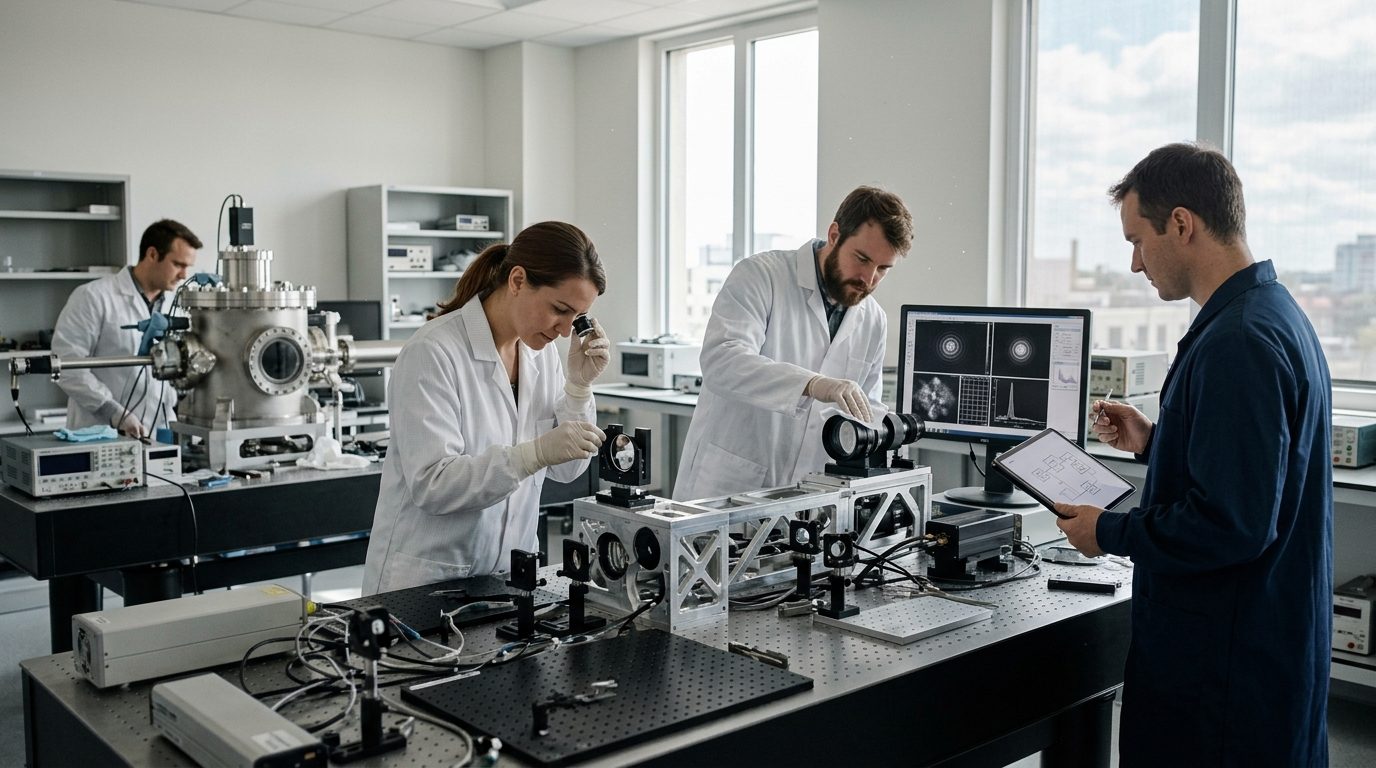
Astronomers are preparing to test equipment designed to support a future search for Earthlike planets, a key step in assessing whether the technology can meet that demanding goal.
The trial will focus on the equipment’s performance rather than announce a new planetary discovery. Details about the test date, location, participating institutions, and instrument design have not been disclosed.
If successful, the equipment could become crucial for discovering Earthlike planets. Such worlds are difficult to identify because they are small, distant, and often hidden by the glare of their host stars.
A Technology Test With Long-Term Goals
The immediate purpose is to learn whether the equipment works as intended. Astronomers must establish that its measurements are accurate, stable, and repeatable before relying on it during a planet search.
Testing often includes calibration, repeated observations, and comparisons with known targets. Researchers also examine how an instrument responds to vibration, temperature changes, unwanted light, and other sources of error.
The planned work reflects a practical order of operations. Scientists first validate the hardware and its data. They can then decide whether it is ready for research or requires further development.
“If it’s successful,” the equipment could “one day be crucial for discovering Earthlike planets.”
That wording sets clear limits on the announcement. The equipment remains under evaluation, and any role in finding another Earth would come later.
Why Earthlike Worlds Are Hard to Find
Astronomers have several methods for detecting planets outside the solar system. Some watch for small dips in starlight when a planet crosses its star. Others measure tiny stellar movements caused by an orbiting planet’s gravity.
Earthlike planets present a harder challenge than large planets. Their smaller size can produce weaker signals. A planet near a bright star can also be difficult to separate from the star’s light.
Equipment intended for this task may need to achieve several goals:
- Detect very faint planetary signals.
- Limit interference from nearby starlight.
- Maintain stable measurements over long periods.
- Help researchers distinguish planets from false signals.
A successful equipment test would not prove that an Earthlike planet has been found. It would show that astronomers may have another useful instrument for pursuing that search.
Success Will Require Careful Verification
Researchers will need to define clear standards for the trial. A positive result should rest on measurable performance, not only on whether the equipment operates.
Independent checks will also matter. Signals linked to small planets can be confused with stellar activity, background objects, or instrument errors. Follow-up observations are often needed before researchers can confirm a candidate.
The distinction between Earth-sized and Earthlike will remain important. Size alone does not establish surface conditions, an atmosphere, liquid water, or habitability. More detailed observations would be required to assess those traits.
The coming test is therefore an early technical step in a much longer scientific effort. Its value will depend on transparent performance results, repeatable measurements, and successful follow-up work.
If the equipment passes those tests, it could strengthen future searches for small planets resembling Earth. The next signs to watch will be the trial’s location, the standards used to judge success, and whether the technology advances into routine observations.

Senior Software Engineer with a passion for building practical, user-centric applications. He specializes in full-stack development with a strong focus on crafting elegant, performant interfaces and scalable backend solutions. With experience leading teams and delivering robust, end-to-end products, he thrives on solving complex problems through clean and efficient code.